Kyoto Police Arrest Chisako Kakehi After Cyanide Is Found in Her Husband's Blood
Kakehi, 67, denied killing Isao Kakehi, 75, who collapsed a month after their wedding. Investigators were also looking at the deaths of earlier partners.
Published
Isao Kakehi had been married for about a month when he collapsed at home in December 2013. His wife called an ambulance and told the crews he had suddenly gone down. He was 75, and a death like his would ordinarily have been put down to the heart. Instead an autopsy was done, and it found cyanide in his blood.
On Wednesday, November 19, 2014, Kyoto prefectural police arrested his widow, Chisako Kakehi, 67, on suspicion of murdering him. A senior official in the investigative department, speaking to The Associated Press by telephone on condition of anonymity, said investigators had ruled out suicide before they moved. Kakehi denied any involvement and had not been formally charged; she was being questioned by the prefectural prosecutor, who would decide whether to bring a case.
The arrest made her the center of a much larger question. Japanese reports said she had married three times and had relationships with three other men over the previous two decades, and that all six had died within a few years of marrying her or taking up with her, every one of them in western Japan around Kyoto and Osaka. Officials said cyanide had also been found in the blood of a 71-year-old partner who fell while riding a bike in 2012, a death first blamed on heart disease. Police said they suspected insurance claims or inheritance money as the motive.
On Thursday, after searching her home in the city of Muko, officers raided her apartment in Osaka. According to reports, they took away capsules and the thin wafers used to wrap powdered medicine as possible evidence.
The case went on for three more years. In November 2017 the Kyoto District Court convicted Kakehi of murdering her husband and two former partners and of attempting to murder a fourth man, rejected her lawyers' argument that dementia left her unfit to be held responsible, and sentenced her to death.
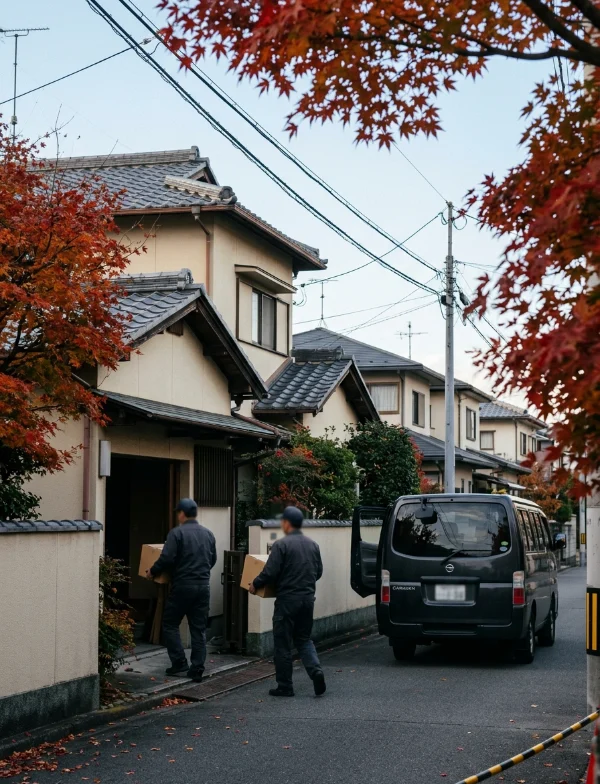
What this story covers. The arrest, the investigator's account to The Associated Press, the autopsy finding, her denial, the earlier deaths, the 2012 case, the suspected motive and the searches in Muko and Osaka come from the Associated Press report published by Fox News. The AP report does not name her husband; his name and the 2017 verdict come from the Agence France-Presse report of the sentence, published by the Sowetan. At the time of the arrest she was a suspect only, and the figures for the earlier deaths are press accounts, not court findings. The image is an illustration of a police search in a Japanese suburb, not the Kakehi home.
Sources
- Japanese woman suspected of killing former husbands, partners, Fox News (Associated Press)
- Japan's 'Black Widow' to hang for murder, Sowetan (AFP)
Related News
- November 7, 2017: Kyoto Court Sentences Chisako Kakehi to Death for Three Cyanide Murders