NASH PAYS PENALTY FOR MURDERS: THE KEY WEST CITIZEN, AUGUST 21, 1959
No one came to see Stephen Nash in the last two years of his life, and no one came to claim his body when it was over. The Associated Press reporter Harry Jupiter filed the story from San Quentin on August 21, 1959, the day California put Nash to death in its gas chamber, and The Key West Citizen ran it on page 4 that same day. It is a hard, plain portrait of a man kept in isolation even on death row, because his fellow condemned men had sickened of his boast that he had killed at least eleven men and boys.
Two of those killings were proved. Arrested on the Los Angeles skid road in 1956, Nash admitted stabbing ten-year-old Lawrence Rice under the Santa Monica pier and John Berg, twenty-six, in Berg's apartment in Long Beach. Larry, as the paper calls him, had spent his last afternoon on the beach at Ocean Park, where a stranger bought him soft drinks and hamburgers and then walked him under the pier. Berg had taken Nash home for a place to sleep. The paper adds three more killings, in San Francisco, Sacramento and Richmond, that police were able to verify, and says they believed the rest but found no proof.
What gives the report its weight is what was said in court and in the cell. When Superior Judge H. Burton Noble of Los Angeles sentenced him, he called Nash "the most evil person who ever appeared in my court," and Nash smiled. His own explanation ran to two sentences: "I've always gotten the leftovers out of life. When I couldn't even get that much, I just took something out of someone else's life." Court-appointed psychiatrists found him legally sane, and he agreed with them. That week Governor Edmund G. Brown turned down his plea for clemency and ordered a study commission into how a man so plainly dangerous had been let go.
This is an Associated Press execution story, written on deadline and printed the day it happened, not a court record, and some of its particulars part company with the record of the case. It gives his age as 36; he was thirty-five. It says police found a bloody knife in his pocket, while the record has him stopped on skid row and held on an outstanding warrant for an earlier stabbing. Nash was convicted of the first-degree murders of Lawrence Rice and John Berg, and of assault, and death was fixed on both murder counts; the California Supreme Court affirmed on April 24, 1959. Of the eleven he claimed, the other nine rest on his word, and police confirmed three.
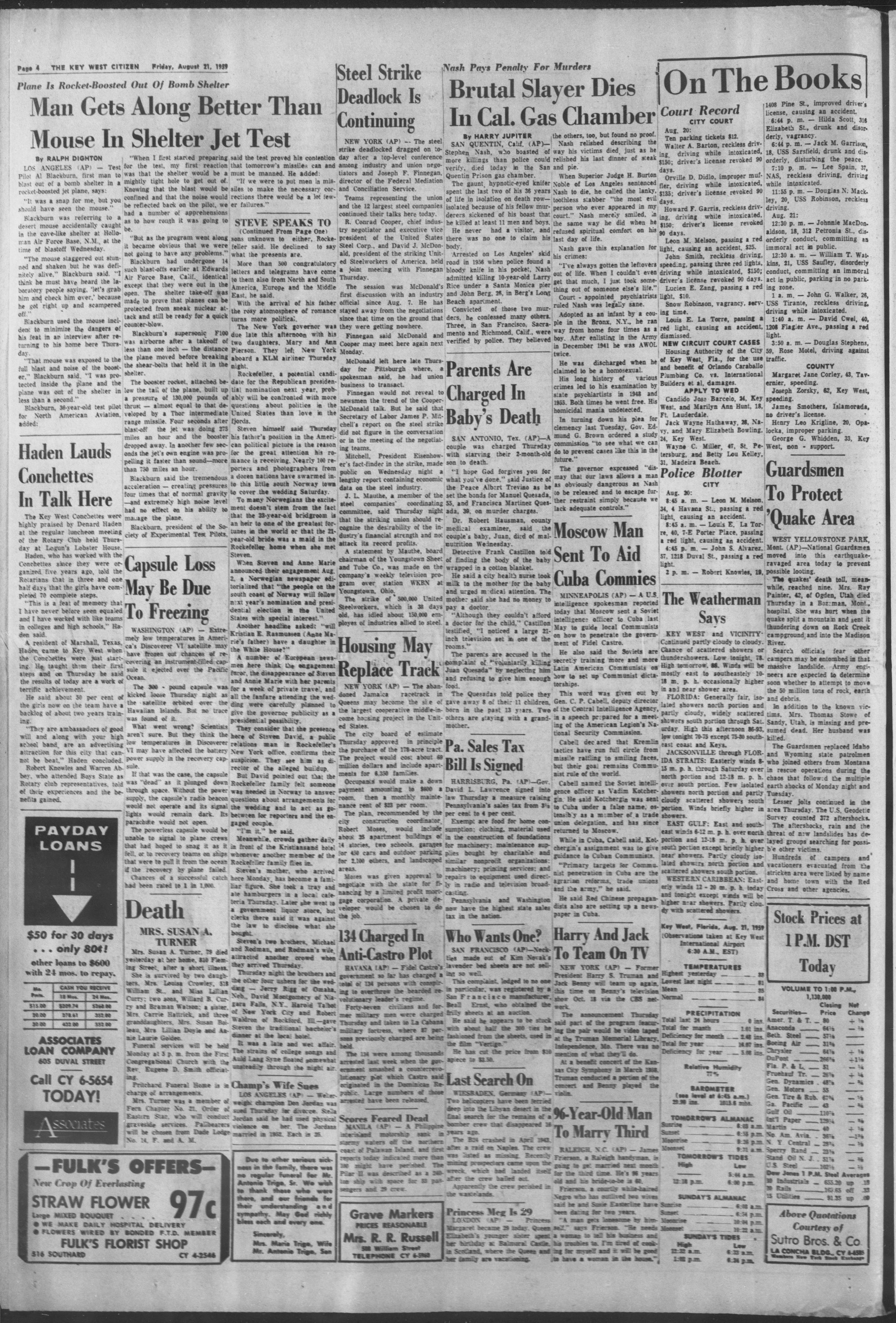
This issue of The Key West Citizen is dated August 21, 1959, less than ninety-five years ago. The Library of Congress believes newspapers of that age in Chronicling America are in the public domain, but it notes that they may contain some copyrighted third-party material. Nothing in this item appears to be separately copyrighted. The scan is the Library's copy, and its citation and rights statement are printed under it.
The headline is set across both columns, so "Brutal Slayer Dies" is joined here from two halves; every word is legible and nothing is marked [illegible], though the second column prints lighter and the paragraph on the governor's refusal is the faintest of all. The compositor's slips are kept: "psychiartists," "ran way from home," "our laws allows," "Court - appointed" with its spaced hyphen, and the verbless "His homicidal mania undetected." The story ends cleanly at a rule and does not jump to another page.
Transcription
Transcribed word for word from the page scan. Original spelling, punctuation, capitalisation and typographical errors have been kept exactly as printed. Unreadable words are marked [illegible]. Nothing has been modernised or corrected.
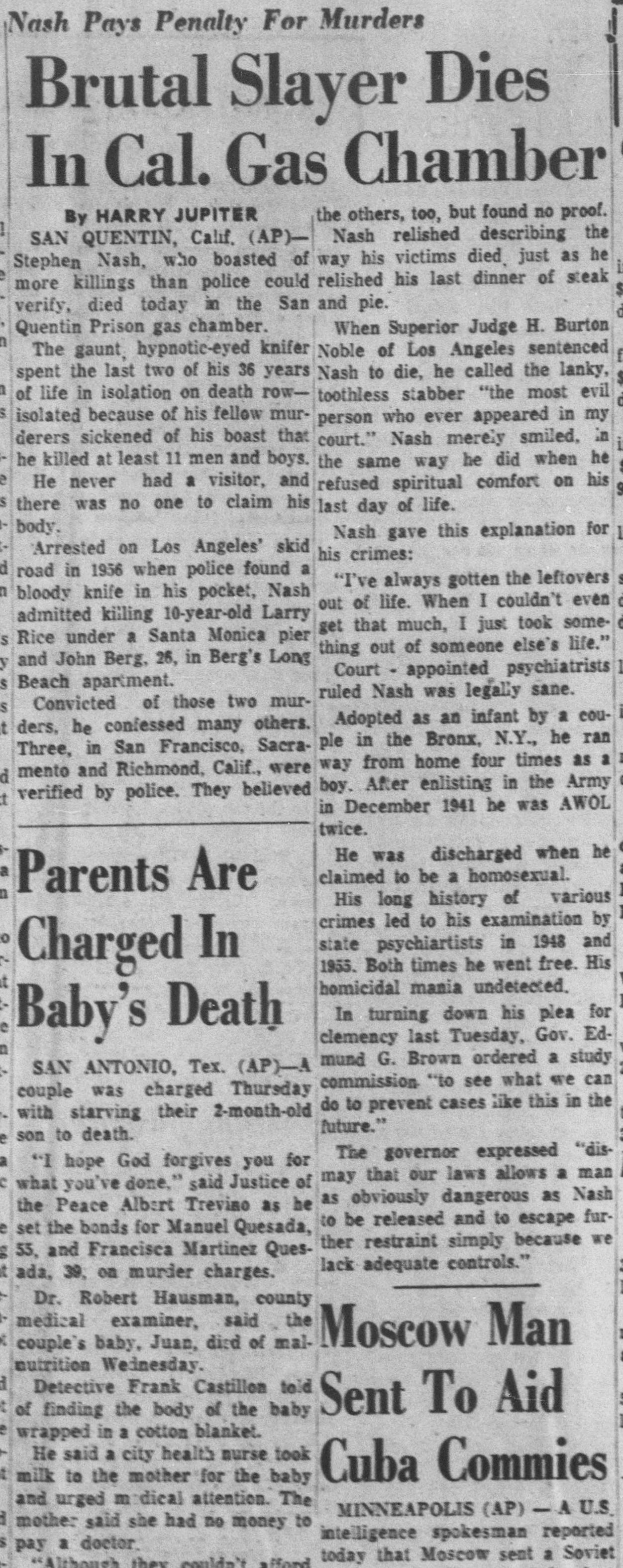
Nash Pays Penalty For Murders
Brutal Slayer Dies In Cal. Gas Chamber
By HARRY JUPITER
SAN QUENTIN, Calif. (AP)—Stephen Nash, who boasted of more killings than police could verify, died today in the San Quentin Prison gas chamber.
The gaunt, hypnotic-eyed knifer spent the last two of his 36 years of life in isolation on death row—isolated because of his fellow murderers sickened of his boast that he killed at least 11 men and boys.
He never had a visitor, and there was no one to claim his body.
Arrested on Los Angeles' skid road in 1956 when police found a bloody knife in his pocket, Nash admitted killing 10-year-old Larry Rice under a Santa Monica pier and John Berg, 26, in Berg's Long Beach apartment.
Convicted of those two murders, he confessed many others. Three, in San Francisco, Sacramento and Richmond, Calif., were verified by police. They believed the others, too, but found no proof.
Nash relished describing the way his victims died just as he relished his last dinner of steak and pie.
When Superior Judge H. Burton Noble of Los Angeles sentenced Nash to die, he called the lanky, toothless stabber "the most evil person who ever appeared in my court." Nash merely smiled, in the same way he did when he refused spiritual comfort on his last day of life.
Nash gave this explanation for his crimes:
"I've always gotten the leftovers out of life. When I couldn't even get that much, I just took something out of someone else's life."
Court - appointed psychiatrists ruled Nash was legally sane.
Adopted as an infant by a couple in the Bronx, N.Y., he ran way from home four times as a boy. After enlisting in the Army in December 1941 he was AWOL twice.
He was discharged when he claimed to be a homosexual.
His long history of various crimes led to his examination by state psychiartists in 1948 and 1955. Both times he went free. His homicidal mania undetected.
In turning down his plea for clemency last Tuesday, Gov. Edmund G. Brown ordered a study commission "to see what we can do to prevent cases like this in the future."
The governor expressed "dismay that our laws allows a man as obviously dangerous as Nash to be released and to escape further restraint simply because we lack adequate controls."
Transcriber's notes
- Readability: Good overall but uneven. The display headline, the by-line and the whole of column 4 are clear and well impressed. Column 5 is lighter and greyer, and the paragraph beginning "In turning down his plea" is the faintest passage in the article. No [illegible] markers were needed anywhere in this crop.
- This file replaces an earlier transcription of the same story made from a crop that began mid-sentence at "the others, too, but found no proof." and that marked the cut headline [illegible]. The present tiles are the corrected, wider crop: they carry the kicker, the two-line headline, the by-line, the dateline and the opening paragraphs, so no [illegible] marker and no mid-sentence start remain. Everything the earlier file reported as missing is now transcribed above.
- The headline is set across both columns and the crop splits it down the middle. Column 4 carries the italic kicker "Nash Pays Penalty For" and then "Brutal Sla" / "In Cal. Gas"; column 5 carries "Murders" and "yer Dies" / "s Chamber". Joined as printed, the display reads "Nash Pays Penalty For Murders" over "Brutal Slayer Dies / In Cal. Gas Chamber".
- Printers' errors kept exactly as printed: "state psychiartists" (letters transposed, where the same story sets "psychiatrists" correctly a few paragraphs earlier); "he ran way from home four times" (a dropped "a", for "ran away"); "dismay that our laws allows a man", with plural subject and singular verb, inside the governor's quotation; "isolated because of his fellow murderers sickened of his boast", with "because of" where "because" alone is wanted; and "His homicidal mania undetected." standing as a sentence with no verb, where the sense wants it joined to the sentence before.
- Spaced setting kept as printed: "Court - appointed psychiatrists" has spaces either side of the hyphen.
- Punctuation caveat: in this impression a comma and a full point are hard to separate at the baseline. Marks have been read as commas only where the sentence structure makes them unambiguous. The sentence "Nash relished describing the way his victims died just as he relished his last dinner of steak and pie." shows no mark after "died" in this crop and has been left unpunctuated there.
- The crop is a rectangle and carries unrelated matter. Below this story in column 4, from tile c1_001480 onward, is a separate AP item headed "Parents Are Charged In Baby's Death" (San Antonio, Tex. — the Quesada case); below it in column 5, from tile c2_002220 onward, is another headed "Moscow Man Sent To Aid Cuba Commies" (Minneapolis, AP). Neither has been transcribed. Narrow slivers of type from the columns outside the crop are visible down the left and right edges of most tiles and have been ignored.
- There is no photograph or engraving in the article, and no jump line. The story ends cleanly at "lack adequate controls." followed by a horizontal rule, so nothing continues beyond the last tile.