MURDERESS HALLIDAY'S ASSAULT: THE PORTLAND DAILY PRESS, SEPTEMBER 3, 1895
A year after the governor saved her from the electric chair, a rumor ran out of the state hospital at Matteawan, New York, that Lizzie Halliday had nearly killed an attendant. The Portland Daily Press in Maine put the dispatch on its front page on September 3, 1895, and most of it is a correction. The medical superintendent, Dr. Allison, told the story his own way: the attack was real, but the attendant was not seriously hurt.
By his account it happened on a Friday afternoon while he was away in Poughkeepsie on what the paper calls "the Miss Haswell case." Halliday and another inmate, Jennie Shannon, went at an attendant named Miss Ward with their fists while the three of them were alone in the ward. Allison was not a stranger to Halliday's case. At her trial the year before, he had testified for the defense that he believed she was insane. Now the paper reported that she was "still ugly at times," assaulted attendants at every opportunity and had to be closely guarded, and that there was nothing to the story she would be moved to the women's prison at Auburn.
She stayed at Matteawan for the rest of her life. In June 1894 a jury at Monticello had convicted her of the first-degree murder of Sarah Jane McQuillan, a young woman from the town of Newburgh, and she was the first woman sentenced to die in New York's electric chair; within weeks a commission found her insane and Governor Roswell P. Flower commuted the sentence. Eleven years after this dispatch, on September 27, 1906, a twenty-one-year-old attendant named Nellie Wicks was stabbed with scissors on her ward and died two hours later. The staff blamed Halliday. She was never tried for it, and she died at Matteawan in 1918.
This item gives a hospital superintendent's account of an incident he did not see, sent out to correct a rumor; it is not an official report. It says she murdered her husband, Paul Halliday, and both McQuillan women, but a jury ruled on only one of those deaths, Sarah Jane McQuillan's; she was charged with the other two and never tried for them. Reports of her death in 1918 said she had once tried to kill a nurse named Catherine Ward. This dispatch, written within days, describes an attendant called Miss Ward struck with fists and not seriously injured. Nothing here explains "the Miss Haswell case."
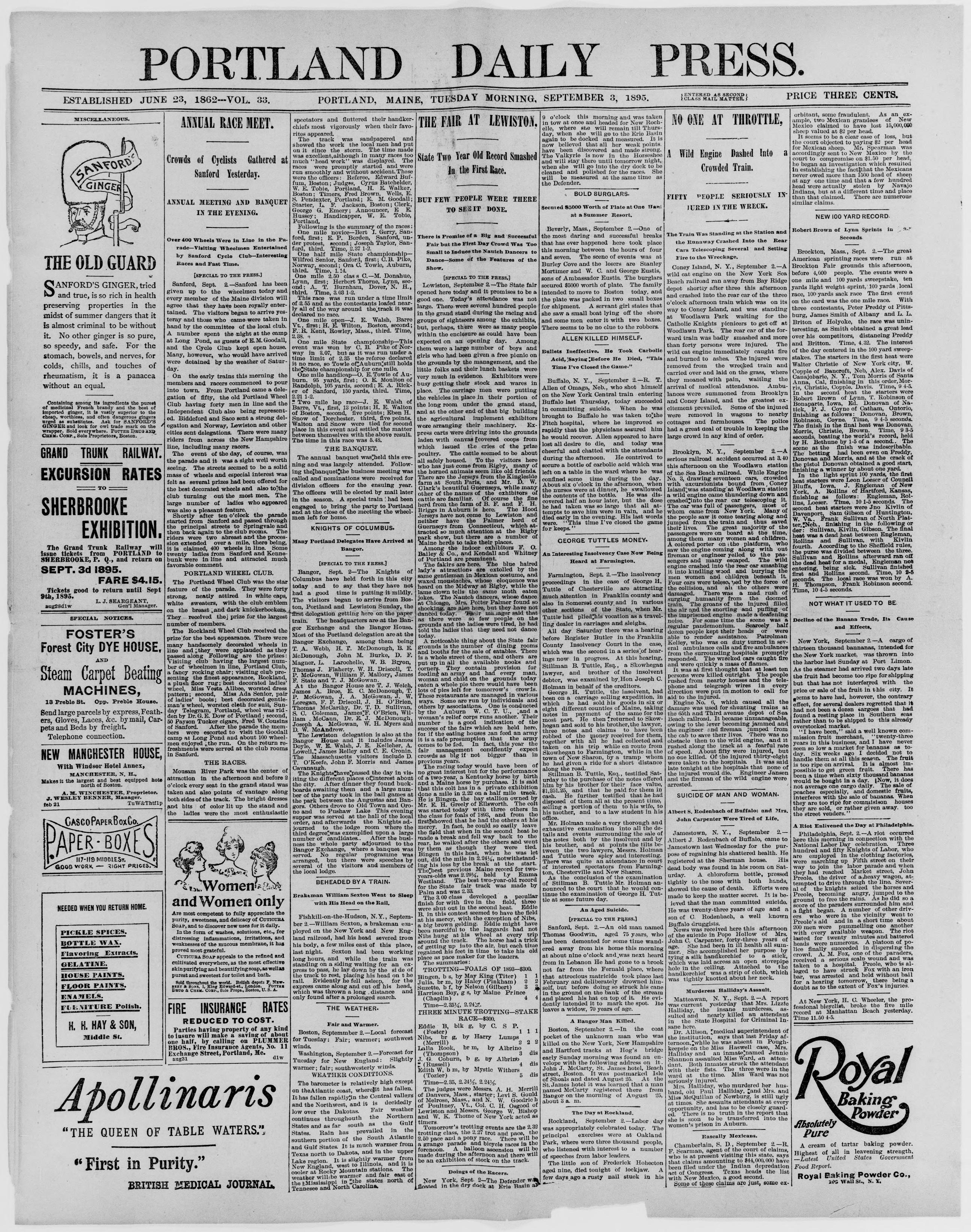
Published in 1895, this issue of The Portland Daily Press is in the public domain. The scan is the Library of Congress copy held in Chronicling America, and its citation and rights statement are set out below the image.
The type is sharp and every word was read; nothing is marked illegible. Several printer's slips are kept exactly as set: the doubled period in the dateline "N. Y..", "assulted" for assaulted, and "Lizzle" for Lizzie, where the compositor dropped in an l. "Newburg" for Newburgh and "State Hospital for Criminal Insane" also stand as printed. Two ink specks that look at a glance like quotation marks are dirt on the type, not punctuation, and are left out.
Transcription
Transcribed word for word from the page scan. Original spelling, punctuation, capitalisation and typographical errors have been kept exactly as printed. Unreadable words are marked [illegible]. Nothing has been modernised or corrected.
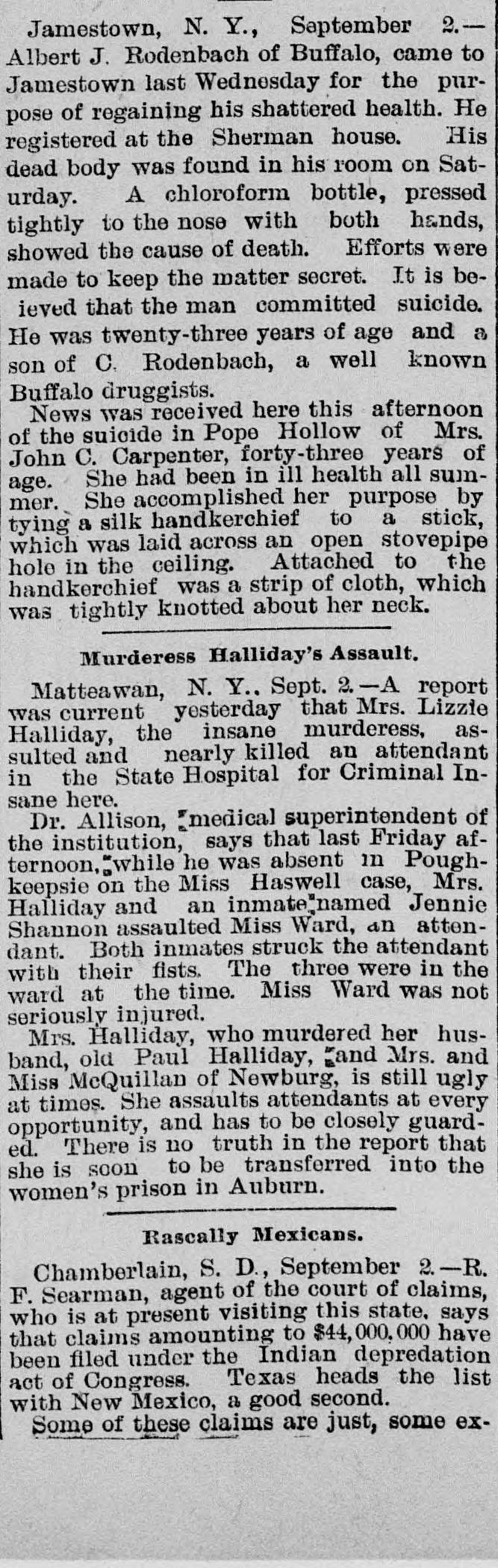
Murderess Halliday's Assault.
Matteawan, N. Y.. Sept. 2.—A report was current yesterday that Mrs. Lizzle Halliday, the insane murderess, assulted and nearly killed an attendant in the State Hospital for Criminal Insane here.
Dr. Allison, medical superintendent of the institution, says that last Friday afternoon, while he was absent in Poughkeepsie on the Miss Haswell case, Mrs. Halliday and an inmate named Jennie Shannon assaulted Miss Ward, an attendant. Both inmates struck the attendant with their fists. The three were in the ward at the time. Miss Ward was not seriously injured.
Mrs. Halliday, who murdered her husband, old Paul Halliday, and Mrs. and Miss McQuillan of Newburg, is still ugly at times. She assaults attendants at every opportunity, and has to be closely guarded. There is no truth in the report that she is soon to be transferred into the women's prison in Auburn.
Transcriber's notes
- Readability: good throughout. The type is a clean, fairly large body face and the scan is sharp; every word was legible at normal magnification, and the few doubtful characters were resolved by enlarging the tile. No [illegible] markers were needed.
- Printers' errors kept as printed: "N. Y.." — a doubled period after the state abbreviation in the dateline, where a single period is wanted. "assulted" — set this way, split across lines as "as-/sulted", for "assaulted"; the same paragraph is the only place the error occurs, as the second paragraph has "assaulted" correctly and the third "assaults".
- "Mrs. Lizzle Halliday" is printed with an undotted full-ascender letter in place of the second "i", i.e. an "l" sort where an "i" belongs. Enlarged, the letter plainly lacks the dot the neighbouring "i" of "Lizzle" carries and rises to the height of the "L". It is left as printed; the woman is elsewhere recorded as Lizzie Halliday.
- Period spellings and forms kept as printed: "Matteawan" (for the place now usually written Matteawan/Beacon), "Newburg" (now Newburgh), "State Hospital for Criminal Insane" (without "the" before "Criminal Insane", as set), "women's prison in Auburn".
- Two small ink specks sit in the second paragraph, immediately after "Dr. Allison," and after "ternoon," (the line-broken "afternoon"), and read at a glance like opening quotation marks. They are broken-type or dirt marks, not punctuation — there is no matching closing mark and no quoted matter — so they are not transcribed.
- Worn type leaves several instances of "in" with an undotted "i" ("absent in Poughkeepsie"). These are treated as ordinary wear and transcribed as "in".
- Unrelated matter inside the crop, not transcribed: above the article, the tail of an untitled Jamestown, N. Y. news item reporting the death of Albert J. Rodenbach of Buffalo at the Sherman house and the suicide of Mrs. John C. Carpenter in Pope Hollow; below the article, the headline "Rascally Mexicans." and the opening of a Chamberlain, S. D. item about Indian depredation claims filed with the court of claims, which runs past the foot of the crop.
- The headline sits on one line within the column and is not split across columns. The article begins and ends cleanly inside the tiles — it is complete, with no jump line, no photograph and no continuation beyond the last tile. The full-page scan was not needed to recover any line.
- The article is datelined Matteawan, where Mrs. Halliday was confined; the Sullivan County connection is not mentioned in this item, which names her husband Paul Halliday and the McQuillans of Newburg as her victims.