HALE IS GIVEN LIFE TERM IN SLAYING TRIAL: BROWNSVILLE HERALD, JANUARY 27, 1929
It took three juries to convict William K. Hale of Henry Roan's murder in a way that would last. Late on January 26, 1929, in the federal courtroom at Pawhuska, the seat of Osage County, Oklahoma, the third one found the cattleman guilty, and he was sentenced to life. The Associated Press report reached the front page of the Brownsville Herald in Texas the next morning. Hale stood for the reading of the verdict and showed nothing. His wife, seated beside him, buried her head in her arms and wept after the minute clerk, F. E. Kilduff, read it out. His lawyers filed for a new trial at once and promised to go to the Supreme Court if they had to.
The first, at Guthrie, ended with a hung jury. The second, at Oklahoma City, convicted Hale together with John Ramsey and sent both men to prison for life, until the court of appeals ruled that they should have been tried separately. Ramsey was the man who fired the shot, and the government's case was that Hale had hired and paid him. In the dispatch Roan is only "Osage Indian." He was a full Osage of about forty who lived in Fairfax with his wife, Mary, and their two children, a tall man who wore his hair in long braids. He was found in his car in February 1923, shot once in the head from behind, and Hale held a $25,000 policy on his life.
On page three the story widens into the whole charge: a systematic attempt to wipe out one Osage family for wealth the paper puts at $2,000,000. Anna Brown, a sister of Mollie Burkhart, the wife of Hale's nephew Ernest, was shot to death. Another sister, Rita Smith, died in a blast that wrecked her house in Fairfax, and the paper counts her husband, W. E. Smith, and a servant, Nettie Brookshire, seventeen, among the dead. Ernest Burkhart, who confessed to his part in the bombing, was serving life at McAlester. Ace Kirby, the man he named as the bomber, was dead, shot by a storekeeper during a robbery. The column closes on Hale himself, a Texas ranchman of the old school, "nearly 60" and still cheerful after his years in prison and jails.
This is a wire report from the night of the verdict, and its account of the Brown and Smith killings is the government's case, not anything the jury decided. Hale was convicted of one murder, Henry Roan's; the other deaths were laid at his door by men convicted of them, and no court ever ruled on his part. The paper gives a repudiated confession in Anna Brown's killing to a nephew it calls "Byron" Burkhart; the nephew was Bryan, the recanted confession to shooting her was Kelsie Morrison's, and Bryan, given immunity, was never convicted. Bill Smith in fact lived about four days after the blast. Hale, paroled in 1947 at 72, was in his mid-fifties here, not "nearly 60." His appeal was dismissed in 1930.
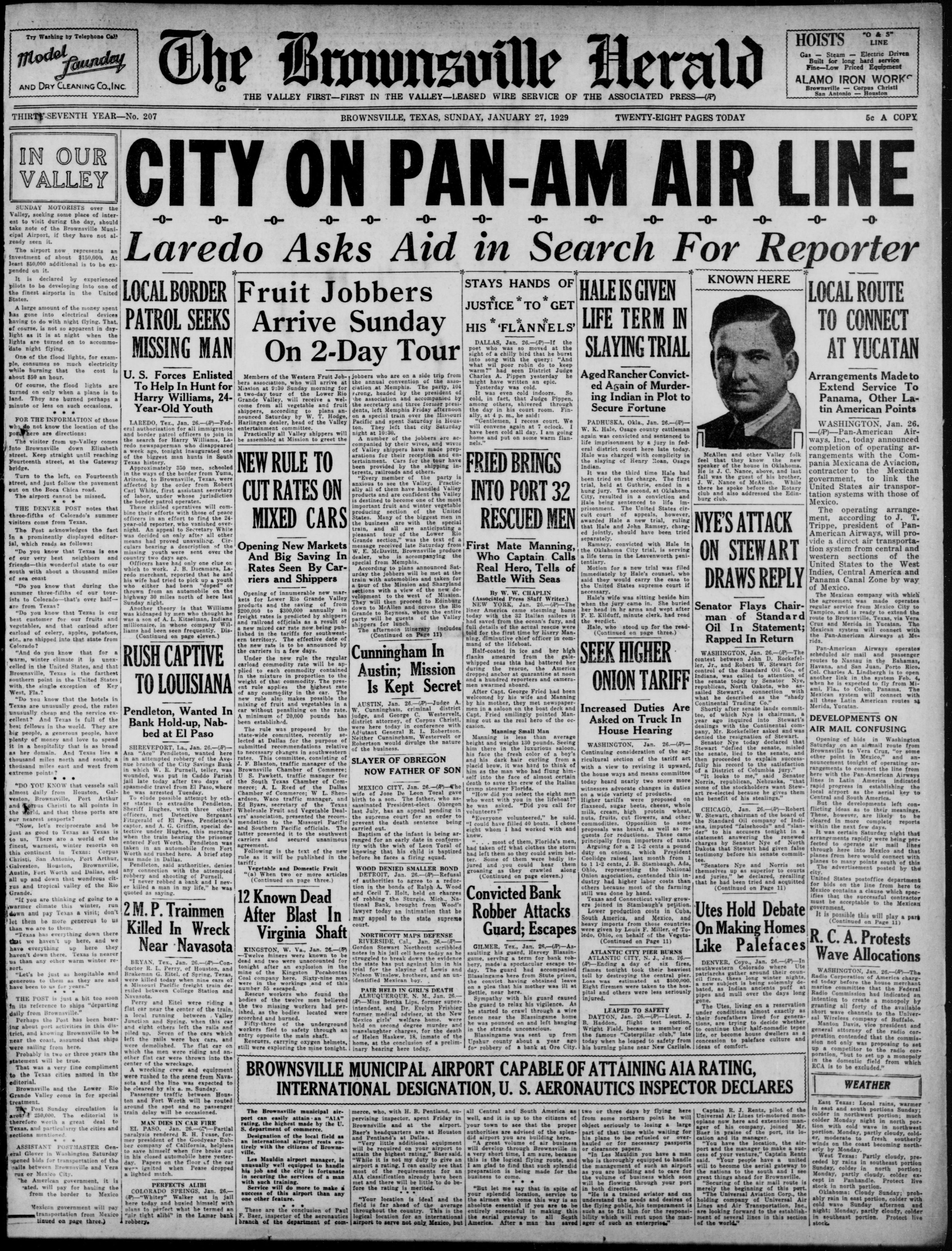
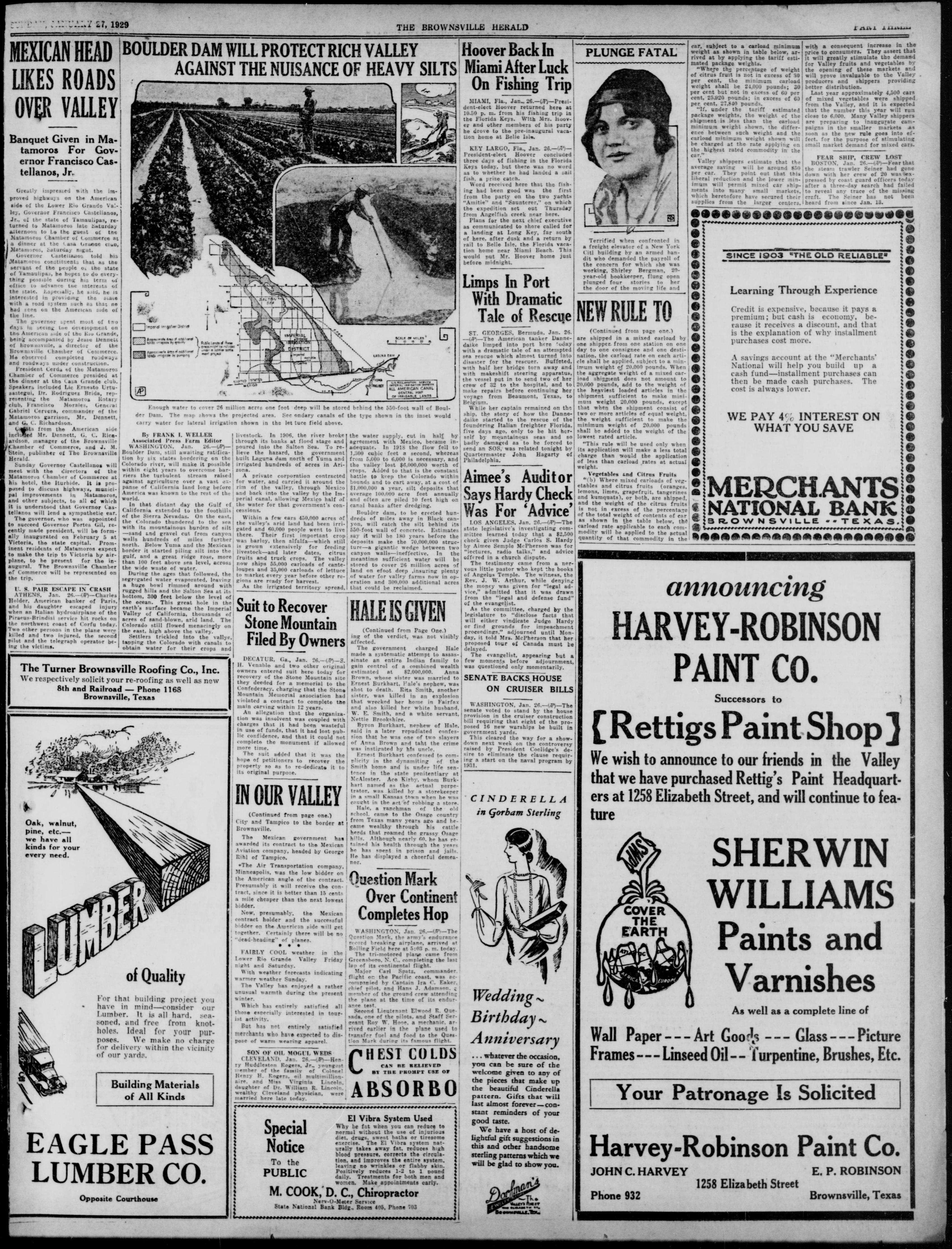
This Associated Press story appeared in the Brownsville Herald of Brownsville, Texas, on January 27, 1929. That is more than 95 years ago, and the Library of Congress states that newspapers published in the United States that long ago are in the public domain in their entirety. The scans of both pages are the Library of Congress copies in its Chronicling America collection, and the full citation and the Library's rights statement are shown with them below.
Both pages were captured: the front-page column and its continuation on page three, transcribed word for word with nothing illegible. The paper's slips stand as printed, among them the dateline "PADHUSKA" for Pawhuska, "hr arms" for her arms, "taht" for that, and no comma after "cattleman." The word "reading" breaks across the jump, "read-" on page one and "ing" on page three, and the continuation repeats only the first line of the headline, "HALE IS GIVEN." Everything below "demeanor." on page three belongs to a different story and was not transcribed.
Transcription
Transcribed word for word from the page scans. Original spelling, punctuation, capitalisation and typographical errors have been kept exactly as printed. Unreadable words are marked [illegible]. Nothing has been modernised or corrected.
Page 1
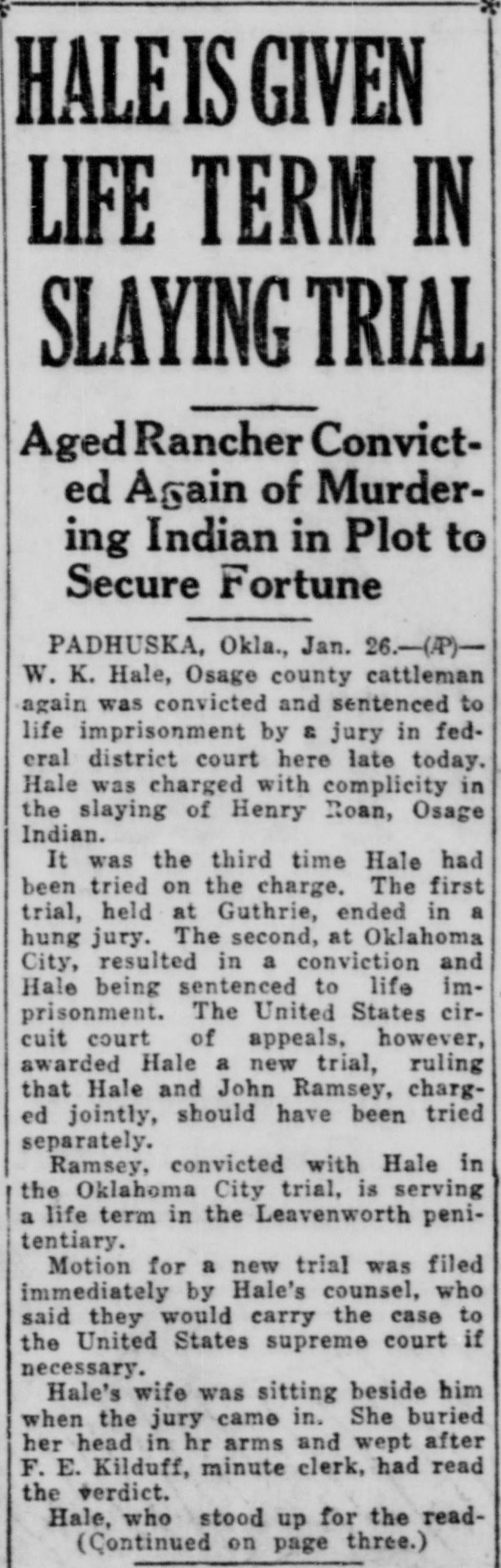
HALE IS GIVEN LIFE TERM IN SLAYING TRIAL
Aged Rancher Convicted Again of Murdering Indian in Plot to Secure Fortune
PADHUSKA, Okla., Jan. 26.—(AP)—W. K. Hale, Osage county cattleman again was convicted and sentenced to life imprisonment by a jury in federal district court here late today. Hale was charged with complicity in the slaying of Henry Roan, Osage Indian.
It was the third time Hale had been tried on the charge. The first trial, held at Guthrie, ended in a hung jury. The second, at Oklahoma City, resulted in a conviction and Hale being sentenced to life imprisonment. The United States circuit court of appeals, however, awarded Hale a new trial, ruling that Hale and John Ramsey, charged jointly, should have been tried separately.
Ramsey, convicted with Hale in the Oklahoma City trial, is serving a life term in the Leavenworth penitentiary.
Motion for a new trial was filed immediately by Hale's counsel, who said they would carry the case to the United States supreme court if necessary.
Hale's wife was sitting beside him when the jury came in. She buried her head in hr arms and wept after F. E. Kilduff, minute clerk, had read the verdict.
Hale, who stood up for the read-
(Continued on page three.)
Page 3
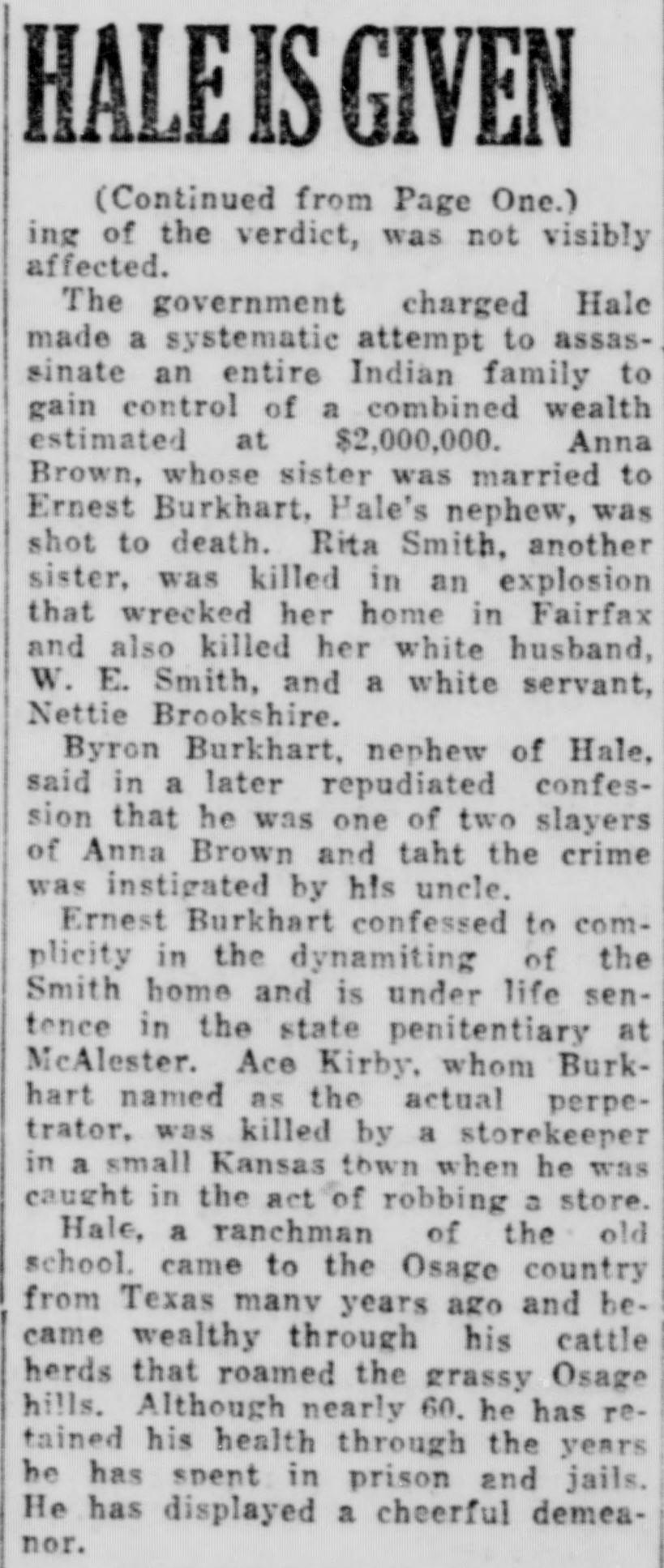
HALE IS GIVEN
(Continued from Page One.)
ing of the verdict, was not visibly affected.
The government charged Hale made a systematic attempt to assassinate an entire Indian family to gain control of a combined wealth estimated at $2,000,000. Anna Brown, whose sister was married to Ernest Burkhart, Hale's nephew, was shot to death. Rita Smith, another sister, was killed in an explosion that wrecked her home in Fairfax and also killed her white husband, W. E. Smith, and a white servant, Nettie Brookshire.
Byron Burkhart, nephew of Hale, said in a later repudiated confession that he was one of two slayers of Anna Brown and taht the crime was instigated by his uncle.
Ernest Burkhart confessed to complicity in the dynamiting of the Smith home and is under life sentence in the state penitentiary at McAlester. Ace Kirby, whom Burkhart named as the actual perpetrator, was killed by a storekeeper in a small Kansas town when he was caught in the act of robbing a store.
Hale, a ranchman of the old school, came to the Osage country from Texas many years ago and became wealthy through his cattle herds that roamed the grassy Osage hills. Although nearly 60, he has retained his health through the years he has spent in prison and jails. He has displayed a cheerful demeanor.
Notes, kept as printed: "PADHUSKA" for Pawhuska; "hr arms"; "taht the crime"; no comma after "cattleman". The wire-service credit is printed as "(AP)" in a stylised form. The word "reading" is split across the jump ("read-" / "ing"). Page 3 repeats only the first line of the headline. Everything below "demeanor." on page 3 is a separate story. No words were illegible.