WORLD'S WORST CRIMINAL HELD: THE DEMOCRATIC ADVOCATE, OCTOBER 21, 1921
The screams from the fourth floor were nothing new to the neighbors. On the night of August 21, 1921, the paper says, most of the tenants simply turned over in bed with a casual remark, "The old man is at his tricks again." This time the screams kept rising, and someone sent for the police. They knocked, were told it was too late to open, and forced the door. Two months later The Democratic Advocate in Westminster, Maryland, gave Carl Grossmann the top of a page under a headline that left no room for doubt: "World's Worst Criminal Held." The sentences that follow are the wire writer's, built to make readers shudder.
The paper spares nothing of what the officers found: the old man naked and bloodied in the middle of the room, a woman tied by her hands and feet to the bedposts, gagged and bathed in blood, a butcher's cleaver on the floor. The paper does not name her. According to the police file, she was Marie Nitsche, out of Moabit prison that day after a month inside, who had met him on the street and spent the evening drinking with him before he drugged her coffee, tied her and beat her to death. The writer then turns to the brown paper parcels neighbors remembered him carrying near the Silesian railway station, and the women's remains that had surfaced for years in the canal near Andreas Square and the Engelbecken basin.
The rest is prophecy and rumor, and much of it proved wrong. The paper credits him with a confession to at least twenty murders over some twenty years and repeats that he sold the flesh of some victims as "veal steak" or "sausage." It declares him a degenerate "foredoomed in his cradle," certain never to hang, bound for a hospital for the criminally insane, with universities already bidding for his skull. He went on trial in Berlin in July 1922. On the third day he was found hanged in his cell, and the case ended without a verdict.
This is a wire feature written in the weeks after his arrest, before any court had heard evidence, and much of it is the rumor of the day. Grossmann was charged with three murders, those of Marie Nitsche, Johanna Sosnowski and Albertine Asche, and was never convicted of any, because he died before judgment. Accounts of his confessions run from three killings to five, not the paper's twenty. The flesh-selling story was a rumor that nothing in the record supports. He was fifty-seven, not "more than 60," and his 1899 sentence was fifteen years for raping two small girls, where the paper says fourteen years for an attack on one.
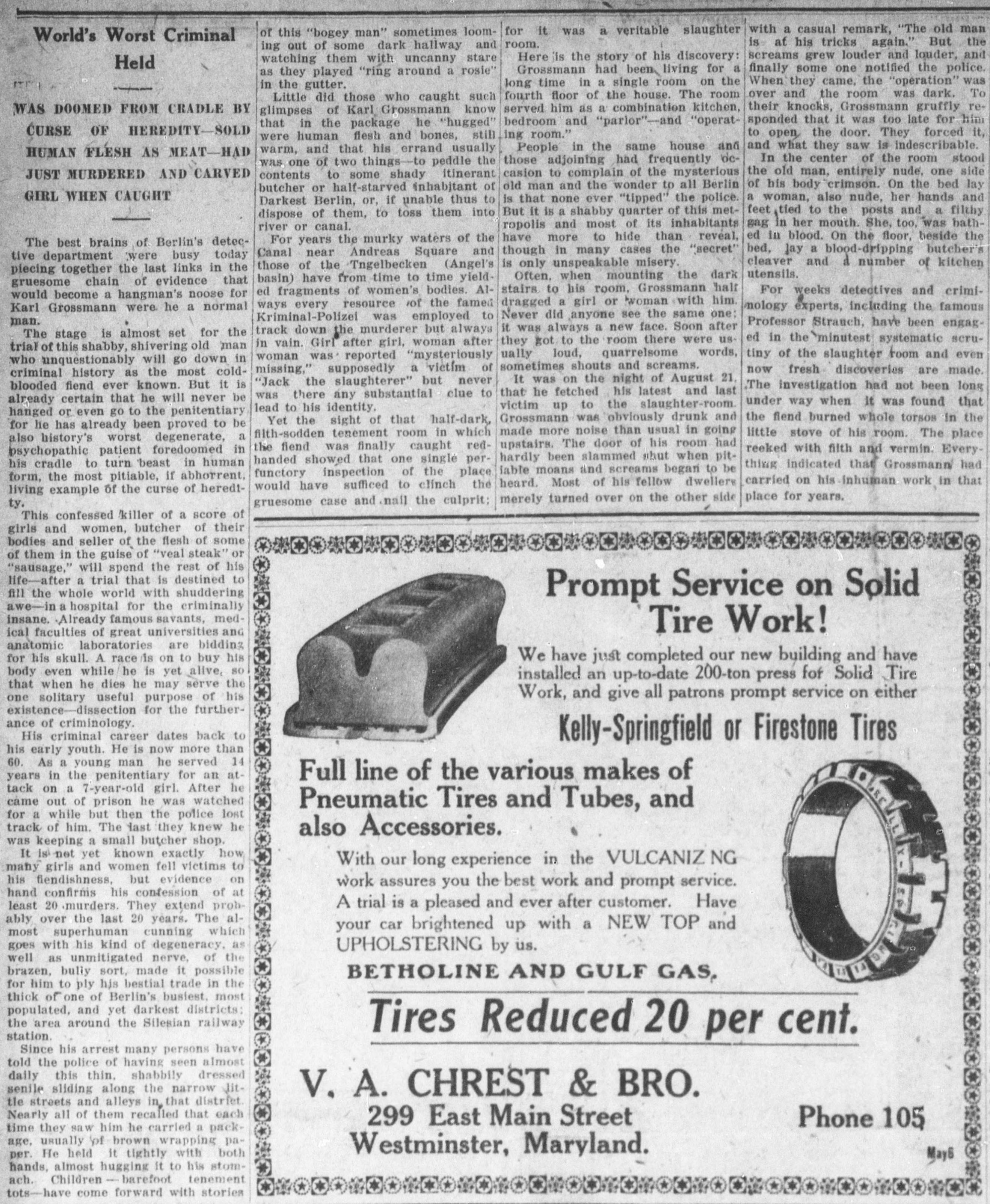
The Democratic Advocate for October 21, 1921, is more than ninety-five years old and in the public domain. The scan is the Library of Congress copy in Chronicling America. Because the crop takes in all four columns at once, a tire dealer's advertisement from lower on the page fills much of it; the advertisement is not part of the article. The citation and rights statement are under the scan.
Despite a darkened page and a crease through the last column, every word came through, and the transcription is complete with no illegible marks. It keeps the paper's "Tngelbecken (Angel's basin)," a garbled setting of Engelbecken, along with "ring around a rosie," "senile" used as a noun, and "anatomic." The language of heredity and degeneracy belongs to the 1921 wire writer and is reproduced as printed, not endorsed.

Transcription
Transcribed word for word from the page scan. Original spelling, punctuation, capitalisation and typographical errors have been kept exactly as printed. Unreadable words are marked [illegible]. Nothing has been modernised or corrected.
World's Worst Criminal Held
WAS DOOMED FROM CRADLE BY CURSE OF HEREDITY—SOLD HUMAN FLESH AS MEAT—HAD JUST MURDERED AND CARVED GIRL WHEN CAUGHT
The best brains of Berlin's detective department were busy today piecing together the last links in the gruesome chain of evidence that would become a hangman's noose for Karl Grossmann were he a normal man.
The stage is almost set for the trial of this shabby, shivering old man who unquestionably will go down in criminal history as the most cold-blooded fiend ever known. But it is already certain that he will never be hanged or even go to the penitentiary for he has already been proved to be also history's worst degenerate, a psychopathic patient foredoomed in his cradle to turn beast in human form, the most pitiable, if abhorrent, living example of the curse of heredity.
This confessed killer of a score of girls and women, butcher of their bodies and seller of the flesh of some of them in the guise of "veal steak" or "sausage," will spend the rest of his life—after a trial that is destined to fill the whole world with shuddering awe—in a hospital for the criminally insane. Already famous savants, medical faculties of great universities and anatomic laboratories are bidding for his skull. A race is on to buy his body even while he is yet alive, so that when he dies he may serve the one solitary useful purpose of his existence—dissection for the furtherance of criminology.
His criminal career dates back to his early youth. He is now more than 60. As a young man he served 14 years in the penitentiary for an attack on a 7-year-old girl. After he came out of prison he was watched for a while but then the police lost track of him. The last they knew he was keeping a small butcher shop.
It is not yet known exactly how many girls and women fell victims to his fiendishness, but evidence on hand confirms his confession of at least 20 murders. They extend probably over the last 20 years. The almost superhuman cunning which goes with his kind of degeneracy, as well as unmitigated nerve, of the brazen, bully sort, made it possible for him to ply his bestial trade in the thick of one of Berlin's busiest, most populated, and yet darkest districts; the area around the Silesian railway station.
Since his arrest many persons have told the police of having seen almost daily this thin, shabbily dressed senile sliding along the narrow little streets and alleys in that district. Nearly all of them recalled that each time they saw him he carried a package, usually of brown wrapping paper. He held it tightly with both hands, almost hugging it to his stomach. Children — barefoot tenement tots—have come forward with stories of this "bogey man" sometimes looming out of some dark hallway and watching them with uncanny stare as they played "ring around a rosie" in the gutter.
Little did those who caught such glimpses of Karl Grossmann know that in the package he "hugged" were human flesh and bones, still warm, and that his errand usually was one of two things—to peddle the contents to some shady itinerant butcher or half-starved inhabitant of Darkest Berlin, or, if unable thus to dispose of them, to toss them into river or canal.
For years the murky waters of the Canal near Andreas Square and those of the Tngelbecken (Angel's basin) have from time to time yielded fragments of women's bodies. Always every resource of the famed Kriminal-Polizei was employed to track down the murderer but always in vain. Girl after girl, woman after woman was reported "mysteriously missing," supposedly a victim of "Jack the slaughterer" but never was there any substantial clue to lead to his identity.
Yet the sight of that half-dark, filth-sodden tenement room in which the fiend was finally caught red-handed showed that one single perfunctory inspection of the place would have sufficed to clinch the gruesome case and nail the culprit; for it was a veritable slaughter room.
Here is the story of his discovery:
Grossmann had been living for a long time in a single room on the fourth floor of the house. The room served him as a combination kitchen, bedroom and "parlor"—and "operating room."
People in the same house and those adjoining had frequently occasion to complain of the mysterious old man and the wonder to all Berlin is that none ever "tipped" the police. But it is a shabby quarter of this metropolis and most of its inhabitants have more to hide than reveal, though in many cases the "secret" is only unspeakable misery.
Often, when mounting the dark stairs to his room, Grossmann half dragged a girl or woman with him. Never did anyone see the same one; it was always a new face. Soon after they got to the room there were usually loud, quarrelsome words, sometimes shouts and screams.
It was on the night of August 21, that he fetched his latest and last victim up to the slaughter-room. Grossmann was obviously drunk and made more noise than usual in going upstairs. The door of his room had hardly been slammed shut when pitiable moans and screams began to be heard. Most of his fellow dwellers merely turned over on the other side with a casual remark, "The old man is at his tricks again." But the screams grew louder and louder, and finally some one notified the police. When they came, the "operation" was over and the room was dark. To their knocks, Grossmann gruffly responded that it was too late for him to open the door. They forced it, and what they saw is indescribable.
In the center of the room stood the old man, entirely nude, one side of his body crimson. On the bed lay a woman, also nude, her hands and feet tied to the posts and a filthy gag in her mouth. She, too, was bathed in blood. On the floor, beside the bed, lay a blood-dripping butcher's cleaver and a number of kitchen utensils.
For weeks detectives and criminology experts, including the famous Professor Strauch, have been engaged in the minutest systematic scrutiny of the slaughter room and even now fresh discoveries are made. The investigation had not been long under way when it was found that the fiend burned whole torsos in the little stove of his room. The place reeked with filth and vermin. Everything indicated that Grossmann had carried on his inhuman work in that place for years.
Transcriber's notes
- Readability: good. The page is greyed and the paper stock has darkened, and there is a vertical crease through the last column, but every word was legible at magnification. No [illegible] markers were needed.
- Kept as printed: "Karl Grossmann" (SKC files him as Georg Karl Grossmann); "Tngelbecken (Angel's basin)", a garbled setting of Engelbecken; "ring around a rosie"; "senile" used as a noun; "anatomic"; "center"; and the paper's quotation marks throughout.
- The language of the piece — "degenerate", "curse of heredity", "foredoomed in his cradle" — is the wire service's own in 1921 and is reproduced as printed.
- The article is a feature set across four columns at the top of the page. The crop supplied is a single rectangle covering all four, so the lower part of columns 2, 3 and 4 shows the advertising that ran beneath the article. That advertising is not part of the article.
- Grossmann hanged himself in his cell in Berlin in July 1922, before judgment; this report was printed while he was awaiting trial.