WORKERS DEMAND DEATH OF BIGAMIST: THE SEATTLE STAR, MAY 18, 1920
Fifty stevedores crowded the station at Port Costa, California, when the train from Los Angeles pulled in early on May 18, 1920, and they wanted the prisoner. They demanded that he be handed over and said they would lynch him. James Watson, the "Bluebeard" of that spring's front pages, stayed locked in a compartment, and the train went on. The Seattle Star put the scene at the top of page one that afternoon, stacking three short wire dispatches one above another to follow him through the last day of his journey into San Quentin.
At Richmond, where the train stopped for forty minutes, almost nobody knew who he was. He chatted with Police Chief W. H. Wood and with the two Los Angeles deputies, Couts and Bell, made several last-minute financial arrangements with the deputies that were never explained, and looked so "very weak and emaciated" that he was carried to the ferry in a patrol wagon. At the prison they took his beard and his hair, put him in regulation clothes and gave him a number, 33755. By ten that morning he had begun a life sentence and been assigned to the jute mill.
The paper says the prison clothes made him look thinner still, but that he was "perceptibly relieved." He had said openly that he feared a lynching, or a second trial for another of the deaths with a hanging at the end of it. Behind that fear sat the bargain that had put him on this train: a full confession and his help finding the dead in exchange for being spared the gallows. The column's closing passage turns away from him to J. D. Beard, a burglar traveling with the party, who by Deputy Couts's account was outraged at the company he had to keep.
These are three wire dispatches, from Port Costa, San Quentin and Richmond, run together under one headline on the day they were filed, and they report only the journey. The paper calls Watson the confessed murderer of nine of his wives. He was convicted of one murder, by a guilty plea: that of Nina Lee Deloney, killed at Signal Hill near Long Beach in January 1920, and he was sentenced to life on May 10. The other deaths rest on his own confession, which was almost never tested, and few of the women he named were ever traced. The paper renders Beard's words in the heavy dialect the press of the period used for Black speakers, and how closely it matches anything he said cannot be known.
The Seattle Star of May 18, 1920, falls well inside the Library of Congress statement that American newspapers more than ninety-five years old are in the public domain in their entirety. The scan reproduced here is the Library's own copy from Chronicling America, and the full citation and rights statement appear beneath it.
Every word below was taken from the scan, and none had to be marked illegible. The broken sentence that begins "Garbed in the prison clothes" is printed as the paper set it, without the subject it needs. In Beard's quoted speech the stray apostrophe in "'lots of grief" and the spelling "'till" also stand, and the rows of dots that divide the three dispatches are reproduced as they appear on the page.

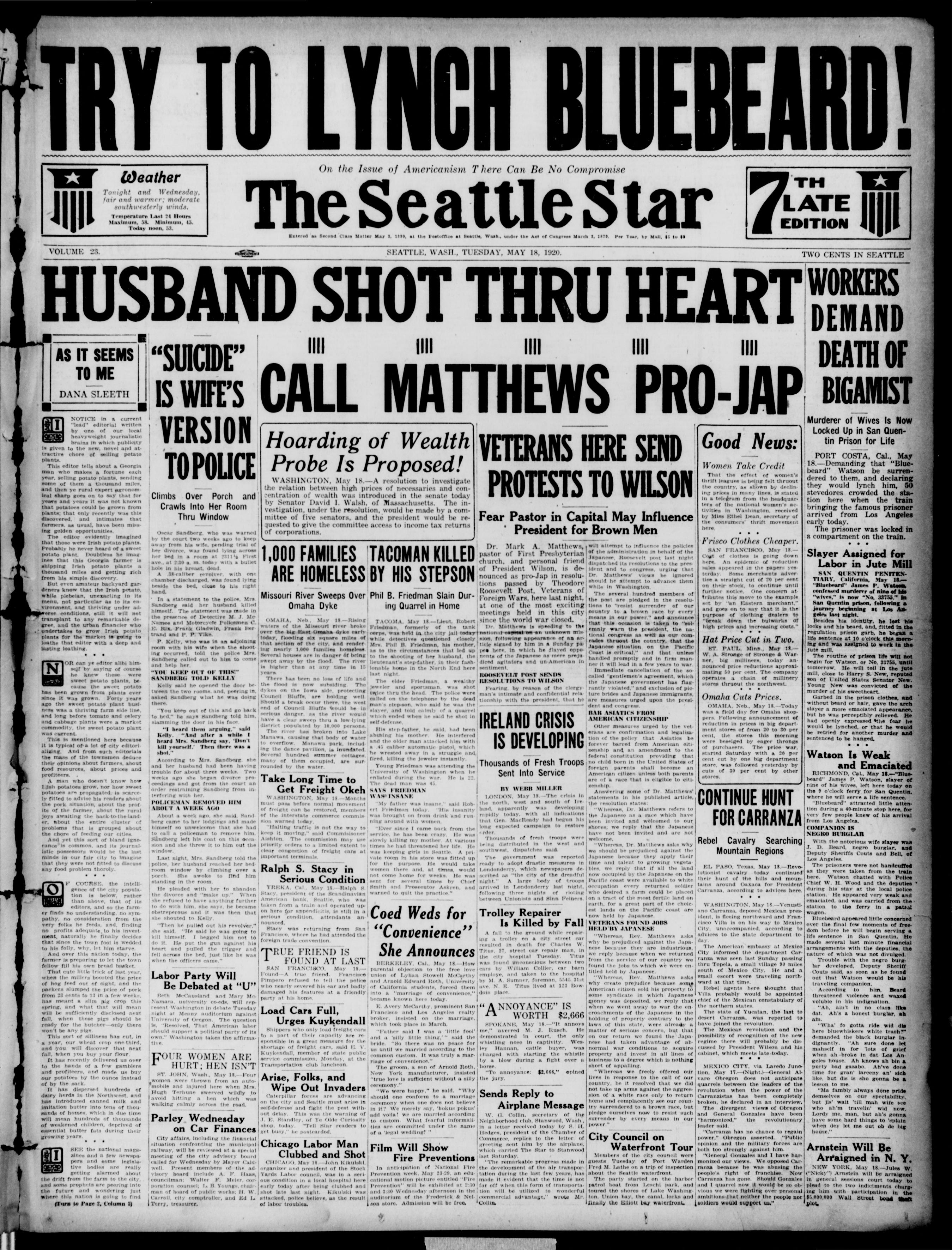
Transcription
Transcribed word for word from the page scan. Original spelling, punctuation, capitalisation and typographical errors have been kept exactly as printed. Unreadable words are marked [illegible]. Nothing has been modernised or corrected.
WORKERS DEMAND DEATH OF BIGAMIST
Murderer of Wives Is Now Locked Up in San Quentin Prison for Life
PORT COSTA, Cal., May 18.—Demanding that "Bluebeard" Watson be surrendered to them, and declaring they would lynch him, 50 stevedores crowded the station here when the train bringing the famous prisoner arrived from Los Angeles early today.
The prisoner was locked in a compartment on the train.
• • •
Slayer Assigned for Labor in Jute Mill
SAN QUENTIN PENITENTIARY, California, May 18.—"Bluebeard" James P. Watson, confessed murderer of nine of his "wives," is now "No. 33755," in San Quentin prison, following a journey beginning at Los Angeles last night.
Besides his identity, he lost his locks and his beard, and, fitted in the regulation prison garb, he began a life sentence at 10 o'clock this morning and was assigned to work in the jute mill.
The routine of prison life will not begin for Watson, or No. 33755, until tomorrow. He will toil in the jute mill, close to Harry S. New, reputed son of United States Senator New. Young New was convicted of the murder of his sweetheart.
Garbed in the prison clothes, and without beard or hair, gave the arch slayer a more emaciated appearance, but he was perceptibly relieved. He had openly expressed the fear he would be lynched, or that he would be retried for another murder and sentenced to be hanged.
• • •
Watson Is Weak and Emaciated
RICHMOND, Cal., May 18.—"Bluebeard" James P. Watson, slayer of nine of his wives, left here today on the 9 o'clock ferry for San Quentin, where he will serve a life sentence.
"Bluebeard" attracted little attention during a 40-minute stop here, for very few people knew of his arrival from Los Angeles.
COMPANION IS NEGRO BURGLAR
With the notorious wife slayer was J. D. Beard, negro burglar, and Deputy Sheriffs Couts and Bell, of Los Angeles.
The prisoners were not handcuffed as they were taken from the train here. Watson chatted with Police Chief W. H. Wood and the deputies during his stay at the local police station. He appeared very weak and emaciated, and was carried from the station to the ferry in a patrol wagon.
Bluebeard appeared little concerned over the final few moments of freedom before he will begin serving a life sentence in San Quentin. He made several last minute financial arrangements with the deputies, the nature of which was not divulged.
Trouble with the negro burglar developed, Deputy Sheriff Couts said, as soon as he found out that Watson would be his traveling companion.
According to him, Beard threatened violence and waxed voluble in his indignation.
"Ah, ain't in no class like dat. Ah's a honest burglar, ah am.
"Wha' fo gotta ride wid dis here bluewhiskers white trash?" demanded the black burglar indignantly. "Ah sure done let mahself in for 'lots of grief when ah broke in dat Los Angeles house. Ah knows ah bin a purty bad gazabo. Ah've done time for gran' larceny an' sich like, but dis is sho gonna be a lesson to me.
"Ma fambly always done pride demselves on our spectability, but jis' wait 'till mah wife see who ah'm travelin' wid now. Lordy me, man, but ah's gonna have some hard things to 'splain when dey let me out ob de big house."