WOMAN POISONER KILLS HUSBANDS FOR A FEE: THE SAN FRANCISCO CALL, MARCH 26, 1909
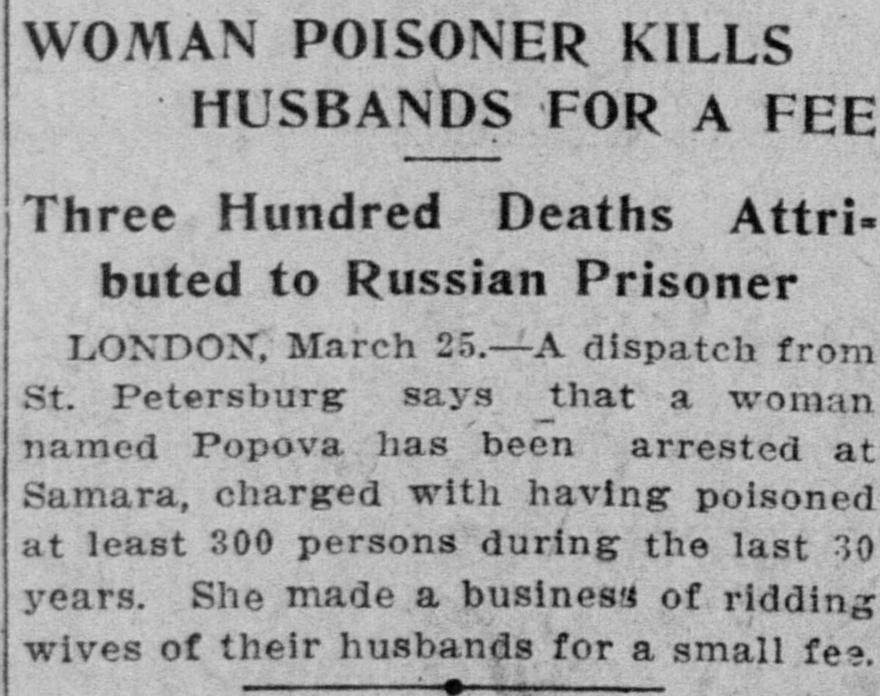
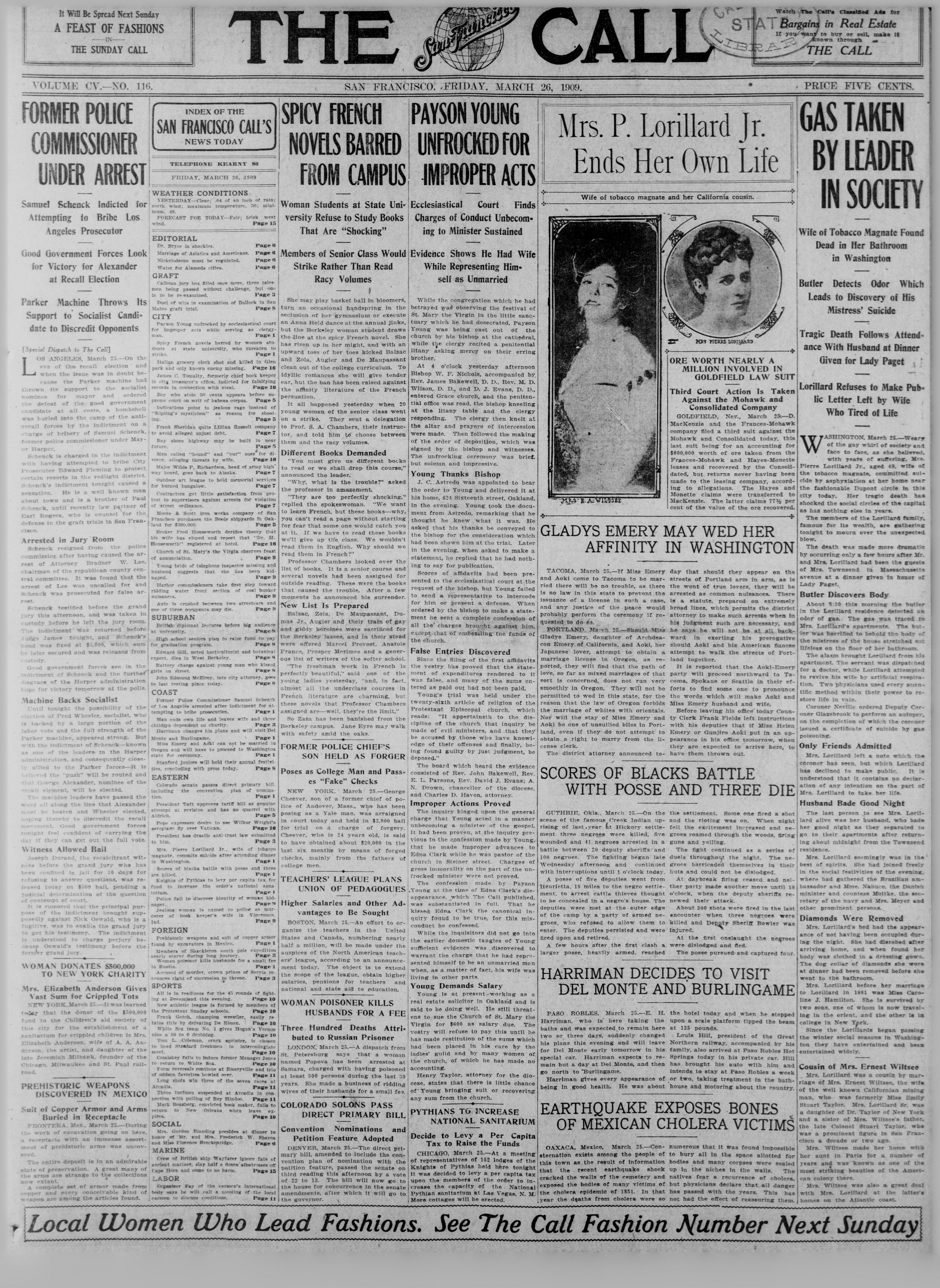
The story that made Madame Popova a legend reached California in three sentences, and it had changed hands twice on the way. On March 26, 1909, The San Francisco Call set it in column 4 of the front page: a dispatch from St. Petersburg, passed along by London the day before, said that "a woman named Popova" had been arrested at Samara, "charged with having poisoned at least 300 persons during the last 30 years." That is all the paper knew of her. She has no first name in it, no age and no face, and not one of the three hundred dead is named.
The last sentence is the one that carried. "She made a business of ridding wives of their husbands for a small fee." The Call's headline writer lifted it straight to the top of the column, "WOMAN POISONER KILLS HUSBANDS FOR A FEE," and gave the number a deck of its own: "Three Hundred Deaths Attributed to Russian Prisoner." The round figure, the thirty years and the trade in dead husbands for unhappy wives are all here already, and they are the parts every later telling keeps. The brief names no court, describes no evidence and does not say who in St. Petersburg sent the word.
What happened next is where the trail gives out. The version told ever since has her confessing, regretting nothing, and dying before a firing squad that same March. The Call reports an arrest and stops. No trial record, no arrest record and no account in the Russian press of 1909 has been produced for any of it, though rural Russia at the turn of the century did see real prosecutions of peasant women who poisoned violent husbands. Whatever lies under the story, this little item shows the number already fixed to it as the story crossed the Atlantic in 1909.
This is a secondhand wire brief, an American paper reprinting what London said St. Petersburg had reported, and it is not a Russian record or the work of anyone in Samara. It reports an accusation, not a finding. No conviction of anyone named Popova has been documented, the figure of 300 has never been supported by any record that has come to light, and the execution that later accounts place in March 1909 does not appear here at all. Her first name and the identity of any victim remain unknown.
The San Francisco Call of March 26, 1909, is well over ninety-five years old, so the whole issue is in the public domain. The image is the Library of Congress copy from Chronicling America, and the Library's citation and rights statement appear in full under the scan, where the deck and the closing rule can be seen as they were printed.
The item is short and the type is clear, so the headline, the deck and all three sentences are transcribed complete, with nothing marked illegible. The text keeps the paper's own forms: the dateline "LONDON, March 25," a day earlier than the issue itself, the word "persons" where a modern paper would write people, and the figures 300 and 30 set as numerals. The story begins and ends in this one column and does not continue elsewhere in the issue.
Transcription
Transcribed word for word from the page scan. Original spelling, punctuation, capitalisation and typographical errors have been kept exactly as printed. Unreadable words are marked [illegible]. Nothing has been modernised or corrected.
WOMAN POISONER KILLS HUSBANDS FOR A FEE
Three Hundred Deaths Attributed to Russian Prisoner
LONDON, March 25.—A dispatch from St. Petersburg says that a woman named Popova has been arrested at Samara, charged with having poisoned at least 300 persons during the last 30 years. She made a business of ridding wives of their husbands for a small fee.