WOMAN DIES FOR MURDER: BROWNSVILLE HERALD, DECEMBER 30, 1932
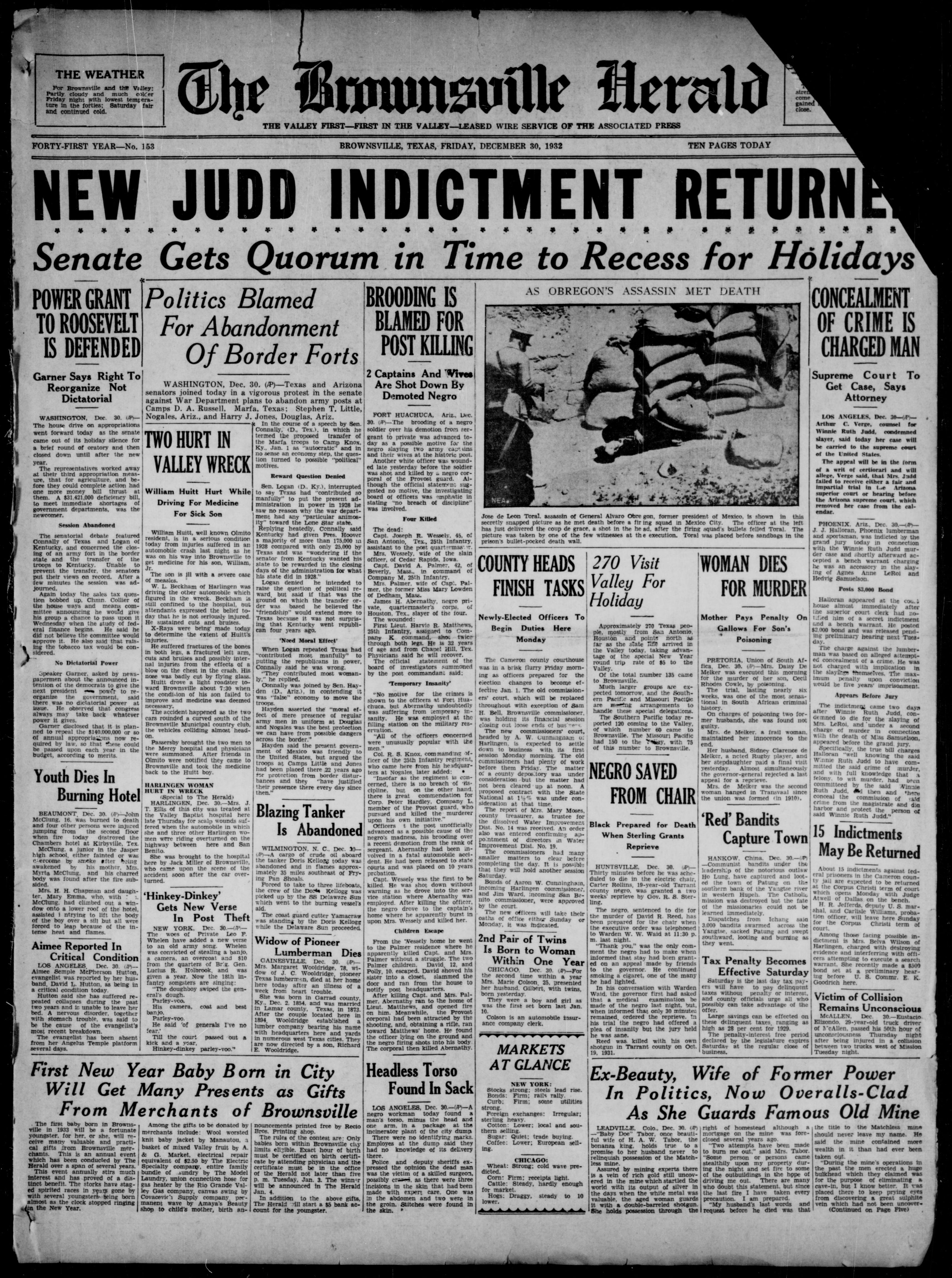
On the morning of December 30, 1932, Daisy Louisa De Melker was hanged in Pretoria for poisoning her son, and before the day was out an Associated Press bulletin about it stood in the first column of the front page of the Brownsville Herald, at the southern tip of Texas. The headline did not need her name. It called her a woman and a mother: "WOMAN DIES FOR MURDER," and beneath that, "Mother Pays Penalty On Gallows For Son's Poisoning." The son, whom the bulletin names as Cecil Rhodes Cowle, was twenty when he died in March 1932 after drinking coffee from a flask she had filled.
The dispatch runs to six short paragraphs, and one of them is about what the trial had failed to prove. She had also been tried for poisoning two former husbands, and on those charges, the bulletin says, she was found not guilty. She went to the gallows for her child alone. The trial had lasted nearly six weeks and was, in the wire's phrase, "one of the most sensational in South African criminal history." Through all of it the frail woman at its center maintained her innocence, and she maintained it to the end.
The last day takes two sentences. Her husband, a rugby player the paper calls Sidney Clarence de Melker, came with her stepdaughter for a final visit on December 29, and at almost the same hour the governor-general turned down a last appeal for a reprieve. The bulletin closes on a statistic: she was, it says, only the second woman hanged in the Transvaal since the Union of South Africa was formed in 1910. The arsenic she had bought at a Turffontein pharmacy, signing the poisons register under an old married name, is nowhere in it.
This is a brief wire bulletin filed from Pretoria on the day of the hanging; it is not a court record and does not say how the case was tried. It names the son Cecil Rhodes Cowle, while the record of the case gives his name as Rhodes Cecil Cowle, and it spells her husband's name Sidney where the record has Sydney. Justice Leopold Greenberg, sitting with two assessors and no jury, convicted her on November 25, 1932, of murdering her son with arsenic, and acquitted her on both husbands because the evidence that they had died of strychnine was inconclusive. The figure for women hanged in the Transvaal is the wire service's own and comes with no source.
The Brownsville Herald of December 30, 1932, is less than ninety-five years old. The Library of Congress believes issues from those years are in the public domain but warns that they may contain some copyrighted third-party material, and this item is exactly that kind of matter in origin: wire copy, credited to the Associated Press in its dateline rather than written in Brownsville. No separate copyright notice appears on it. The scan is the Library's own copy in Chronicling America, and its citation and rights statement are printed below.
Short as it is, the bulletin is set in large, clear type, and the transcription follows it word for word with no illegible marks. The compositor's slip "ncted" for noted is left as printed. So is the paper's wavering between "De Melker" in the first paragraph and "de Melker" afterward, "Transvaal" without its article, and the parenthetical "(in 1910)" tacked onto the last line.
Transcription
Transcribed word for word from the page scan. Original spelling, punctuation, capitalisation and typographical errors have been kept exactly as printed. Unreadable words are marked [illegible]. Nothing has been modernised or corrected.
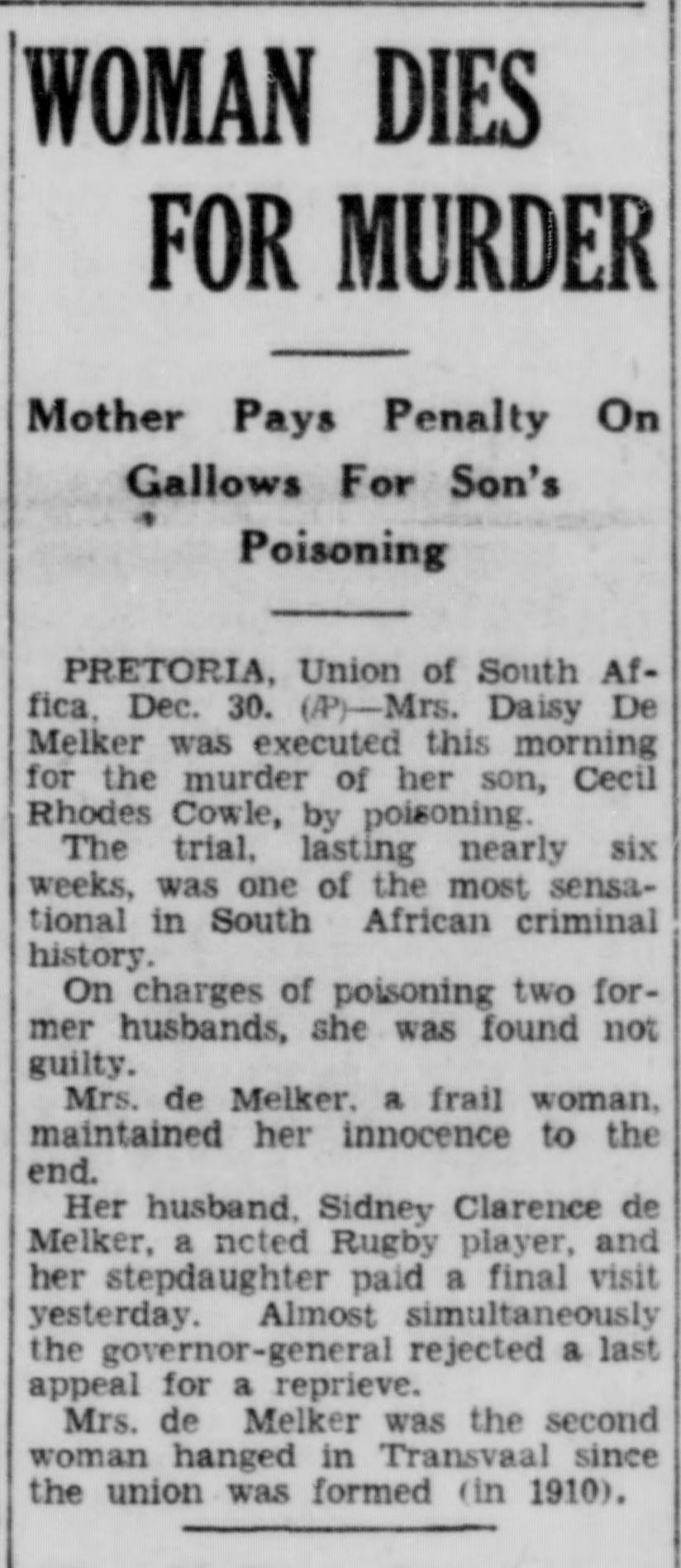
WOMAN DIES FOR MURDER
Mother Pays Penalty On Gallows For Son's Poisoning
PRETORIA, Union of South Africa, Dec. 30. (AP)—Mrs. Daisy De Melker was executed this morning for the murder of her son, Cecil Rhodes Cowle, by poisoning.
The trial, lasting nearly six weeks, was one of the most sensational in South African criminal history.
On charges of poisoning two former husbands, she was found not guilty.
Mrs. de Melker, a frail woman, maintained her innocence to the end.
Her husband, Sidney Clarence de Melker, a ncted Rugby player, and her stepdaughter paid a final visit yesterday. Almost simultaneously the governor-general rejected a last appeal for a reprieve.
Mrs. de Melker was the second woman hanged in Transvaal since the union was formed (in 1910).