WOMAN ACCUSED OF MANY MURDERS: THE WASHINGTON TIMES, OCTOBER 29, 1904
The police had spent two years building their case against a woman in the St. Pauli district of Hamburg, and by the fall of 1904 The Washington Times was giving its readers the result in four decks of headline: "WOMAN ACCUSED OF MANY MURDERS," then "Horrible Series of Crimes Attributed to Her," then "A GERMAN BABY FARMER," and finally a line promising children "Done Away With in Cruelest Manner." The dispatch, datelined Hamburg, October 29, called her Elizabeth Wiese. She was Elisabeth Wiese, a trained midwife, and the Hamburg papers called her the angel-maker of St. Pauli.
The charges come in a single breath. She was accused of murdering five small children, of often attempting to poison her husband, and of forgery, perjury and subornation of perjury. The children, the paper says, had been handed to her by unhappy mothers who paid large premiums, and they were drugged with morphia, thrown into the Elbe or burned in her stove. Four of them were infants who passed through her hands in 1903: Wilhelm Karl Klotsche, Franz Carl Friedrich Sommer, Peter Schultheiss and Bertha Blanck. The fifth was her own newborn grandchild, born to her daughter, Paula, in a cellar flat in July 1902.
Then the dispatch reaches beyond the murder charges into rumor. She was said to have passed babies on to other baby farmers who never saw a second payment, to have sold children "for unnameable purposes," to have found infants to pose as heirs when estates turned on childless marriages, and to have blackmailed a London doctor for hundreds of pounds. The writer called her business "a vast commercial agency." Its last line predicted a long trial, since evidence had been taken in only one case of child murder. No child's body was ever found.
This is a foreign dispatch, not a court report, and it ran behind events. Datelined October 29, 1904, it describes the trial as still in progress, but the Hamburg jury court had opened the case on October 4 and on October 10 convicted her on all five counts of murder and sentenced her to death five times; she was beheaded in the courtyard of the Hamburg remand prison on February 2, 1905. The Elbe, the children sold, the counterfeit heirs and the London blackmail are the paper's allegations, unsourced, and none of them appears among the charges she faced. The paper spells her first name Elizabeth.
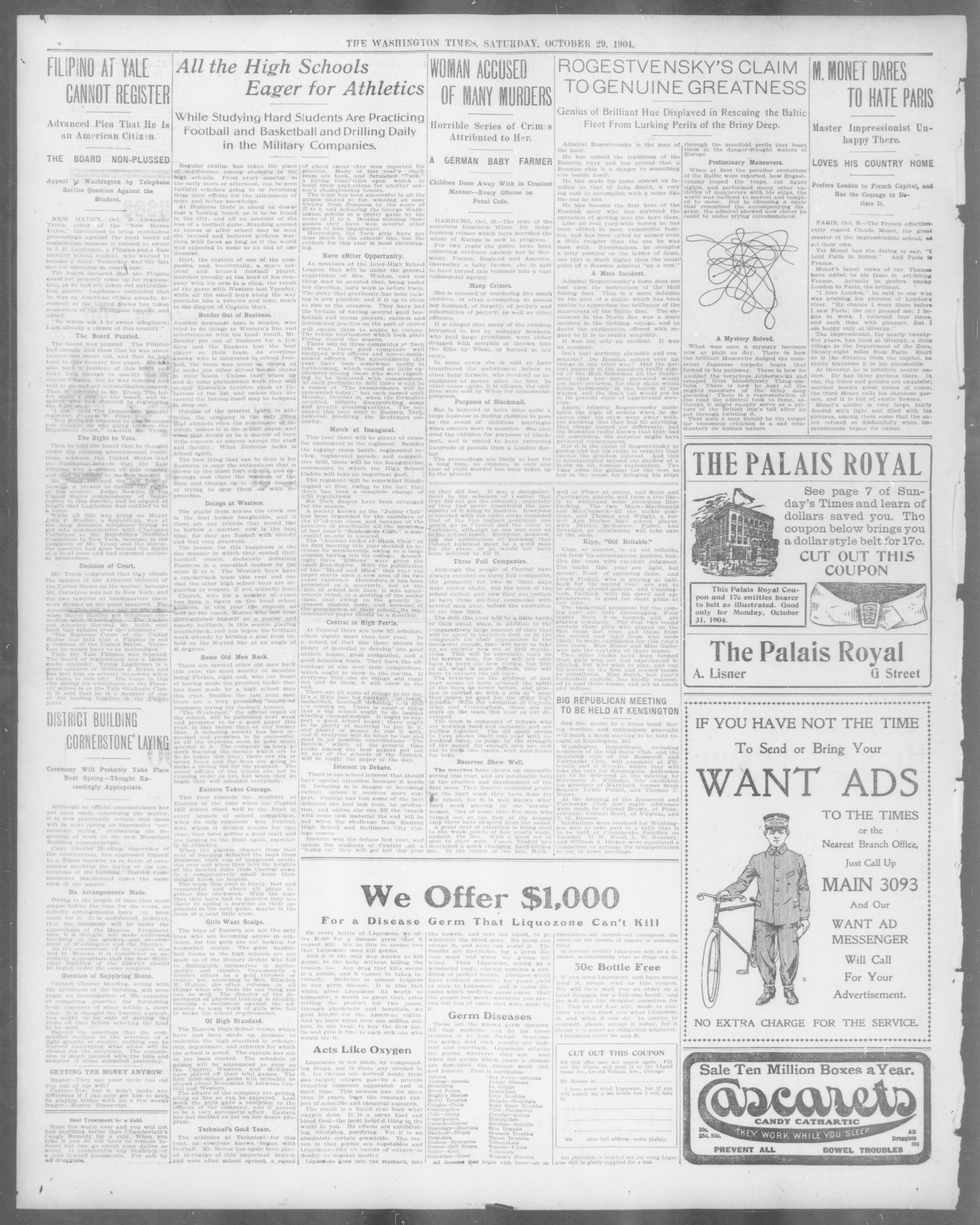
At well over ninety-five years old, The Washington Times of October 29, 1904, lies entirely in the public domain, dispatch, headlines and all. The scan is the Library of Congress copy of page 4 in Chronicling America, and the citation and the Library's rights statement are set out under it in full.
The condensed first deck has faded on the page but can still be read, and the whole story is transcribed without a single illegible mark. Its period forms stay as printed: "intrusted" for entrusted, "morphia" for morphine, "baby-farming" with its hyphen, and the double hyphen in "Manner--Every Offense on Penal Code." Her first name keeps the paper's spelling throughout.
Transcription
Transcribed word for word from the page scan. Original spelling, punctuation, capitalisation and typographical errors have been kept exactly as printed. Unreadable words are marked [illegible]. Nothing has been modernised or corrected.
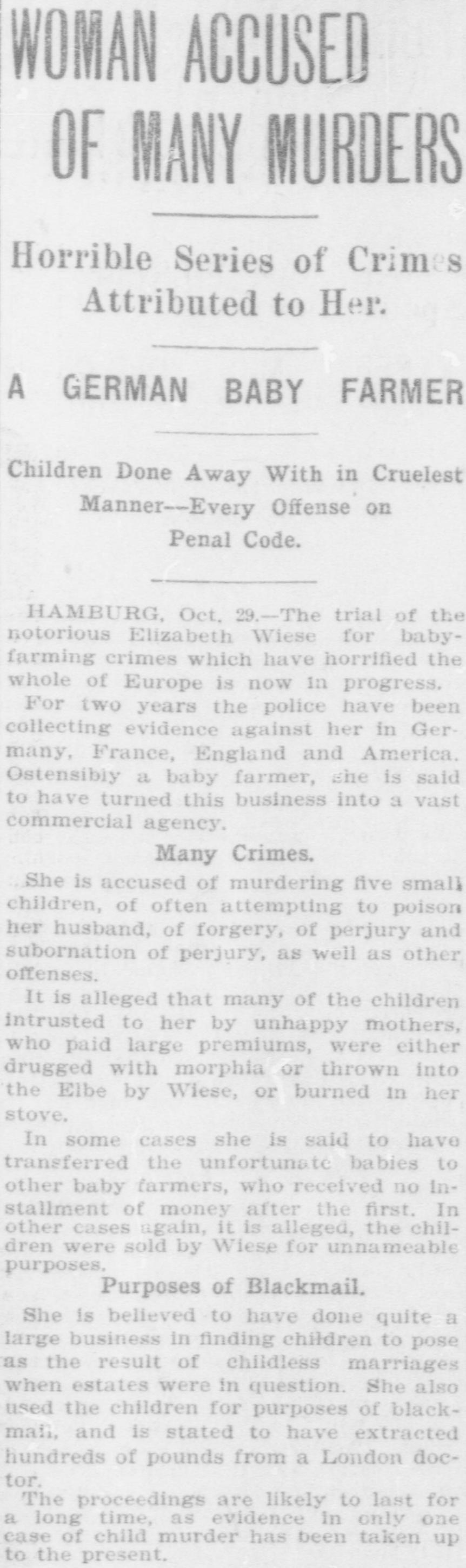
WOMAN ACCUSED OF MANY MURDERS
Horrible Series of Crimes Attributed to Her.
A GERMAN BABY FARMER
Children Done Away With in Cruelest Manner--Every Offense on Penal Code.
HAMBURG, Oct. 29.—The trial of the notorious Elizabeth Wiese for baby-farming crimes which have horrified the whole of Europe is now in progress.
For two years the police have been collecting evidence against her in Germany, France, England and America. Ostensibly a baby farmer, she is said to have turned this business into a vast commercial agency.
Many Crimes.
She is accused of murdering five small children, of often attempting to poison her husband, of forgery, of perjury and subornation of perjury, as well as other offenses.
It is alleged that many of the children intrusted to her by unhappy mothers, who paid large premiums, were either drugged with morphia or thrown into the Elbe by Wiese, or burned in her stove.
In some cases she is said to have transferred the unfortunate babies to other baby farmers, who received no installment of money after the first. In other cases again, it is alleged, the children were sold by Wiese for unnameable purposes.
Purposes of Blackmail.
She is believed to have done quite a large business in finding children to pose as the result of childless marriages when estates were in question. She also used the children for purposes of blackmail, and is stated to have extracted hundreds of pounds from a London doctor.
The proceedings are likely to last for a long time, as evidence in only one case of child murder has been taken up to the present.