WILL LOCKETT ELECTROCUTED, PRAYS FOR GIRL: GREAT FALLS DAILY TRIBUNE, MARCH 12, 1920
The current went through him at 4:32 in the morning of March 11, 1920, in the electric chair at the Kentucky state prison at Eddyville, and two of the people watching were brothers of the ten-year-old girl he had killed. The Great Falls Daily Tribune in Montana ran the wire report the next day. It names the dead man as Petrie Kimbrough, alias Will Lockett, convicted of killing Geneva Hardman, and in the same sentence it makes a larger claim: he was the "confessed slayer of four other women."
The size of the guard tells its own story. Seventeen Lexington citizens sat with the Hardman brothers, and so did eight soldiers and twelve prison guards. A month earlier a mob of thousands had tried to storm the Lexington courthouse to take him, police and Guardsmen had fired into it, and six people had died; federal troops then marched him to the train under a guard of four hundred soldiers. None of that is in the item. It is there anyway, in the uniforms around the chair.
The last paragraph gave the paper its headline. All night, it says, he was heard praying and singing hymns. He said he was ready to die and that he prayed "for the little ten-year-old Hardman girl whom he killed and for the entire Hardman family." There were "slight signs of emotion in his face" as he was placed in the chair and the black cap lowered. On February 4, 1920, Geneva Hardman's school satchel and cap had been found by a cornfield fence in southern Fayette County, and her body behind a fodder shock nearby.
This is a four-paragraph wire report from Eddyville, written the day of the execution; it is not a court or prison record, and it spells the town "Eddysville" throughout. Its deck mentions a single "Brother of Victim," though the text names two brothers. The paper calls him convicted; he pleaded guilty in Lexington in February 1920, a jury fixed his punishment at death, and Geneva Hardman's murder is the only one he was ever sentenced for. The "four other women" are the paper's figure. His death-row confession is recorded as three other killings between 1912 and 1917, and none of them was ever tried; authorities let their inquiries drop once he was to be executed.
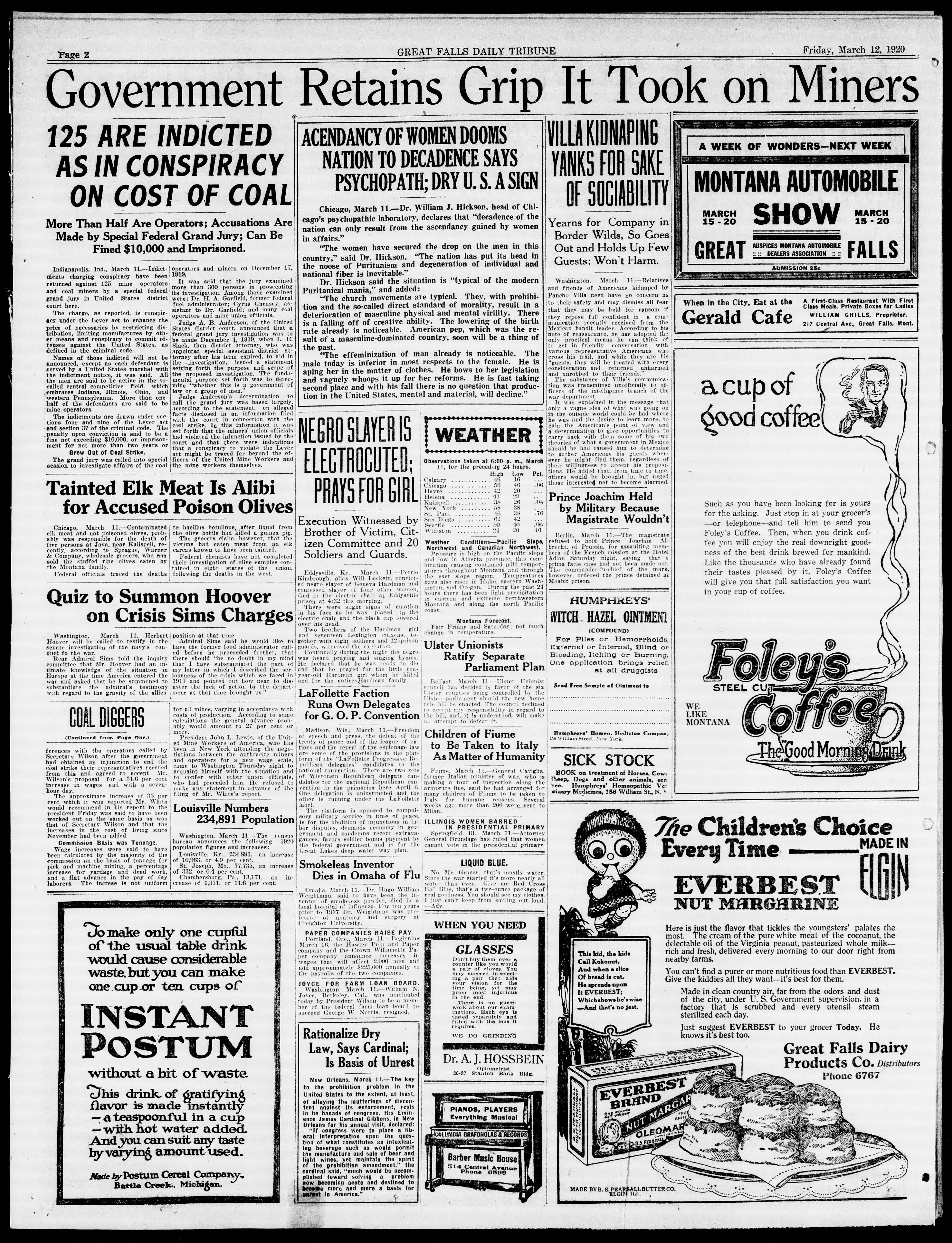
Published March 12, 1920, this issue of the Great Falls Daily Tribune is in the public domain. The scan is the Library of Congress copy in Chronicling America, page two, column one. The crop takes in the whole item, from the three-line headline to the closing sentence about the Hardman family, with the Library's citation and rights statement printed below the image.
The transcription is complete and exact; no word was lost in the scan and none is marked illegible. The headline's three stacked lines are kept as set. So is "Eddysville" in both the dateline and the text, along with the mixed style of "seventeen Lexington citizens" beside "12 prison guards," the deck's "20 Soldiers and Guards," and the paper's racial wording, which is reproduced rather than softened.
Transcription
Transcribed word for word from the page scan. Original spelling, punctuation, capitalisation and typographical errors have been kept exactly as printed. Unreadable words are marked [illegible]. Nothing has been modernised or corrected.
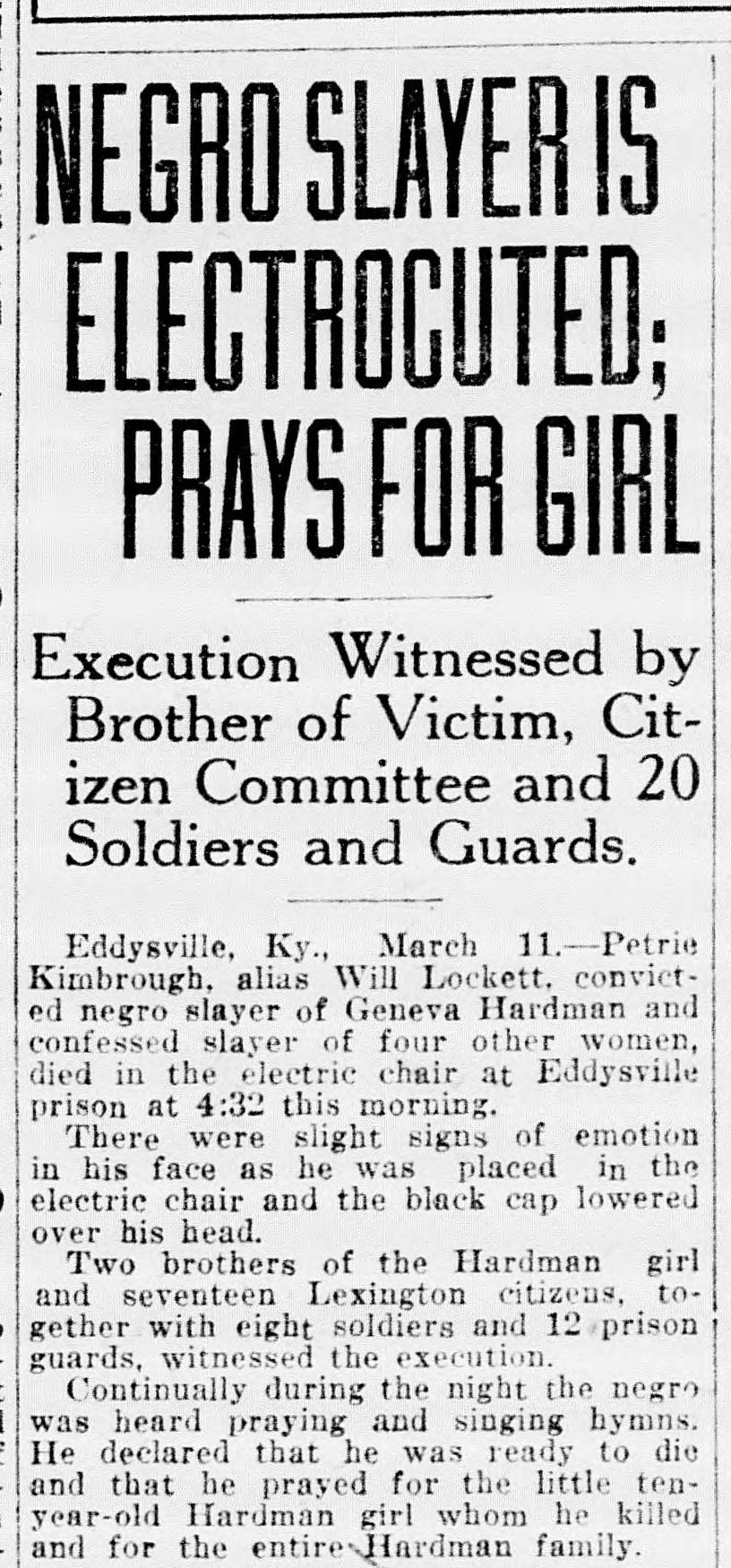
NEGRO SLAYER IS ELECTROCUTED; PRAYS FOR GIRL
Execution Witnessed by Brother of Victim, Citizen Committee and 20 Soldiers and Guards.
Eddysville, Ky., March 11.—Petrie Kimbrough, alias Will Lockett, convicted negro slayer of Geneva Hardman and confessed slayer of four other women, died in the electric chair at Eddysville prison at 4:32 this morning.
There were slight signs of emotion in his face as he was placed in the electric chair and the black cap lowered over his head.
Two brothers of the Hardman girl and seventeen Lexington citizens, together with eight soldiers and 12 prison guards, witnessed the execution.
Continually during the night the negro was heard praying and singing hymns. He declared that he was ready to die and that he prayed for the little ten-year-old Hardman girl whom he killed and for the entire Hardman family.