WHITECHAPEL AGAIN: THE BROOKHAVEN LEADER, NOVEMBER 15, 1888
Six days after the fact, a weekly in Brookhaven, Mississippi, told its readers that the Whitechapel killer had struck again. The dispatch was dated London, November 9, 1888, the morning a woman was found dead in her room off Dorset Street in Spitalfields, mutilated far beyond anything done to the women before her. She is known now as Mary Jane Kelly. The cable could not yet get her name right. It believed she was "Lizzie Fisher," though people around her haunts called her Mary Jane, and it judged, on the first day, that the man who killed her would probably never be identified. Jack the Ripper never was.
The report spares its readers little. It lists the injuries in a long, flat run of sentences, adds that the doctors would say nothing until the inquest, and records that three bloodhounds belonging to private citizens were put on the scent and lost it within a short distance. She had carried a latch key, so no one knew when she came home, and her killer could have slipped out at any hour between one and six without being noticed. The evening before, she had told a companion she had no money and would kill herself if she did not get a supper. A respectably dressed man, the paper heard, offered her money and went back with her to her room.
Behind the misprinted name was a woman who told friends she was born in Limerick and raised in Wales, who had lived in a single room at 13 Miller's Court with a fish porter, Joseph Barnett, until a quarrel at the end of October, and who said on her last evening that she wished she had the money to go home to Ireland. No member of her family could be found for her funeral. The column closes on a prediction. Archibald Forbes and a Mr. Winslow had called the killer a homicidal maniac, and by now, the paper says, it was generally expected that another murder would soon follow.
Cabled from London on the day of the murder and reprinted by a country weekly, much of this is first-day report and rumor. "Lizzie Fisher" was an early misidentification. The body was found not by a landlady but by Thomas Bowyer, sent by the landlord, John McCarthy, to collect overdue rent at about 10:45, not eleven. The paper says three bloodhounds were set on the scent and failed, while other accounts say the police waited hours at the locked door for dogs that never came. The "homicidal maniac" verdict is opinion. Jack the Ripper was never identified, charged or tried, no suspect has ever been proved, and this item names none.
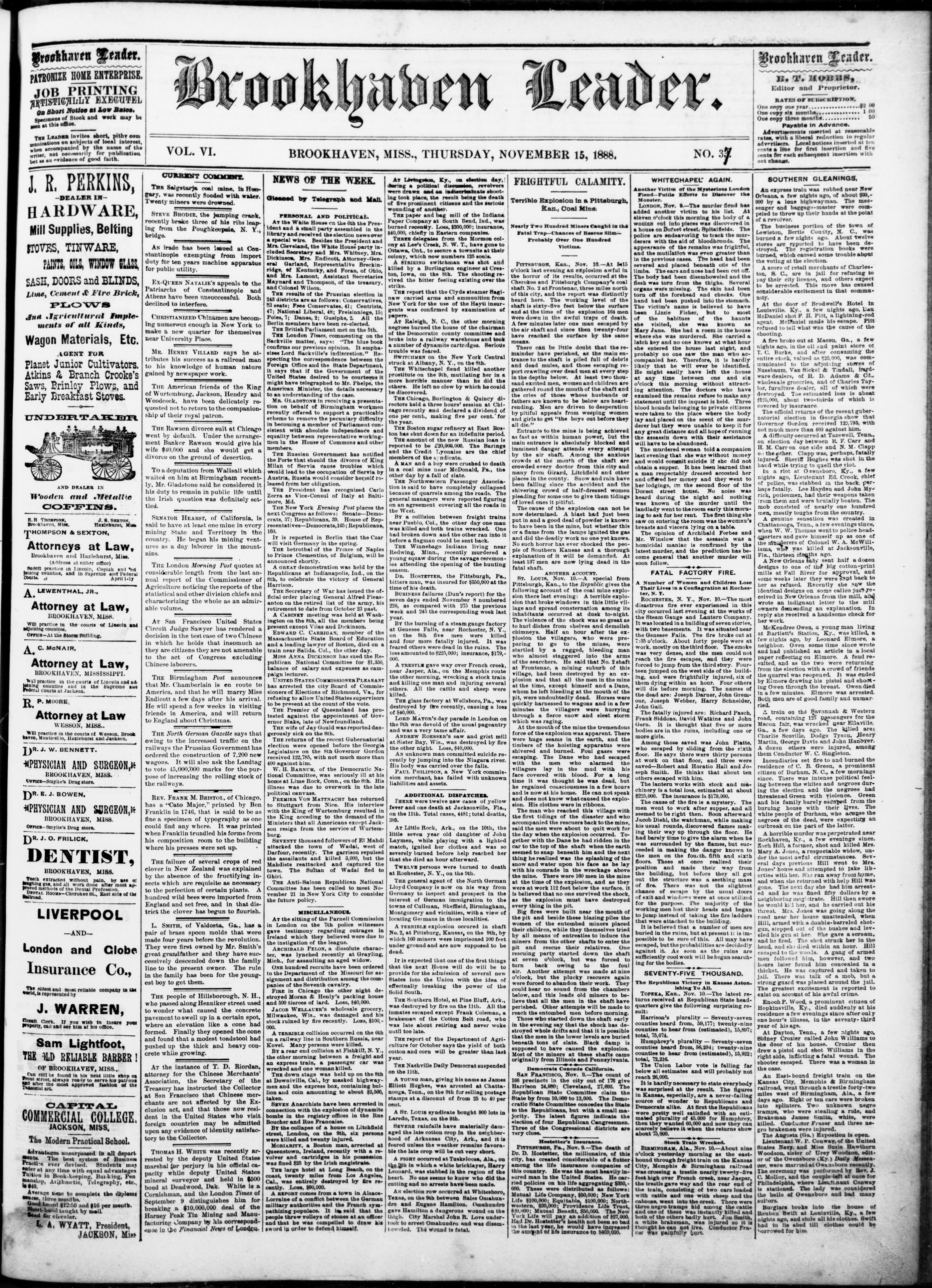
The Brookhaven Leader of November 15, 1888, is well over a century old and wholly in the public domain, free of any copyright restriction. The scan is the Library of Congress copy, held in its Chronicling America collection, and the Library's citation and rights statement for this page are set out in full under it.
The type is heavy and a little over-inked, but no word defeated the transcriber and nothing is marked illegible. The paper's spellings stand: "endeavoring," "disemboweled," "habitues" without its accent, and both "blood hounds" and "bloodhounds" within a few lines of each other. The plural "the murderers" in the opening paragraph is the paper's own. The report ends at an ornamental rule, and the items above and below it are unrelated.
Transcription
Transcribed word for word from the page scan. Original spelling, punctuation, capitalisation and typographical errors have been kept exactly as printed. Unreadable words are marked [illegible]. Nothing has been modernised or corrected.
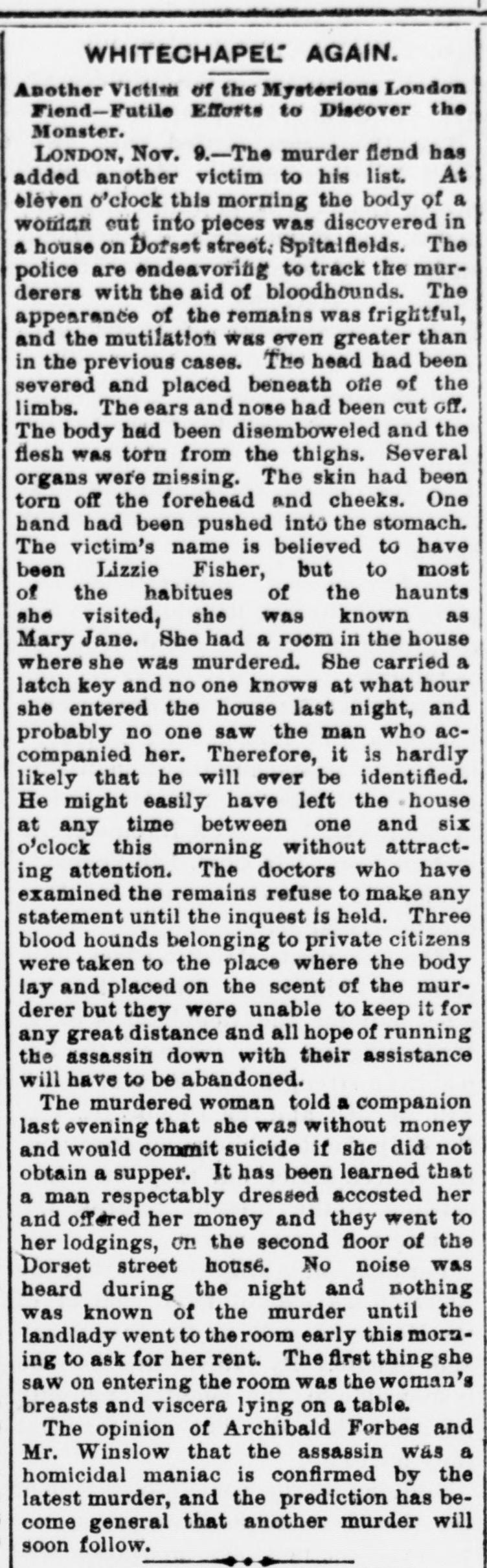
WHITECHAPEL AGAIN.
Another Victim of the Mysterious London Fiend—Futile Efforts to Discover the Monster.
LONDON, Nov. 9.—The murder fiend has added another victim to his list. At eleven o'clock this morning the body of a woman cut into pieces was discovered in a house on Dorset street, Spitalfields. The police are endeavoring to track the murderers with the aid of bloodhounds. The appearance of the remains was frightful, and the mutilation was even greater than in the previous cases. The head had been severed and placed beneath one of the limbs. The ears and nose had been cut off. The body had been disemboweled and the flesh was torn from the thighs. Several organs were missing. The skin had been torn off the forehead and cheeks. One hand had been pushed into the stomach. The victim's name is believed to have been Lizzie Fisher, but to most of the habitues of the haunts she visited, she was known as Mary Jane. She had a room in the house where she was murdered. She carried a latch key and no one knows at what hour she entered the house last night, and probably no one saw the man who accompanied her. Therefore, it is hardly likely that he will ever be identified. He might easily have left the house at any time between one and six o'clock this morning without attracting attention. The doctors who have examined the remains refuse to make any statement until the inquest is held. Three blood hounds belonging to private citizens were taken to the place where the body lay and placed on the scent of the murderer but they were unable to keep it for any great distance and all hope of running the assassin down with their assistance will have to be abandoned.
The murdered woman told a companion last evening that she was without money and would commit suicide if she did not obtain a supper. It has been learned that a man respectably dressed accosted her and offered her money and they went to her lodgings, on the second floor of the Dorset street house. No noise was heard during the night and nothing was known of the murder until the landlady went to the room early this morning to ask for her rent. The first thing she saw on entering the room was the woman's breasts and viscera lying on a table.
The opinion of Archibald Forbes and Mr. Winslow that the assassin was a homicidal maniac is confirmed by the latest murder, and the prediction has become general that another murder will soon follow.
Transcriber's notes
- Readability: very good. Heavy, slightly over-inked type but every word was legible. No [illegible] markers were needed.
- Kept as printed: "endeavoring", "disemboweled", "habitues" without the accent, "blood hounds" as two words in one place and "bloodhounds" as one in another, and "the murderers" in the plural in the opening paragraph.
- The victim is the one now known as Mary Jane Kelly, killed on 9 November 1888. The paper gives her name as "Lizzie Fisher… known as Mary Jane"; that early misidentification is left exactly as printed and is itself part of the record.
- The report was filed from London on 9 November and printed by this Mississippi weekly six days later. It ends at an ornamental rule; the items above and below it are unrelated.