VIENNESE WOMAN, POISONER OF FOUR, TO BE EXECUTED: THE TIMES-NEWS, MAY 20, 1938
Austria had been part of Germany for two months when Martha Marek heard her sentence in Vienna, and the United Press made sure American readers knew it. The dispatch that reached The Times-News in Hendersonville, North Carolina, on May 20, 1938, gives the result first: the red-haired woman the paper calls a "devil in petticoats" had been sentenced the day before to die for the poison murders of four people. Then it adds the detail that fixes the scene in its moment. The prosecution had described her as "half-Jewish," and she sneered at the Nazi judge who sentenced her.
The paper reaches back a decade for the scheme that first made her notorious: her husband's leg, which she "allegedly hacked off" so that she might raise money to finance an invention. The amputation was real. Emil Marek lost his left leg below the knee in 1925, the couple told the insurers the axe had slipped while he was felling a tree, and the insurers' doctors, who saw three separate blows, refused to pay. The two were prosecuted for attempted fraud, and the case ran through the Vienna courts for years. Emil died in 1932, and his death was put down to tuberculosis.
The other deaths followed the same pattern of insurance and inheritance. Their daughter, Ingeborg, died within weeks of her father; an elderly aunt, Susanne Löwenstein, who had made Marek her heir, died in 1934; and a lodger, the seamstress Felicitas Kittenberger, died after taking out insurance in Marek's favor. It was Kittenberger's son who went to the police. The exhumations found thallium in all four, and Marek's own son was found sick with the same poison and recovered in hospital. The dispatch ends on the dose, enough, it says, "to kill a score of oxen."
The dispatch is a three-paragraph wire report, not a court record, and it is wrong about the sentence itself: Marek was not hanged but guillotined in Vienna on December 6, 1938, by the Bavarian state executioner, Johann Reichhart. It speaks of four victims and three murder counts without explaining the difference. It makes Ingeborg three years old, where other accounts give nine months or seven; it puts the amputation ten years back, though it happened in 1925; and it makes Marek 42, though most modern references put her birth in 1897 and older ones in 1904. She was convicted of murder and condemned to death. The paper's leg story remains an allegation.
The Times-News printed this item on May 20, 1938. The Library of Congress considers newspapers of that date in Chronicling America to be public domain, while cautioning that anything published within the last ninety-five years may hold some copyrighted third-party material; nothing in this dispatch appears to be separately copyrighted. Under the scan, which is the Library's copy, are the full citation and the Library's rights statement.
Large, clean type made a complete word-for-word transcription possible, with nothing marked illegible. The paper's language is kept as it stood, including the prosecution's "half-Jewish" and "the Nazi judge," because they record how the trial was reported in the weeks after the Anschluss. The United Press credit appears as "(UP)," and "poison," split across two lines in the original setting, is joined. The item is complete in one column, set between rules.
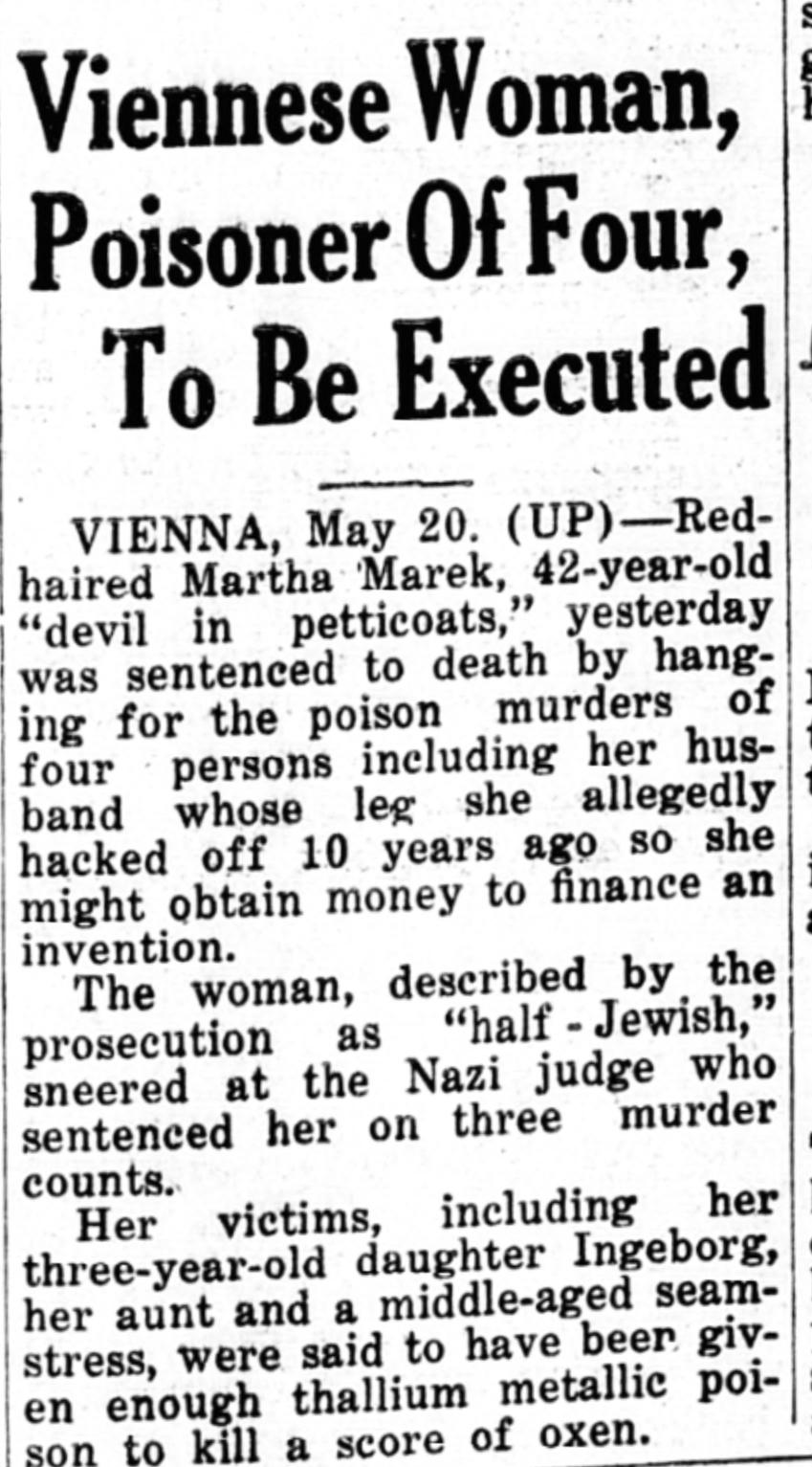

Transcription
Transcribed word for word from the page scan. Original spelling, punctuation, capitalisation and typographical errors have been kept exactly as printed. Unreadable words are marked [illegible]. Nothing has been modernised or corrected.
Viennese Woman, Poisoner Of Four, To Be Executed
VIENNA, May 20. (UP)—Red-haired Martha Marek, 42-year-old "devil in petticoats," yesterday was sentenced to death by hanging for the poison murders of four persons including her husband whose leg she allegedly hacked off 10 years ago so she might obtain money to finance an invention.
The woman, described by the prosecution as "half-Jewish," sneered at the Nazi judge who sentenced her on three murder counts.
Her victims, including her three-year-old daughter Ingeborg, her aunt and a middle-aged seamstress, were said to have been given enough thallium metallic poison to kill a score of oxen.
Transcriber's notes
- Readability: very good. Large, clean type on a lightly greyed front page. No [illegible] markers were needed.
- Printer's errors kept as printed: "have beer given" (for "been") and "metallic poison" split across lines as "poi- son" in the original setting; the United Press credit as "(UP)".
- Kept as printed: the prosecution's description of her as "half-Jewish" and the reference to "the Nazi judge". Austria had been annexed by Germany two months before this trial, and the paper's framing records how the case was being reported in May 1938. It is reproduced as a matter of record.
- The paper gives her age as 42 and the sentence as hanging; Marek was beheaded in Vienna on 6 December 1938.
- The article is self-contained in one column, set between rules.