THREE WOMEN ADMIT POISONING 29 PERSONS: CASPER DAILY TRIBUNE, MAY 4, 1925
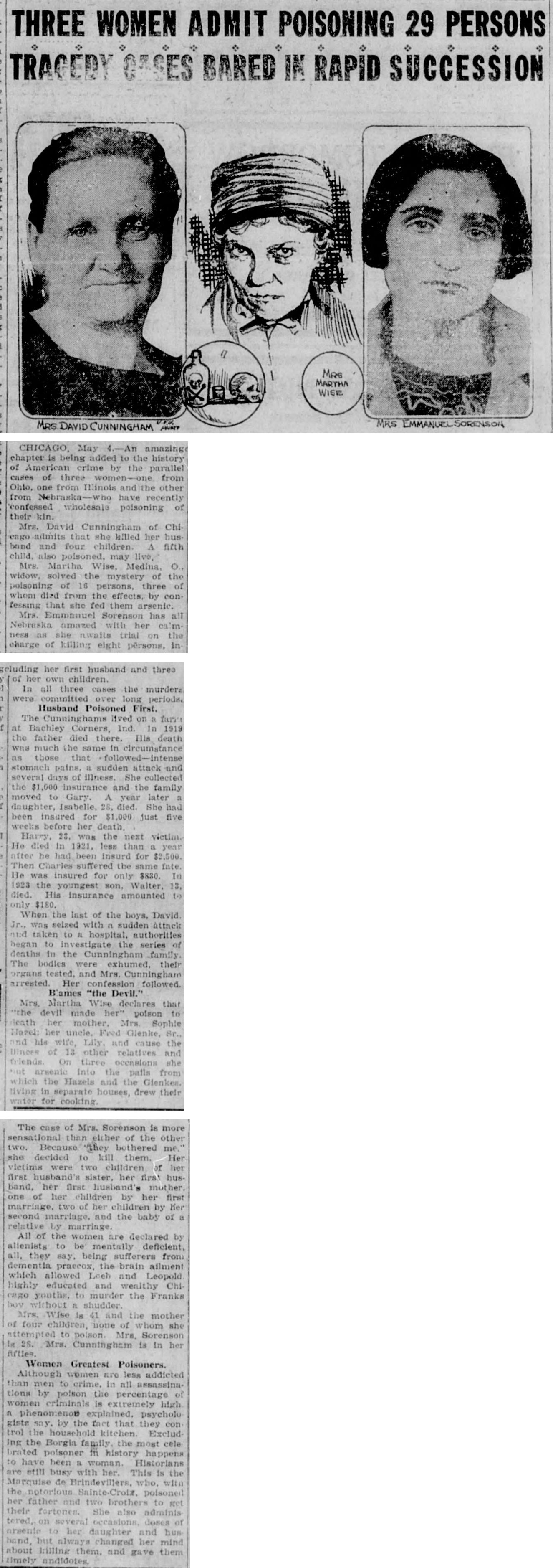
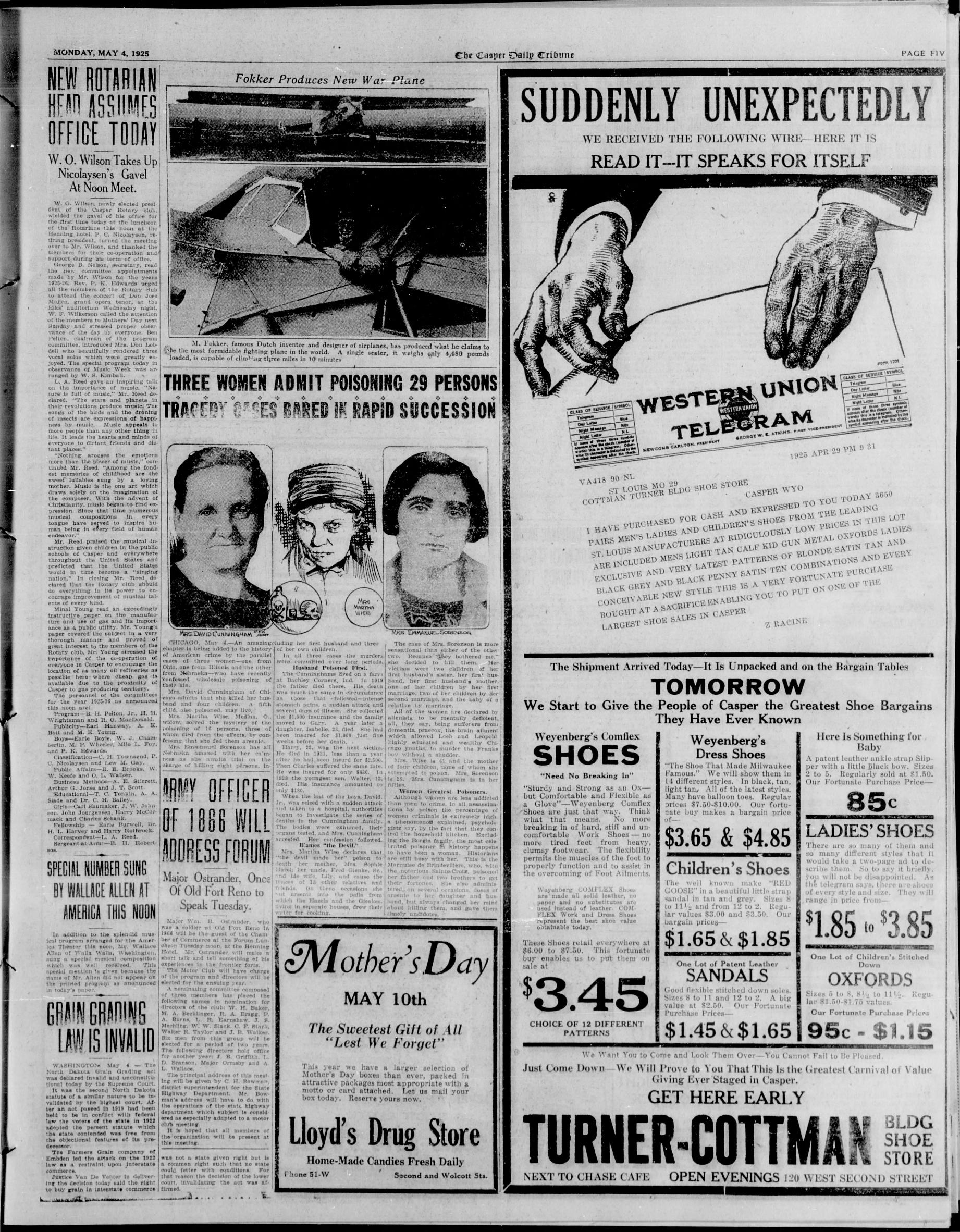
In the spring of 1925 three American women confessed, in what the paper called rapid succession, to poisoning members of their own families, and a wire writer in Chicago folded all three into a single story. The Casper Daily Tribune in Wyoming ran it on May 4 under a banner across three columns, "THREE WOMEN ADMIT POISONING 29 PERSONS," with a portrait of each woman above the text. The one on the right was Della Sorenson of Nebraska, printed as Mrs. Emmanuel Sorenson, and the paper judged hers the most sensational of the three cases. She was twenty-eight, it said, and she was calmly waiting to be tried for eight deaths.
The paper's list of her dead reads like a family tree. Two children of her first husband's sister. Her first husband, and his mother. One of her children from that marriage and two from her second. And the baby of what the paper calls a relative by marriage. Asked why, she gave the answer that runs through every account of the case, and the Tribune prints it: "they bothered me." The children had names. Viola Cooper was the infant daughter of her husband's sister, and a little boy named Clifford was another of that sister's babies. Minnie was her own daughter by her first husband. Delia, her daughter by Emmanuel Sorenson, died on her first birthday, and Ruth Brock was the baby of a woman who had brought her to visit.
Around her the writer set the other two. Mrs. David Cunningham, whose husband and four children had died one after another at Bachley Corners, Indiana, and in Gary, each death with an insurance policy behind it, was said to have confessed once the bodies were exhumed. Mrs. Martha Wise of Medina, Ohio, was said to have put arsenic in her relatives' water pails and blamed the devil; her mother, Sophie Hazel, and her uncle and aunt, Fred and Lily Glenke, died. Alienists, the paper reports, called all three women sufferers from dementia praecox, and it closes on a theory of its own: women poison because they control the household kitchen.
This is a wire feature written in Chicago, not local reporting from Nebraska and not a court record, and its account of Sorenson rests on her confession as the press relayed it that spring. She never stood trial. Doctors found her insane, she was committed to the Hastings State Hospital, and she died there on June 24, 1941, and none of the eight deaths was tested in court. The paper gives her three of her own children as victims; later accounts name two, Minnie and Delia, and say a third is sometimes mentioned. Ruth Brock's mother, the paper's "relative by marriage," appears in those accounts as a friend, Christina Brock. The headline's twenty-nine counts the poisoned, survivors included, not the dead.
Because the Casper Daily Tribune for May 4, 1925, is more than ninety-five years old, the whole issue sits within the Library of Congress statement that such newspapers are in the public domain. The three portraits are period newspaper likenesses, and Mrs. Wise's is a drawing, not a photograph. The scan is the Library's copy from Chronicling America, and its citation and rights statement follow it.
The banner and the body type read cleanly, but the second deck, "TRAGEDY CASES BARED IN RAPID SUCCESSION," was badly inked on the page and its letters are blurred; it is given in full as it can be read, and nothing in the article is marked illegible. The paper's misprints stand: "insurd" for insured, "fortones" and "andidotes," and "Brindevilliers" for the Marquise de Brinvilliers, along with its order "Loeb and Leopold." The captions under the three portraits are not part of the transcription.
Transcription
Transcribed word for word from the page scan. Original spelling, punctuation, capitalisation and typographical errors have been kept exactly as printed. Unreadable words are marked [illegible]. Nothing has been modernised or corrected.
THREE WOMEN ADMIT POISONING 29 PERSONS
TRAGEDY CASES BARED IN RAPID SUCCESSION
CHICAGO, May 4.—An amazing chapter is being added to the history of American crime by the parallel cases of three women—one from Ohio, one from Illinois and the other from Nebraska—who have recently confessed wholesale poisoning of their kin.
Mrs. David Cunningham of Chicago admits that she killed her husband and four children. A fifth child, also poisoned, may live.
Mrs. Martha Wise, Medina, O., widow, solved the mystery of the poisoning of 16 persons, three of whom died from the effects, by confessing that she fed them arsenic.
Mrs. Emmanuel Sorenson has all Nebraska amazed with her calmness as she awaits trial on the charge of killing eight persons, including her first husband and three of her own children.
In all three cases the murders were committed over long periods.
Husband Poisoned First.
The Cunninghams lived on a farm at Bachley Corners, Ind. In 1919 the father died there. His death was much the same in circumstance as those that followed—intense stomach pains, a sudden attack and several days of illness. She collected the $1,000 insurance and the family moved to Gary. A year later a daughter, Isabelle, 28, died. She had been insured for $1,000 just five weeks before her death.
Harry, 23, was the next victim. He died in 1921, less than a year after he had been insurd for $2,500. Then Charles suffered the same fate. He was insured for only $830. In 1923 the youngest son, Walter, 13, died. His insurance amounted to only $180.
When the last of the boys, David, Jr., was seized with a sudden attack and taken to a hospital, authorities began to investigate the series of deaths in the Cunningham family. The bodies were exhumed, their organs tested, and Mrs. Cunningham arrested. Her confession followed.
Blames "the Devil."
Mrs. Martha Wise declares that "the devil made her" poison to death her mother, Mrs. Sophie Hazel; her uncle, Fred Glenke, Sr., and his wife, Lily, and cause the illness of 13 other relatives and friends. On three occasions she put arsenic into the pails from which the Hazels and the Glenkes, living in separate houses, drew their water for cooking.
The case of Mrs. Sorenson is more sensational than either of the other two. Because "they bothered me," she decided to kill them. Her victims were two children of her first husband's sister, her first husband, her first husband's mother, one of her children by her first marriage, two of her children by her second marriage, and the baby of a relative by marriage.
All of the women are declared by alienists to be mentally deficient, all, they say, being sufferers from dementia praecox, the brain ailment which allowed Loeb and Leopold, highly educated and wealthy Chicago youths, to murder the Franks boy without a shudder.
Mrs. Wise is 41 and the mother of four children, none of whom she attempted to poison. Mrs. Sorenson is 28. Mrs. Cunningham is in her fifties.
Women Greatest Poisoners.
Although women are less addicted than men to crime, in all assassinations by poison the percentage of women criminals is extremely high, a phenomenon explained, psychologists say, by the fact that they control the household kitchen. Excluding the Borgia family, the most celebrated poisoner in history happens to have been a woman. Historians are still busy with her. This is the Marquise de Brindevilliers, who, with the notorious Sainte-Croix, poisoned her father and two brothers to get their fortones. She also administered, on several occasions, doses of arsenic to her daughter and husband, but always changed her mind about killing them, and gave them timely andidotes.