THE KANSAS HORROR: THE DONALDSONVILLE CHIEF, JUNE 7, 1873
Dr. William York left Fort Scott, Kansas, in March 1873 on a valuable horse, meaning to find out what lay behind a half-burned wagon he had recognized as one he once sold, and he never reached home. By the time The Donaldsonville Chief reprinted this account in Louisiana on June 7, his body had been dug out of a plowed field beside an abandoned house in Labette County, eight more dead had come out of the ground there, and the four people who had lived in the house, known now as the Bloody Benders, were gone. The paper took the story from the Chicago Post of May 12 and called it "The Kansas Horror."
The Post tells it as a chase. York's brother, the state senator, rode back over the road with another brother and a party of men and traced the doctor as far as Drum Creek, where every sign of him ran out. The governor offered $500 for each person concerned. Then the doctor's brother Edward found him stripped and face down in a grave ten rods from the house, his skull broken in a way a shoe hammer found indoors seemed to fit. The paper prints in full the advertisement in which "Prof. Miss Katie Bender" promised to cure blindness, fits and deafness, and adds one dry line: "Her mode of cure is now found to have been effectual."
Then it names the dead it could, mostly by initials: B. F. McKenzie, D. Brown, John Geary, and "H. Longchor and child eighteen months old." That man was George Newton Longcor, a Civil War veteran who had buried his wife and son and set out with his baby daughter, Mary Ann, to go home to his parents in Iowa. After the names the story turns on the crowd. A man called Brockman, thought to know something, was hanged from a beam three times and cut down three times, and finally staggered off into the dark without a word. The last dispatch, from Parsons on May 12, counts three more graves and more than three thousand onlookers.
This is a Louisiana reprint of a Chicago report and two wire dispatches, all written within days of the discovery, and much of the detail is wrong. The bodies were not found under the house; searchers lifted the cabin, found nothing beneath it, and dug the graves out of the garden and orchard. The family had lived there two or three years, not ten. The dead are better known as Henry McKenzie, Ben Brown, John Greary, W. F. McCrotty (the paper's McCarthy) and George Newton Longcor, and the senator was Colonel Alexander M. York. No Bender was ever caught, charged or tried, the relationships among the four were never documented, and the belief that the little girl was buried alive was never proved.
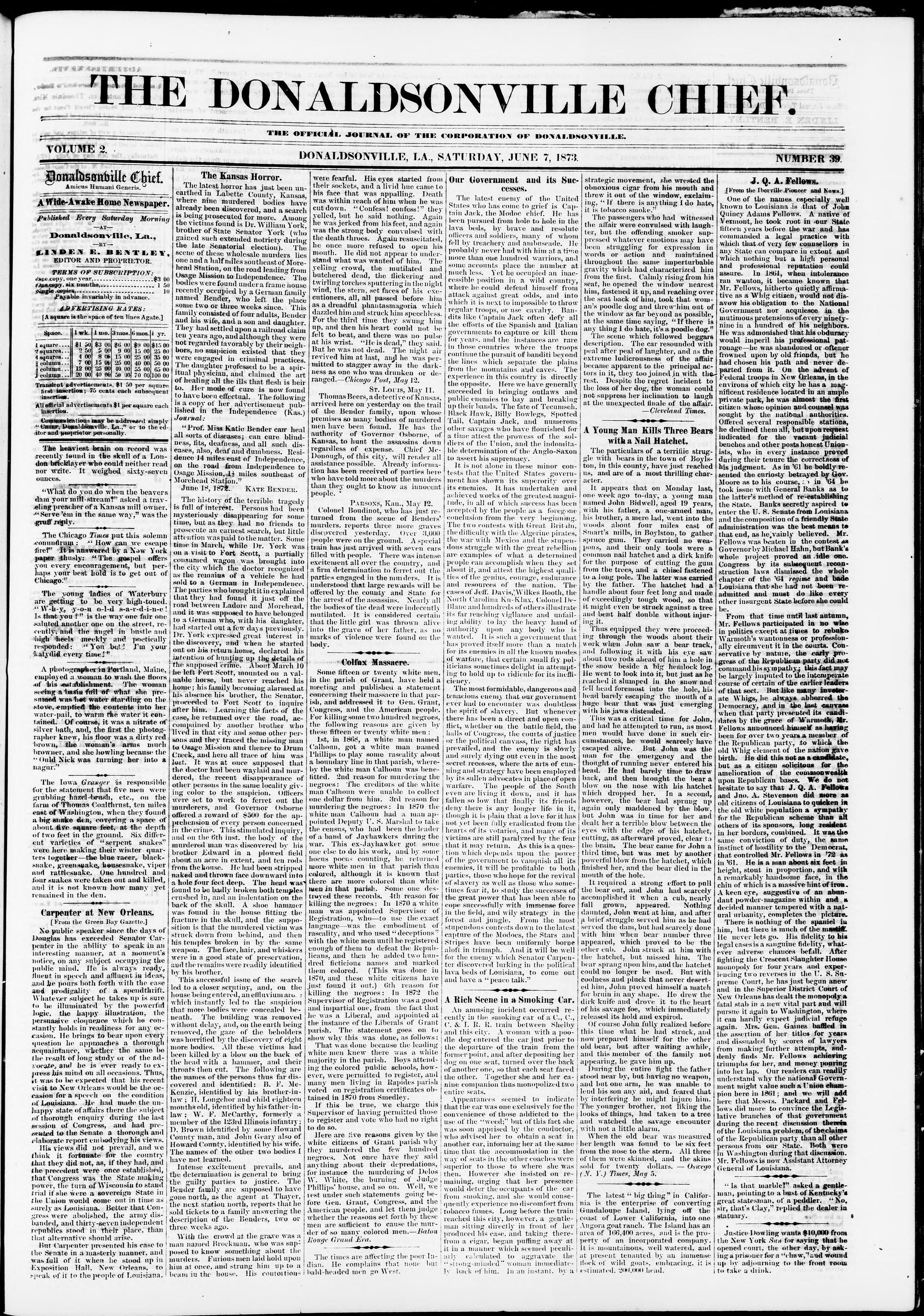
The Donaldsonville Chief printed this on June 7, 1873, and the page, Chicago reprint and wire dispatches together, has long been in the public domain with no restriction of any kind. What appears here is the Library of Congress scan from Chronicling America; look under it for the citation and the Library's rights statement.
Large, clean type let every word be read, and nothing is marked [illegible]. The paper's spellings stand as set, among them "notriety," "accompained," "Osborne" for Governor Thomas A. Osborn, "Longchor" for Longcor and the apostrophe in "Benders' murders." The two newspaper names the paper set in italics, the Journal and the Chicago Post credit, are marked with asterisks. All three parts are transcribed in the order printed, and the item ends at an ornamental rule above an unrelated piece on the Colfax Massacre.
Transcription
Transcribed word for word from the page scan. Original spelling, punctuation, capitalisation and typographical errors have been kept exactly as printed. Unreadable words are marked [illegible]. Nothing has been modernised or corrected.
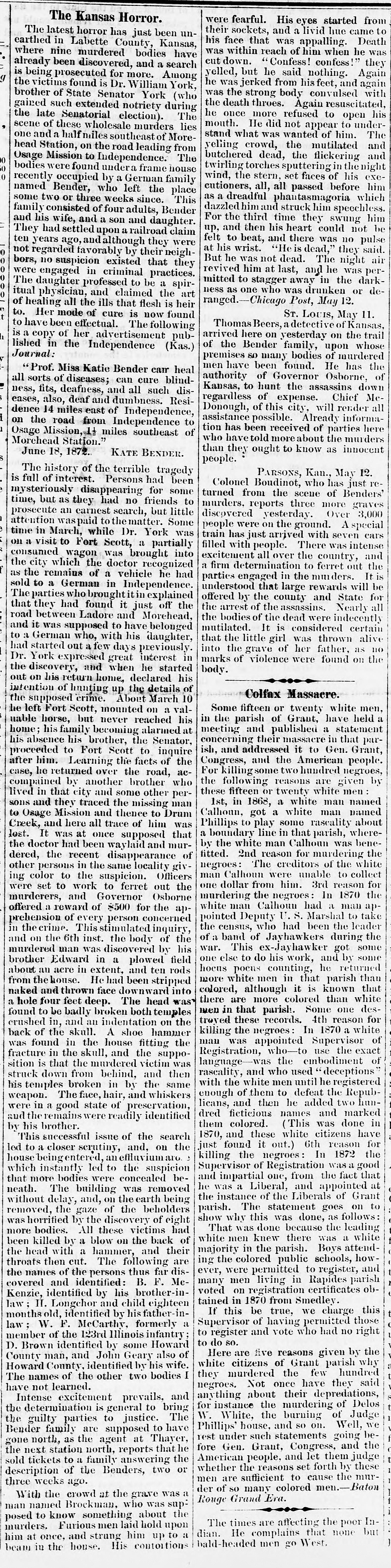
The Kansas Horror.
The latest horror has just been unearthed in Labette County, Kansas, where nine murdered bodies have already been discovered, and a search is being prosecuted for more. Among the victims found is Dr. William York, brother of State Senator York (who gained such extended notriety during the late Senatorial election). The scene of these wholesale murders lies one and a half miles southeast of Morehead Station, on the road leading from Osage Mission to Independence. The bodies were found under a frame house recently occupied by a German family named Bender, who left the place some two or three weeks since. This family consisted of four adults, Bender and his wife, and a son and daughter. They had settled upon a railroad claim ten years ago, and although they were not regarded favorably by their neighbors, no suspicion existed that they were engaged in criminal practices. The daughter professed to be a spiritual physician, and claimed the art of healing all the ills that flesh is heir to. Her mode of cure is now found to have been effectual. The following is a copy of her advertisement published in the Independence (Kas.) *Journal*:
"Prof. Miss Katie Bender can heal all sorts of diseases; can cure blindness, fits, deafness, and all such diseases, also, deaf and dumbness. Residence 14 miles east of Independence, on the road from Independence to Osage Mission, 1½ miles southeast of Morehead Station."
June 18, 1872. KATE BENDER.
The history of the terrible tragedy is full of interest. Persons had been mysteriously disappearing for some time, but as they had no friends to prosecute an earnest search, but little attention was paid to the matter. Some time in March, while Dr. York was on a visit to Fort Scott, a partially consumed wagon was brought into the city which the doctor recognized as the remains of a vehicle he had sold to a German in Independence. The parties who brought it in explained that they had found it just off the road between Ladore and Morehead, and it was supposed to have belonged to a German who, with his daughter, had started out a few days previously. Dr. York expressed great interest in the discovery, and when he started out on his return home, declared his intention of hunting up the details of the supposed crime. About March 10 he left Fort Scott, mounted on a valuable horse, but never reached his home; his family becoming alarmed at his absence his brother, the Senator, proceeded to Fort Scott to inquire after him. Learning the facts of the case, he returned over the road, accompained by another brother who lived in that city and some other persons and they traced the missing man to Osage Mission and thence to Drum Creek, and here all trace of him was lost. It was at once supposed that the doctor had been waylaid and murdered, the recent disappearance of other persons in the same locality giving color to the suspicion. Officers were set to work to ferret out the murderers, and Governor Osborne offered a reward of $500 for the apprehension of every person concerned in the crime. This stimulated inquiry, and on the 6th inst. the body of the murdered man was discovered by his brother Edward in a plowed field about an acre in extent, and ten rods from the house. He had been stripped naked and thrown face downward into a hole four feet deep. The head was found to be badly broken both temples crushed in, and an indentation on the back of the skull. A shoe hammer was found in the house fitting the fracture in the skull, and the supposition is that the murdered victim was struck down from behind, and then his temples broken in by the same weapon. The face, hair, and whiskers were in a good state of preservation, and the remains were readily identified by his brother.
This successful issue of the search led to a closer scrutiny, and, on the house being entered, an effluvium arose which instantly led to the suspicion that more bodies were concealed beneath. The building was removed without delay, and, on the earth being removed, the gaze of the beholders was horrified by the discovery of eight more bodies. All these victims had been killed by a blow on the back of the head with a hammer, and their throats then cut. The following are the names of the persons thus far discovered and identified: B. F. McKenzie, identified by his brother-in-law; H. Longchor and child eighteen months old, identified by his father-in-law; W. F. McCarthy, formerly a member of the 123rd Illinois infantry; D. Brown identified by some Howard County man, and John Geary also of Howard County, identified by his wife. The names of the other two bodies I have not learned.
Intense excitement prevails, and the determination is general to bring the guilty parties to justice. The Bender family are supposed to have gone north, as the agent at Thayer, the next station north, reports that he sold tickets to a family answering the description of the Benders, two or three weeks ago.
With the crowd at the grave was a man named Brockman, who was supposed to know something about the murders. Furious men laid hold upon him at once, and strung him up to a beam in the house. His contortions were fearful. His eyes started from their sockets, and a livid hue came to his face that was appalling. Death was within reach of him when he was cut down. "Confess! confess!" they yelled, but he said nothing. Again he was jerked from his feet, and again was the strong body convulsed with the death throes. Again resuscitated, he once more refused to open his mouth. He did not appear to understand what was wanted of him. The yelling crowd, the mutilated and butchered dead, the flickering and twirling torches sputtering in the night wind, the stern, set faces of his executioners, all, all passed before him as a dreadful phantasmagoria which dazzled him and struck him speechless. For the third time they swung him up, and then his heart could not be felt to beat, and there was no pulse at his wrist. "He is dead," they said. But he was not dead. The night air revived him at last, and he was permitted to stagger away in the darkness as one who was drunken or deranged.—*Chicago Post, May 12.*
ST. LOUIS, May 11.
Thomas Beers, a detective of Kansas, arrived here on yesterday on the trail of the Bender family, upon whose premises so many bodies of murdered men have been found. He has the authority of Governor Osborne, of Kansas, to hunt the assassins down regardless of expense. Chief McDonough, of this city, will render all assistance possible. Already information has been received of parties here who have told more about the murders than they ought to know as innocent people.
PARSONS, Kan., May 12.
Colonel Boudinot, who has just returned from the scene of Benders' murders, reports three more graves discovered yesterday. Over 3,000 people were on the ground. A special train has just arrived with seven cars filled with people. There was intense excitement all over the country, and a firm determination to ferret out the parties engaged in the murders. It is understood that large rewards will be offered by the county and State for the arrest of the assassins. Nearly all the bodies of the dead were indecently mutilated. It is considered certain that the little girl was thrown alive into the grave of her father, as no marks of violence were found on the body.
Transcriber's notes
- Readability: very good. Large, clean type throughout, lightly foxed in places. No [illegible] markers were needed.
- Printer's errors kept as printed: "notriety" for notoriety; "accompained" for accompanied; "favorably"; "plowed"; "Osborne" for Osborn (the Kansas governor was Thomas A. Osborn); "Longchor" (usually given as Longcor or Longcher); "123rd Illinois infantry"; and "Benders' murders" with the apostrophe as set.
- The paper sets the Kate Bender advertisement in quotation marks with her signature and the date beneath, and credits the long narrative to the *Chicago Post* of 12 May. Two further wire dispatches, datelined St. Louis 11 May and Parsons, Kansas 12 May, are printed below it under the same heading; all three are transcribed above in the order printed.
- Italics in the original (the newspaper titles *Journal* and *Chicago Post, May 12.*) are marked with asterisks here; everything else is roman as printed.
- The piece runs from the foot of column 2 into column 3 and ends at an ornamental rule, below which a separate article headed "Colfax Massacre." begins. That article is visible at the foot of the crop and is not part of this item.