THE DERBY POISONER: THE WHEELING DAILY REGISTER, JANUARY 16, 1873
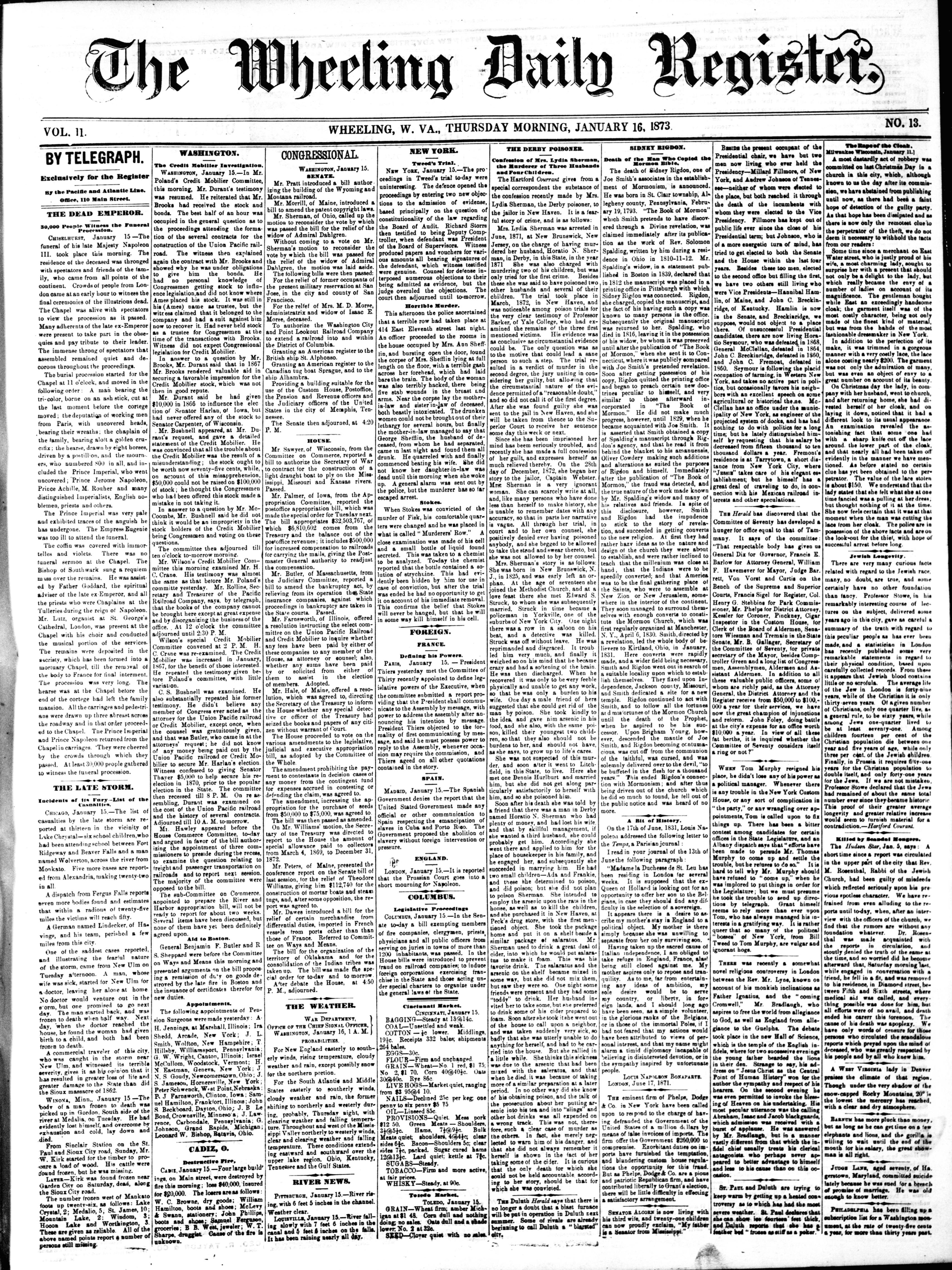
Through the whole of her trial Lydia Sherman swore she had never poisoned anybody, and begged to be allowed into the witness box to say so. Then, convicted and waiting in the New Haven jail to be sentenced, she began to talk. On December 28, 1872, she started telling the jailer, Captain Webster, the story of her life, and less than three weeks later The Wheeling Daily Register in West Virginia put the substance of it on its front page, taken from a special correspondent of the Hartford Courant. The headline called her the murderer of three husbands and four children, and the confession, as the paper sets it out, explains how.
It is a flat and terrible account. Her first husband, Edward Struck, a Yorkville policeman disgraced after a killing on his beat, had become too feeble to work, and when a male friend suggested poison, the paper says, "She took kindly to the idea." Arsenic went into his food, and into the food of their two youngest children, so that they would not be burdens and would not have, as she put it, "to grow up to life's cares." Dennis Hurlburt followed, because she did not get along with him. Then a friend told her of a widower at Derby, Horatio N. Sherman, who had money and might be won by a housekeeper who managed things well.
She took the place and then the man, and she poisoned his two small children, Ada and Frankie, on purpose. Sherman himself, she insisted, was an accident. He liked his cider foamed up with saleratus, and the arsenic she had bought at Peck's drug store in New Haven, for the rats and for the children, sat on the shelf beside the saleratus until the two got mixed. She saw it and said nothing. She had once drunk his cider herself and had to be carried into the house, sick. The correspondent ends on the irony: by her own story Sherman's was the one death she could not be blamed for, and it was the one she was convicted of.
What the paper prints is a summary of a confession, passed from the jail to a Hartford correspondent and on to Wheeling, not her words taken down, and it parts company with the record of her life in places. It has her born in New Brunswick in 1825; she was born Lydia Danbury in Burlington, New Jersey, on December 24, 1824. It dates the trial to March 1872; it opened on April 16. Other accounts of the confession attach the saleratus-in-the-cider story to Dennis Hurlburt, whose poisoning she denied, not to Sherman. Her one conviction was for Horatio Sherman's murder, in the second degree. Exhumations confirmed the Connecticut deaths; the New York deaths rest on her word alone.
Printed on January 16, 1873, this issue of The Wheeling Daily Register is in the public domain, and no restriction of any kind applies to it. The scan reproduced here is the Library of Congress copy, held in its Chronicling America collection, and the full citation and the Library's rights statement are set out beneath it.
The type is heavy and clean, and every word of the transcription was read straight from the scan without a single illegible mark. The compositor's slips stay where he left them: "Courrant" for the Courant, "beem" for been, the missing period after "in the year 1871," and "jailor" for the jailer. Hurlburt keeps the paper's spelling; the name is more often given as Hurlbut. The story ends at an ornamental rule, and nothing below it belongs to the case.

Transcription
Transcribed word for word from the page scan. Original spelling, punctuation, capitalisation and typographical errors have been kept exactly as printed. Unreadable words are marked [illegible]. Nothing has been modernised or corrected.
THE DERBY POISONER.
Confession of Mrs. Lydia Sherman, the Murderer of Three Husbands and Four Children.
The Hartford *Courrant* gives from a special correspondent the substance of the confession recently made by Mrs. Lydia Sherman, the Derby poisoner, to the jailor in New Haven. It is a fearful story of crime, and is as follows:
Mrs. Lydia Sherman was arrested in June, 1871, at New Brunswick, New Jersey, on the charge of having murdered her husband, Horatio N. Sherman, in Derby, in this State, in the year 1871 She was also charged with murdering two of his children, but was only tried for the first crime. Besides these she was said to have poisoned two other husbands and several of their children. The trial took place in March, 1872, in New Haven, and was noticeable among poison trials for the very clear testimony of Professor Barker, of Yale College, who had examined the remains of the three first mentioned victims. His evidence was as conclusive as circumstantial evidence could be. The only question was as to the motive that could lead a sane person to such a step. The trial resulted in a verdict of murder in the second degree, the jury uniting in considering her guilty, but allowing that the circumstantial nature of the evidence permitted of a "reasonable doubt," and so did not call it of the first degree. After she was found guilty she was sent to the jail in New Haven, and she will be taken from thence to the Superior Court to receive her sentence some day this week or next.
Since she has been imprisoned her mind has beem seriously troubled, and recently she has made a full confession of her guilt, and expresses herself as much relieved thereby. On the 28th day of December, 1872, she began her story to the jailor, Captain Webster. Mrs. Sherman is a very ignorant woman. She can scarcely write at all, and, like many persons who have done less than herself to make history, she is unable to remember dates with any accuracy, so that in parts her narrative is vague. All through her trial, in court and to her own counsel, she positively denied ever having poisoned anybody, and she begged to be allowed to take the stand and swear thereto, but she was not allowed to by her counsel.
Mrs. Sherman's story is as follows: She was born in New Brunswick, N. J., in 1825, and was early left an orphan. At the age of seventeen she joined the Methodist Church, and at a love feast there she met Edward S. Struck, to whom she was subsequently married. Struck in time became a policeman in Yorkville, one of the suburbs of New York City. One night there was a row in a saloon on his beat, and a detective was killed. Struck was off without leave. He was reprimanded and disgraced. It troubled him very much, and finally it weighed so on his mind that he became crazy and had a softening of the brain. He was then discharged. When he recovered it was only to be very feeble physically and unable to get any work, so that he was only a burden to his wife. One day a male friend of hers suggested that she could get rid of the man by poison. She took kindly to the idea, and gave him arsenic in his food, and she also, with the same poison, killed their youngest two children, so that they also should not be burdens to her, and should not have, as she says, to grow up to life's cares.
She was not suspected of this murder, and soon after it went to Litchfield, in this State, to live. Here she met one Dennis Hurlburt and married him, but she did not get along particularly satisfactorily to herself with him, and so she poisoned him.
Soon after his death she was told by a friend that there was a man in Derby named Horatio N. Sherman who had plenty of money, and had lost his wife, and that by skillful management, if she wanted a third husband, she could probably get him. Accordingly she went there and applied to him for the place of housekeeper in his family, and he engaged her, and subsequently she succeeded in marrying him. He had two small children—Ada and Frankie, and these she determined to poison, and did poison; but she did not plan to poison Sherman. She intended to employ the arsenic upon the rats in the house, as well as to kill the children, and she purchased it in New Haven, at Peck's drug store, with the first mentioned object. She took the package home and put it on a shelf beside a similar package of saleratus. Mr. Sherman used to drink a great deal of cider, into which he would put saleratus to make it foam. This was his favorite drink. The saleratus and the arsenic on the shelf became mixed in some way, but she did not mix them, but saw they were so. One night some friends were present and they had some "toddy" to drink. Her husband invited her to take some, but she preferred to drink some of his cider prepared to foam. Soon after she took it she went out of the house to call upon a neighbor, and was taken suddenly very sick, so badly that she was utterly unable to do anything for herself, and had to be carried into the house. But she rallied in a little while. She thinks this sickness was due to the arsenic that had been mixed with the saleratus, and that when he died it was because of taking more of a similar preparation at a later period. In no other way did she know of his obtaining poison, and the talk of the prosecution about her putting arsenic into his tea and into "slings" and other hot drinks was all expended on a wrong track. This was not, therefore, such a clear case of murder as the others. In fact, she merely neglected to warn him of his danger, and that she did not always remember it herself is shown in the fact of her taking some of the cider. It is curious that the only death for which she could not be held accountable according to her story, should be that for which she was convicted.
Transcriber's notes
- Readability: very good. Heavy, clean type throughout. No [illegible] markers were needed.
- Printer's errors kept as printed: "Courrant" for Courant (set in italics, marked with asterisks here); "beem" for been; the missing full point after "in the year 1871"; "jailor"; "skillful"; "favorite"; "saleratus" spelled "salaratus" in one place and "saleratus" in another (both as printed); "Hurlburt" (usually Hurlbut).
- The confession was made to the jailer, Captain Webster, beginning 28 December 1872, and reached this paper by way of the Hartford Courant. The article is the newspaper's summary of that confession, not a verbatim transcript of it, and says so in its opening sentence.
- The last sentence is the correspondent's own observation, not Sherman's.
- This piece and the Mary Ann Cotton execution report in this same batch (The Republican journal, 10 April 1873) were printed within three months of each other, and the Cotton article explicitly compares the two women.
- The article ends at an ornamental rule; what follows below it is unrelated.