SUSPECT FREE IN SLAYING: THE SALT LAKE TRIBUNE, JANUARY 4, 1979
For two days at the start of 1979, the police in Jackson, Michigan, held the man a jury would later convict, twice, and could not keep him. Three railroad men had been shot down on New Year's Eve at the Jackson terminal, about a hundred feet from a waiting room full of travelers, and the man picked up for it was Rudy Bladel, forty-six, a former engineer from Elkhart, Indiana. On Wednesday the prosecutor, Edward J. Grant, let him go. The Associated Press story printed in The Salt Lake Tribune on January 4 gives the reason in a sentence: there were no witnesses, and there was no gun.
The dead were Robert Lee Blake, forty-two, a flagman; William Gulak, fifty, a conductor; and Charles Lee Burton, thirty-two, a fireman. The paper names none of them. What it does supply is the reason Bladel's name came up so fast. He had only lately come out of prison for shooting a railroad employee in March 1971, and an Elkhart detective, David Kech, tied him to an old wound: the day the railroad closed its yard at Niles, Michigan, and moved its engineers to Elkhart. The weapon the police could not find was a 12-gauge shotgun loaded with deer slugs.
It was out there, in pieces. Bladel had taken the gun apart after the shootings and hidden it under bushes at Cascade Falls, and it stayed there about three months while divers searched the Grand River and helicopters scanned the rooftops. When it was finally found, the ejector marks on the spent shells matched, and the serial number led straight back to him. He was arrested again on March 22, 1979, and this time he did not walk out. The story catches the case at its lowest point, the day the only suspect went home.
This is a short wire report written while the case was three days old, not a court record, and some of its background is off. It says Bladel had just finished a 4½-year Indiana term for the 1971 shooting; his Indiana sentence was one to five years and he was out in eighteen months, and the term he finished in November 1978 was a federal one, served at Sandstone, Minnesota, for owning a .357 Magnum as a convicted felon. The detective places the Niles closing in 1971, while the railroad's move from Niles to Elkhart dates to 1959. Bladel was convicted of the three Jackson murders, and convicted again at a retrial held without his confession; the older railroad shootings laid to him were never tried as murders.
The story ran without a staff byline, credited to the Associated Press, on page A3 of The Salt Lake Tribune for January 4, 1979. The scan comes from Utah Digital Newspapers at the University of Utah's J. Willard Marriott Library, which rates this issue "In Copyright." Published after 1977, the paper was protected from the moment it was printed, whether or not it carried a notice, and no copyright notice was found on the article or the masthead. The citation and the library's rights rating are printed under the scan.
The column was transcribed exactly as printed, and every word could be read, though the scan is grainy and "witnesses" and "found" in the fourth paragraph have broken letters. The detective's quotation, which opens at "the railroad closed down," never closes in print, and it stays open here. The paper spells his name "Kech," and that spelling is kept. Several lines are letter-spaced. The whole story sits in one crop, with no jump to another page.

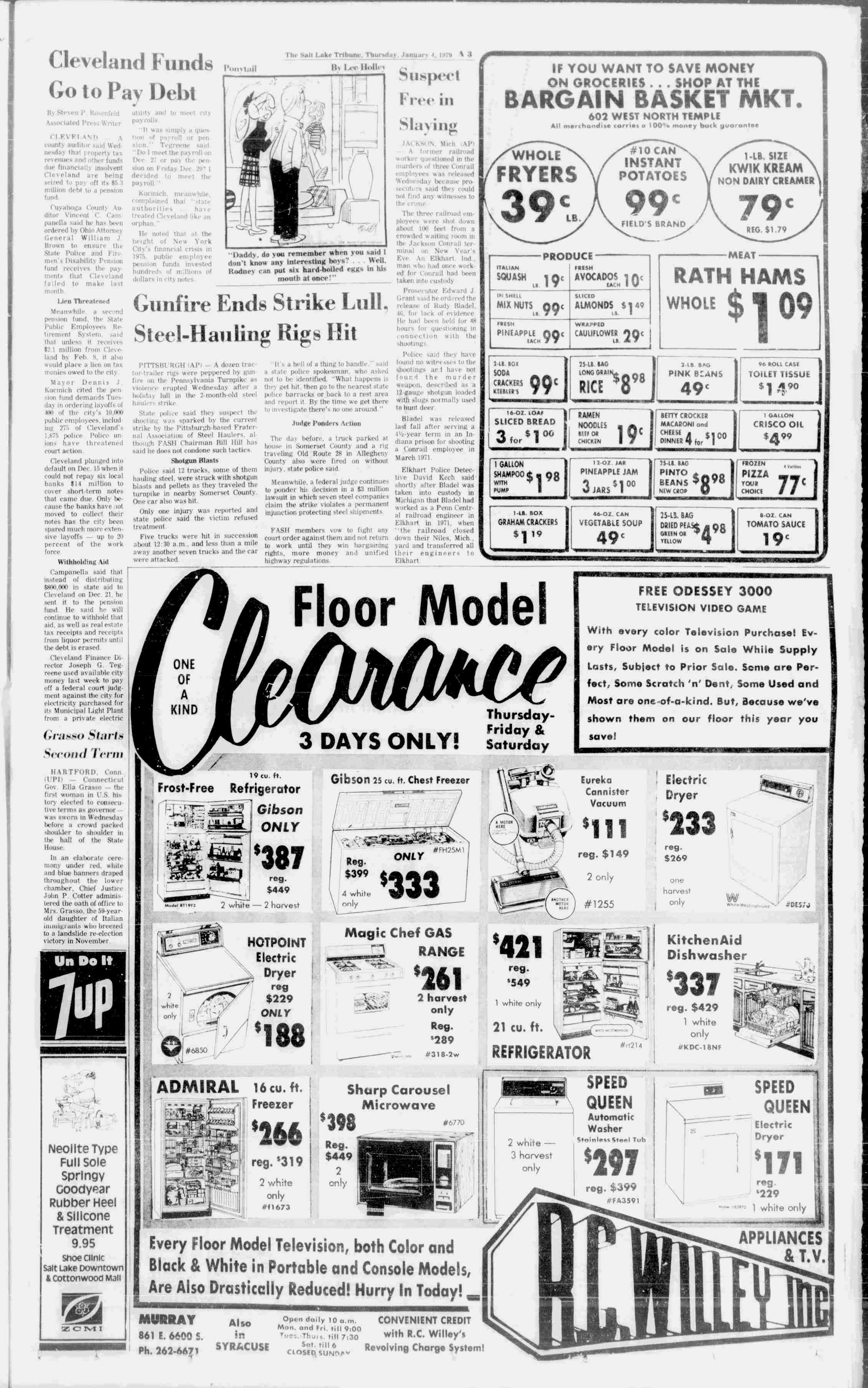
Transcription
Transcribed word for word from the page scan. Original spelling, punctuation, capitalisation and typographical errors have been kept exactly as printed. Unreadable words are marked [illegible]. Nothing has been modernised or corrected.
Suspect Free in Slaying
JACKSON, Mich. (AP) — A former railroad worker questioned in the murders of three Conrail employees was released Wednesday because prosecutors said they could not find any witnesses to the crime.
The three railroad employees were shot down about 100 feet from a crowded waiting room in the Jackson Conrail terminal on New Year's Eve. An Elkhart, Ind., man who had once worked for Conrail had been taken into custody.
Prosecutor Edward J. Grant said he ordered the release of Rudy Bladel, 46, for lack of evidence. He had been held for 48 hours for questioning in connection with the shootings.
Police said they have found no witnesses to the shootings and have not found the murder weapon, described as a 12-gauge shotgun loaded with slugs normally used to hunt deer.
Bladel was released last fall after serving a 4½-year term in an Indiana prison for shooting a Conrail employee in March 1971.
Elkhart Police Detective David Kech said shortly after Bladel was taken into custody in Michigan that Bladel had worked as a Penn Central railroad engineer in Elkhart in 1971, when "the railroad closed down their Niles, Mich., yard and transferred all their engineers to Elkhart.
Notes: The quotation that opens at "the railroad closed down" has no closing quotation mark in print; kept as printed. The scan is grainy, and "witnesses" and "found" in the fourth paragraph have broken letters but are readable. Several lines are letter-spaced. The paper wrote "Kech"; kept as printed. Bladel was rearrested in March 1979 and later convicted. This report is from the first, unsuccessful detention. No words were illegible.