SPENCER HANGED: THE TOPEKA STATE JOURNAL, JULY 31, 1914
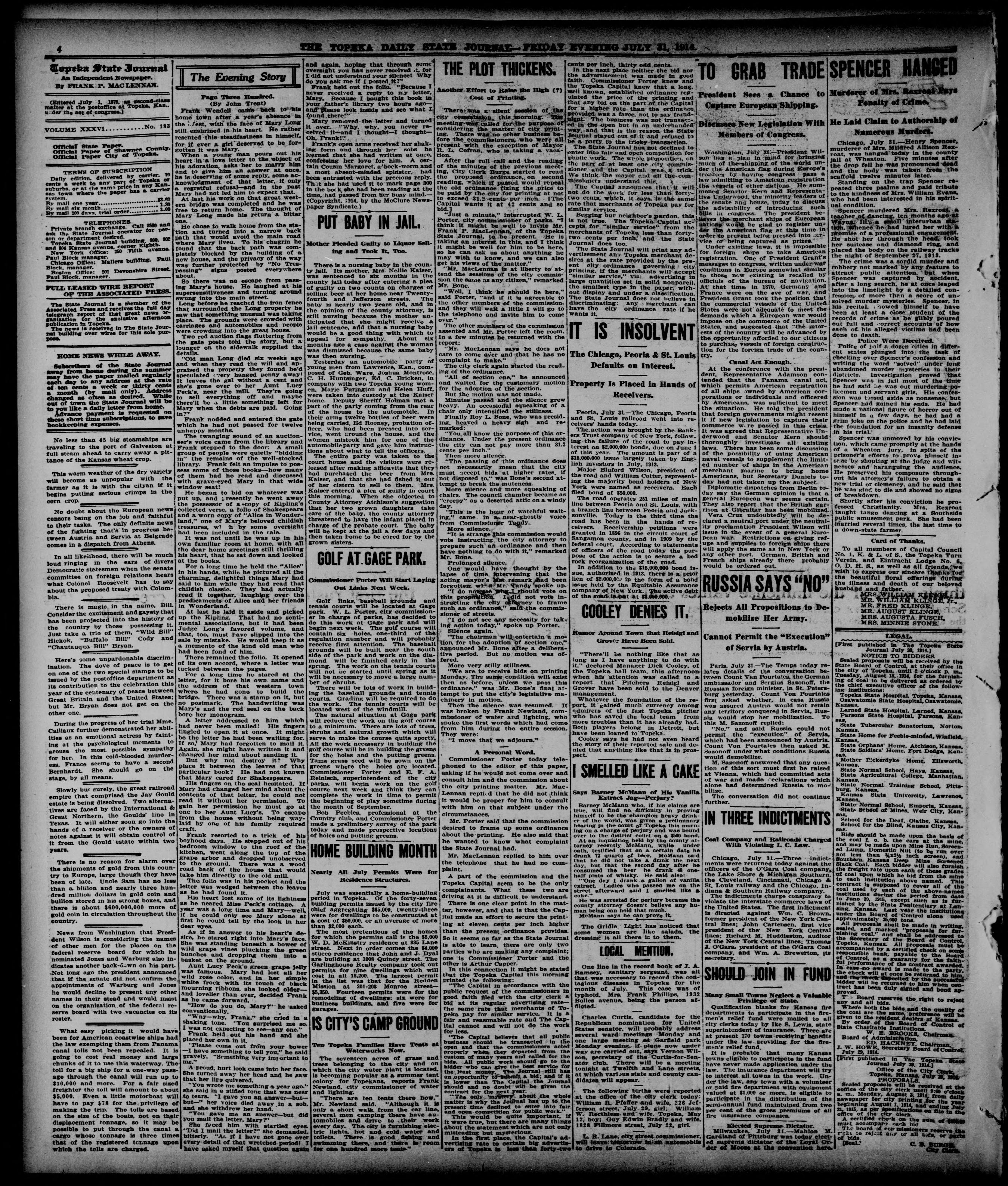
Henry Spencer stood on the trap in the county jail at Wheaton, Illinois, on July 31, 1914, and recited three psalms. He thanked a Mrs. William Evans, who had taken an interest in his spiritual condition. Then the drop fell, and five minutes later, by this account, he was pronounced dead; the body came down from the scaffold twelve minutes after that. The wire report from Chicago ran the same day in The Topeka State Journal under the head "SPENCER HANGED" and two decks, the second of which named the thing that had made him famous: "He Laid Claim to Authorship of Numerous Murders."
The murder he hanged for was far simpler. Mildred Allison Rexroat taught the tango, the dance of the moment, in Chicago, and she was the mother of three sons. Spencer, who had been her pupil for only a few days, told her a club of young men at Wayne wanted lessons. He took her there on the interurban, walked her down the railroad tracks, and shot her through the head. Then he took her suitcase and her diamond ring and laid her body across the rail. Even the Journal calls it "a sordid murder and robbery not marked by any feature to attract public attention."
What made him a national figure came after his arrest. Spencer poured out a detailed confession to more than a score of unsolved killings, and police in half a dozen cities set about writing "solved" under their old cases. Then, the paper says, they found he had been in jail for most of the time he claimed to be out murdering policemen and servant girls. In the Journal's reading he had won anyway: a national reputation for horror, a grim joke on the police, and the groundwork for an insanity defense. The Wheaton jury convicted him regardless, though he shouted at the judge and witnesses. At the end he said he was glad to die.
This is a short wire summary written on the day of the hanging, not a court record, and several of its details part company with the trial evidence. It places the killing on the night of September 27, 1913, but the freight crew found her body on the evening of September 26. It puts her teaching at a South Side amusement park, where the record has her at a dancing academy, and says she had been married several times, where the record names two husbands. Spencer was convicted of one murder, hers, and the Illinois Supreme Court affirmed it in People v. Spencer (1914). None of the killings he claimed was ever charged, and nothing establishes that any of them happened.
The Topeka State Journal of July 31, 1914, was published well over ninety-five years ago and belongs to the public domain, wire copy included. The scan is the Library of Congress copy of page 4 from Chronicling America, and its citation and the Library's rights statement are printed below the scan.
The two decks under the headline are heavily over-inked, but every word of them and of the report below could be read, and nothing is marked illegible. The paper's styling is kept exactly: "Southside" as one word, "tango" in lower case, and the formal "interurban station, whence he had lured her." Where "Rexroat" is broken across two lines in the first sentence, the transcription closes it up as a single word.
Transcription
Transcribed word for word from the page scan. Original spelling, punctuation, capitalisation and typographical errors have been kept exactly as printed. Unreadable words are marked [illegible]. Nothing has been modernised or corrected.
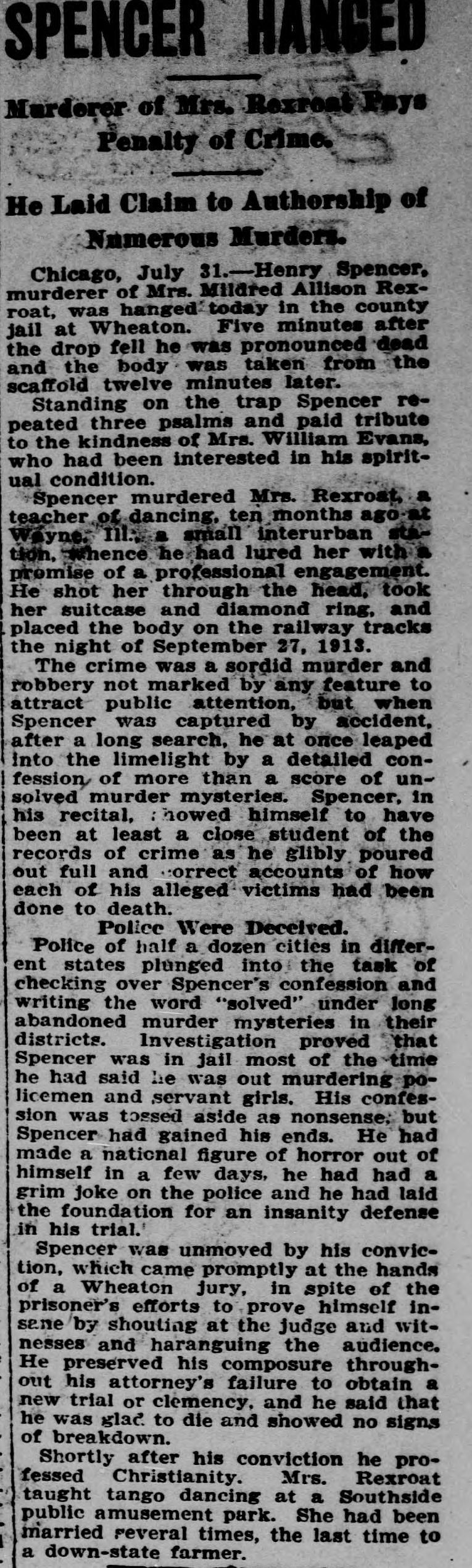
SPENCER HANGED
Murderer of Mrs. Rexroat Pays Penalty of Crime.
He Laid Claim to Authorship of Numerous Murders.
Chicago, July 31.—Henry Spencer, murderer of Mrs. Mildred Allison Rexroat, was hanged today in the county jail at Wheaton. Five minutes after the drop fell he was pronounced dead and the body was taken from the scaffold twelve minutes later.
Standing on the trap Spencer repeated three psalms and paid tribute to the kindness of Mrs. William Evans, who had been interested in his spiritual condition.
Spencer murdered Mrs. Rexroat, a teacher of dancing, ten months ago at Wayne, Ill., a small interurban station, whence he had lured her with a promise of a professional engagement. He shot her through the head, took her suitcase and diamond ring, and placed the body on the railway tracks the night of September 27, 1913.
The crime was a sordid murder and robbery not marked by any feature to attract public attention, but when Spencer was captured by accident, after a long search, he at once leaped into the limelight by a detailed confession of more than a score of unsolved murder mysteries. Spencer, in his recital, showed himself to have been at least a close student of the records of crime as he glibly poured out full and correct accounts of how each of his alleged victims had been done to death.
Police Were Deceived.
Police of half a dozen cities in different states plunged into the task of checking over Spencer's confession and writing the word "solved" under long abandoned murder mysteries in their districts. Investigation proved that Spencer was in jail most of the time he had said he was out murdering policemen and servant girls. His confession was tossed aside as nonsense, but Spencer had gained his ends. He had made a national figure of horror out of himself in a few days, he had had a grim joke on the police and he had laid the foundation for an insanity defense in his trial.
Spencer was unmoved by his conviction, which came promptly at the hands of a Wheaton jury, in spite of the prisoner's efforts to prove himself insane by shouting at the judge and witnesses and haranguing the audience. He preserved his composure throughout his attorney's failure to obtain a new trial or clemency, and he said that he was glad to die and showed no signs of breakdown.
Shortly after his conviction he professed Christianity. Mrs. Rexroat taught tango dancing at a Southside public amusement park. She had been married several times, the last time to a down-state farmer.