SPECK FOUND GUILTY OF 8 MURDERS: THE SUNDAY HERALD, APRIL 16, 1967
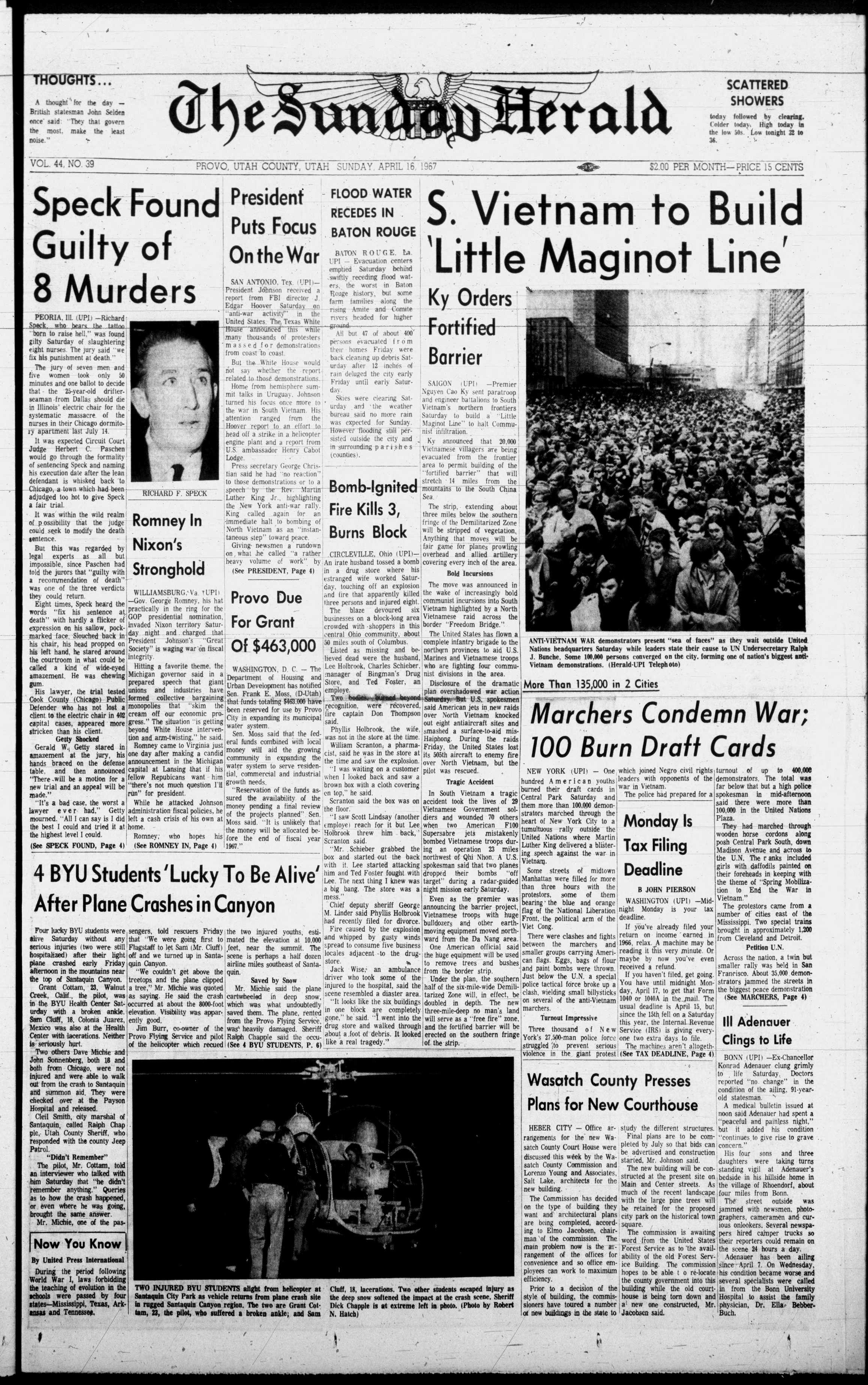
Seven men and five women needed only 50 minutes and a single ballot. On Saturday, April 15, 1967, in Peoria, Illinois, the jury found Richard Speck guilty of murdering eight student nurses in Chicago the previous July and said, "we fix his punishment at death." The United Press International report ran the next morning across the front of The Sunday Herald in Provo, Utah, beside his photograph. The paper calls him a 25-year-old drifter-seaman from Dallas who bore the tattoo "born to raise hell," and it notes that the trial had come to Peoria because Chicago was judged too hot to give him a fair one.
The reporter watched the defendant more than the jury. Eight times Speck heard the death verdict read, and his sallow, pockmarked face hardly moved. He slouched in his chair with his head propped on his left hand, stared around the room, and chewed gum. His lawyer, the Cook County public defender Gerald W. Getty, looked worse. The paper says Getty had never lost a client to the electric chair in 402 capital cases, and now he stood braced against the defense table. "It's a bad case, the worst a lawyer ever had," he said, and promised a motion for a new trial and an appeal.
The continuation on page four leaves the courtroom. Within 35 minutes Speck was in pajamas in his cell in the Peoria County courthouse, and outside the locked courtroom doors people cheered. Two of the women's fathers had come to hear it. One was Joseph Matusek, a Chicago tavern owner, and the column breaks off just as he begins to speak to reporters on the courthouse steps. The dead were Gloria Jean Davy, Patricia Matusek, Nina Jo Schmale, Pamela Wilkening, Suzanne Farris, Mary Ann Jordan, Merlita Gargullo and Valentina Pasion. Corazon Amurao, who lay hidden under a bed for hours that night, had identified him in court.
This wire story was written within hours of the verdict and is not the court's record. It places the killings in a "dormitory apartment"; the women lived together in a townhouse on East 100th Street. The caption gives his name as Richard F. Speck, matching the Illinois Supreme Court's Richard Franklin Speck, though most biographies give his middle name as Benjamin. The death sentences did not stand. The convictions on all eight counts were upheld, but the Supreme Court of the United States, citing Witherspoon v. Illinois, set aside the sentences because jurors with general objections to capital punishment had been excluded, and he was resentenced to 400 to 1,200 years. He died of a heart attack at Silver Cross Hospital in Joliet on December 5, 1991, still serving his sentence.
The story is United Press International wire copy, credited "(UPI)" in the dateline, as printed in The Sunday Herald of Provo, Utah, on April 16, 1967. Both pages come from Utah Digital Newspapers at the University of Utah's J. Willard Marriott Library, which rates this issue "No Copyright - United States (NoC-US)," meaning the library has determined it is free of copyright under United States law. In 1967 a published work needed a copyright notice to keep its copyright, and none appears on the masthead or on this story. The citation and the library's rights statement sit beneath the scans.
Both parts of the story are here, the front-page column and its jump to page four, copied word for word with nothing illegible. The paper's errors are left alone: "found gilty," the unhyphenated "trial tested" public defender who goes unnamed until the next paragraph, and a Getty quotation on page one that never closes. Page four then opens on a line that reads like the end of that quotation, which looks like a make-up slip at the paper, and the jump ends with Matusek about to speak but no words from him. The page-one crop also takes in part of an unrelated story, "Romney In Nixon's Stronghold."
Transcription
Transcribed word for word from the page scans. Original spelling, punctuation, capitalisation and typographical errors have been kept exactly as printed. Unreadable words are marked [illegible]. Nothing has been modernised or corrected.
Page 1
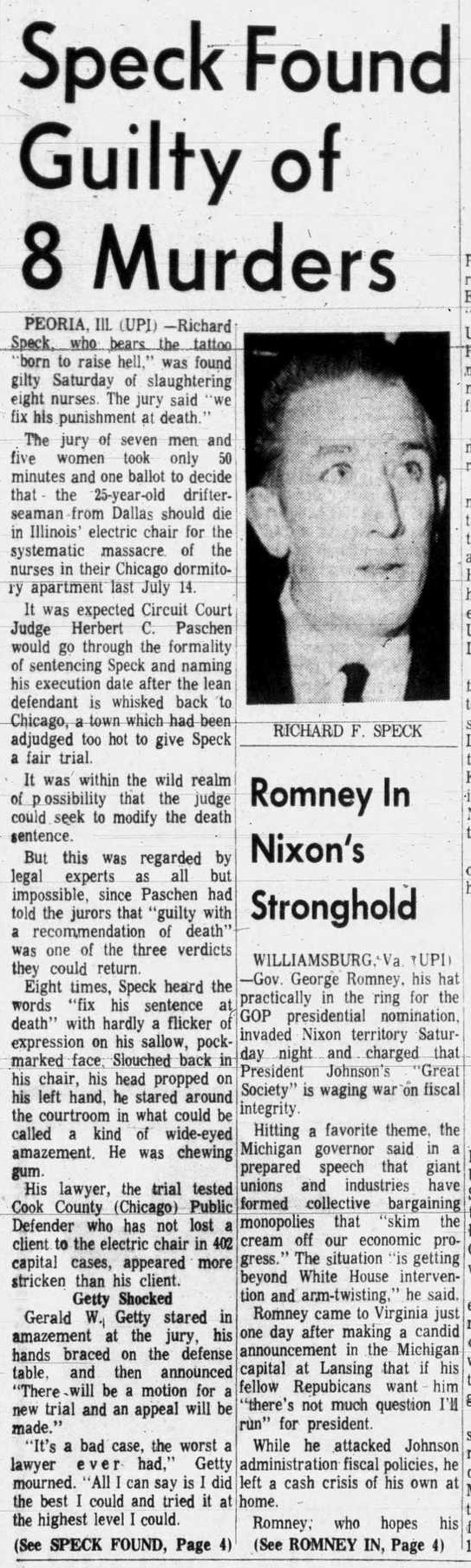
Speck Found Guilty of 8 Murders
PEORIA, Ill. (UPI) —Richard Speck, who bears the tattoo "born to raise hell," was found gilty Saturday of slaughtering eight nurses. The jury said "we fix his punishment at death."
The jury of seven men and five women took only 50 minutes and one ballot to decide that the 25-year-old drifter-seaman from Dallas should die in Illinois' electric chair for the systematic massacre of the nurses in their Chicago dormitory apartment last July 14.
It was expected Circuit Court Judge Herbert C. Paschen would go through the formality of sentencing Speck and naming his execution date after the lean defendant is whisked back to Chicago, a town which had been adjudged too hot to give Speck a fair trial.
It was within the wild realm of possibility that the judge could seek to modify the death sentence.
But this was regarded by legal experts as all but impossible, since Paschen had told the jurors that "guilty with a recommendation of death" was one of the three verdicts they could return.
Eight times, Speck heard the words "fix his sentence at death" with hardly a flicker of expression on his sallow, pockmarked face. Slouched back in his chair, his head propped on his left hand, he stared around the courtroom in what could be called a kind of wide-eyed amazement. He was chewing gum.
His lawyer, the trial tested Cook County (Chicago) Public Defender who has not lost a client to the electric chair in 402 capital cases, appeared more stricken than his client.
Getty Shocked
Gerald W. Getty stared in amazement at the jury, his hands braced on the defense table, and then announced "There will be a motion for a new trial and an appeal will be made."
"It's a bad case, the worst a lawyer ever had," Getty mourned. "All I can say is I did the best I could and tried it at the highest level I could.
(See SPECK FOUND, Page 4)
[Photo caption] RICHARD F. SPECK
Page 4
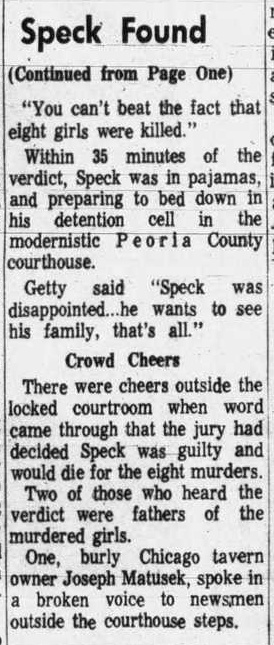
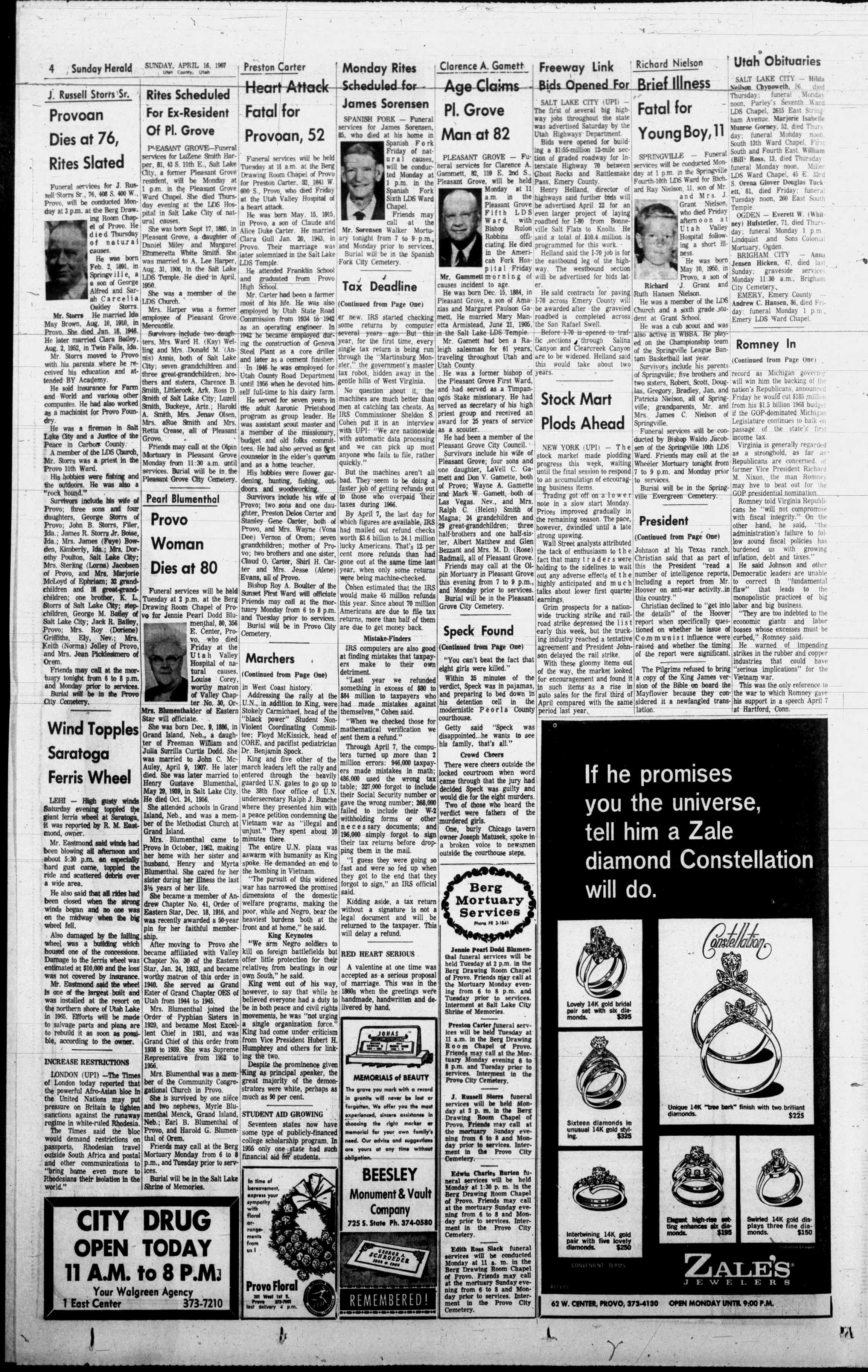
Speck Found
(Continued from Page One)
"You can't beat the fact that eight girls were killed."
Within 35 minutes of the verdict, Speck was in pajamas, and preparing to bed down in his detention cell in the modernistic Peoria County courthouse.
Getty said "Speck was disappointed...he wants to see his family, that's all."
Crowd Cheers
There were cheers outside the locked courtroom when word came through that the jury had decided Speck was guilty and would die for the eight murders.
Two of those who heard the verdict were fathers of the murdered girls.
One, burly Chicago tavern owner Joseph Matusek, spoke in a broken voice to newsmen outside the courthouse steps.
Notes: "found gilty" as printed. "the trial tested Cook County (Chicago) Public Defender" is printed without hyphen and without the lawyer's name before the next paragraph names him as Gerald W. Getty. The page 1 text ends with Getty's quotation unclosed ("...at the highest level I could."), and page 4 opens with "You can't beat the fact that eight girls were killed." The jump ends with Matusek beginning to speak, and no quotation from him follows. Both parts are transcribed as printed; the order looks like a make-up slip at the paper. "Peoria" is letter-spaced in the scan. The page 1 crop is a rectangle and also takes in the unrelated story "Romney In Nixon's Stronghold" below Speck's photograph in column 2. No words were illegible.