SLAYER OF U. S. GIRL BEHEADED: THE TACOMA TIMES, JUNE 19, 1939
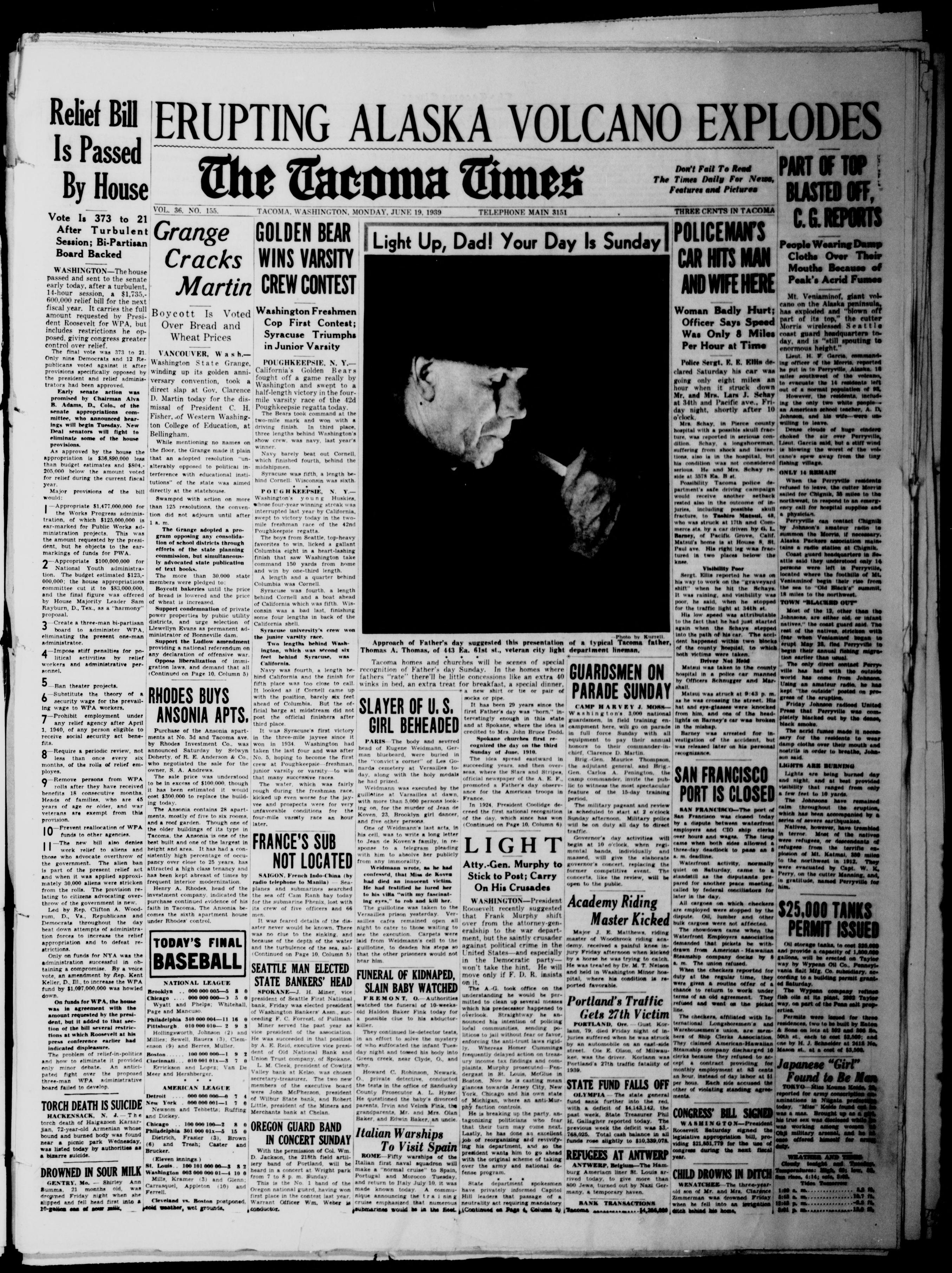
France never again cut off a man's head in front of a crowd. The last time was at Versailles in June 1939, and The Tacoma Times gave it a front-page column on June 19 under a headline aimed squarely at American readers: "SLAYER OF U. S. GIRL BEHEADED." The condemned man was Eugen Weidmann, a German the paper called a "bluebeard," guillotined for the murder of Jean de Koven, a young dancer from Brooklyn, and five other people. When the column was written, his body and severed head had been buried in the "convict's corner" of Les Gonards cemetery, along with the holy medals he had prized.
The detail that gives the piece its weight is a letter. A telegram had reached him in his cell, pleading with him to clear Jean de Koven publicly of any immorality, and one of his last acts was to write her family at length. He told them, as he had already confessed, that she died an innocent victim. The paper sets that beside his own testimony that he had lured her to his villa "with my fascinating eyes," to rob and kill her. In the summer of 1937 she had been in Paris with her aunt and went to La Celle-Saint-Cloud to meet a charming German who called himself Siegfried. He strangled her there and buried her in the garden.
The closing lines catch the night before the execution. The guillotine was brought to the Versailles prison; the town's cafes stayed open until morning for the people waiting to watch; carpets were laid from Weidmann's cell to the scaffold so that the other prisoners would not hear his steps. The paper counts more than five thousand onlookers. What the column leaves out is how that crowd behaved: spectators pushed and shouted, some dipped handkerchiefs in the blood, and photographs taken from windows above the square were published. Within days the government issued a decree ending public executions.
The Tacoma Times printed this Paris report two days after the execution, without a wire credit, and it is a newspaper summary, not a court record. It calls him Eugene; his name was Eugen. It gives Jean de Koven's age as 23, where reports of the case give twenty-two and a Boston birth record would make her twenty-four. The crowd of more than five thousand is the paper's figure. Weidmann confessed to all six killings, and in March 1939 a jury at Versailles found him guilty of all six, with premeditation in three of them, and of trying to extort a ransom from her aunt.
This issue dates from June 19, 1939, so it is under ninety-five years old. The Library of Congress believes newspapers of that age in Chronicling America are in the public domain but warns that they may contain some copyrighted third-party material. This report carries no syndicate credit or separate copyright notice, and nothing in it appears to be syndicated or separately copyrighted. The scan is the Library's copy, with the citation and rights statement below it.
The inking is heavy and blotted, and several words could be read only under enlargement, but none had to be marked illegible. The transcription keeps "Varsailles," a one-time misspelling in the second paragraph (the name is spelled correctly elsewhere), and "cafes" without its accent. The fourth paragraph is set in bold on the page; its wording is unchanged. Two unrelated stories below the column, about a kidnapped baby's funeral in Ohio and a cruise by Italian warships, are not transcribed.
Transcription
Transcribed word for word from the page scan. Original spelling, punctuation, capitalisation and typographical errors have been kept exactly as printed. Unreadable words are marked [illegible]. Nothing has been modernised or corrected.
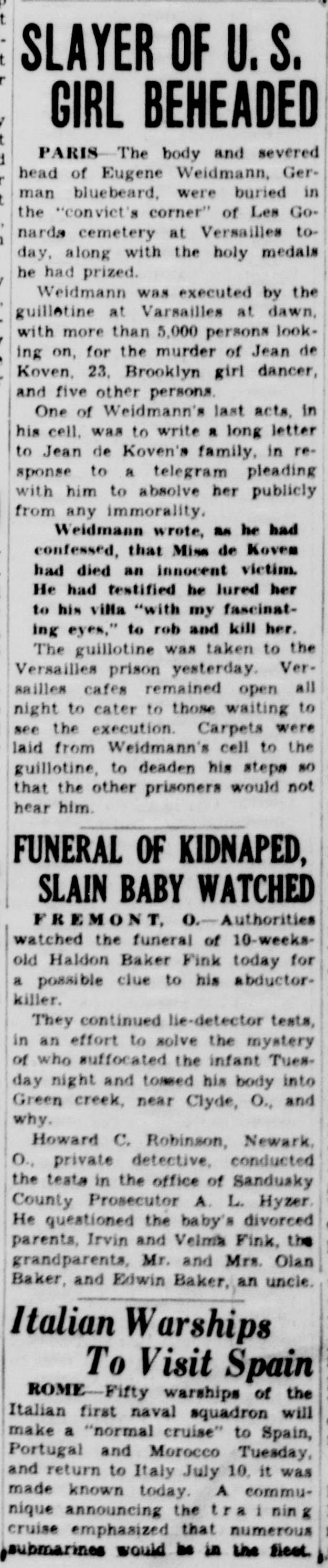
SLAYER OF U. S.
GIRL BEHEADED
PARIS—The body and severed head of Eugene Weidmann, German bluebeard, were buried in the "convict's corner" of Les Gonards cemetery at Versailles today, along with the holy medals he had prized.
Weidmann was executed by the guillotine at Varsailles at dawn, with more than 5,000 persons looking on, for the murder of Jean de Koven, 23, Brooklyn girl dancer, and five other persons.
One of Weidmann's last acts, in his cell, was to write a long letter to Jean de Koven's family, in response to a telegram pleading with him to absolve her publicly from any immorality.
Weidmann wrote, as he had confessed, that Miss de Koven had died an innocent victim. He had testified he lured her to his villa "with my fascinating eyes," to rob and kill her.
The guillotine was taken to the Versailles prison yesterday. Versailles cafes remained open all night to cater to those waiting to see the execution. Carpets were laid from Weidmann's cell to the guillotine, to deaden his steps so that the other prisoners would not hear him.
Transcriber's notes
- Readability: fair. The inking is heavy and blotted in places — "s" frequently fills in and reads at a glance like a blob, and the lower lines of each tile soften — but the type is large and every word was legible, several of them only after enlargement. No [illegible] markers were needed.
- Printers' error kept as printed: "the guillotine at Varsailles at dawn" — "Varsailles" for "Versailles", in the second paragraph. The same paragraph of the story has "Versailles" spelled correctly twice elsewhere, in the first and fifth paragraphs, so the error is confined to this one instance. It was enlarged and confirmed.
- "cafes" is printed without the accent, as set.
- The fourth paragraph, beginning "Weidmann wrote, as he had confessed," is set entirely in bold face, as a display paragraph within the body type. The emphasis is typographic only and the wording is transcribed as it stands.
- The dateline is "PARIS—" with no wire-service credit, unlike the other items on the page.
- Words broken by the column rule are joined without the line-break hyphen: "Ger-/man", "Go-/nards", "to-/day", "re-/sponse", "fascinat-/ing", "look-/ing", "Ver-/sailles".
- The paper prints the condemned man's forename as "Eugene Weidmann"; he is recorded elsewhere as Eugen Weidmann. It also gives Jean de Koven's age as 23, where she is elsewhere recorded as 22, and the crowd as "more than 5,000 persons", a figure other accounts put differently. All are left as printed.
- The headline is a two-line, single-column head and is not split across columns; this was checked against the full-page scan, `weidmann.fullpage.jpg`, which also confirms the second line "GIRL BEHEADED" is complete and not clipped at the column edge. No line had to be recovered from the full-page scan.
- The article begins and ends cleanly inside the tiles. There is no jump line, no continuation beyond the last tile and no photograph.
- Unrelated matter inside the crop, not transcribed: above the article, two lines of a Father's Day feature ("fathers 'rate' there'll be little cor— / winks in bed, an extra treat for br—", clipped by the crop at the right); below the article, the headline "FUNERAL OF KIDNAPED, SLAIN BABY WATCHED" with its Fremont, O. story about the Haldon Baker Fink case, and after that the headline "Italian Warships To Visit Spain" with its Rome story about the Italian first naval squadron, which runs past the foot of the crop.