SHOTS FELL SLAYER IN DIXIE 'SCUFFLE': THE SALT LAKE TRIBUNE, DECEMBER 19, 1974
When they fingerprinted him after his capture in November, Paul John Knowles told the officers, "They're going to smoke me before this is over." A month later he was dead. On Wednesday, December 18, 1974, the 28-year-old Florida parolee was shot in the back seat of a sheriff's car on Interstate 20, east of Douglasville, Georgia. The Salt Lake Tribune ran the Associated Press story on page 26 the next morning. The officers called it an escape attempt. Two of his lawyers, Ellis Rubin and Sheldon Yavitz of Miami, called it an execution.
Sheriff Earl Lee told it this way. Knowles had agreed to ride with him and a Georgia Bureau of Investigation agent, Ron Angel, to help find a weapon from one of the killings. He sat on the left of the rear seat in handcuffs, leg irons and a waist chain, lit a cigarette, and when the sheriff began pulling over to stop him smoking, freed his right hand, reached over the seat and "jerked my sidearm from the holster." Lee grabbed his hand and the gun went off. "Several shots were fired which resulted in the death of Paul John Knowles," he said, without saying who fired them. A GBI agent later said it was Angel who shot him, three times in the chest.
A third lawyer, Charles Marchman of Macon, had more to say. Knowles, he said, claimed 35 killings across the country, beginning with his parole in May and ending with his arrest in Georgia, and had described sixteen of them on a taped journal now held by the federal appeals court in New Orleans. "Whether he was bragging or not, I don't know," Marchman said. Among the dead the record does tie to Knowles were Florida Highway Patrol Trooper Charles Eugene Campbell and James Meyer, a businessman he stopped with the trooper's own siren, both found handcuffed to a tree in Pulaski County.
This is wire copy built on the officers' account, which no court ever tested. Knowles was charged at his death with six killings in three states, as the story says, and was never tried for any of them. The 35 was his own claim, passed on by his lawyer; about eighteen deaths have been tied to him, and some counts run to twenty. The claim that the killings began with his parole in May is his too; the first death investigators tied to him came in late July, after he broke out of a Jacksonville holding cell. The lawyer's remark about the circumstances of the killings is his alone. The paper's "Ron Angel" was GBI Special Agent Ronnie Angel.
The Associated Press story ran without a byline in The Salt Lake Tribune of December 19, 1974. Utah Digital Newspapers, at the University of Utah's J. Willard Marriott Library, holds the scan and rates the issue No Copyright, United States. It was published before 1978, when an American work still needed a notice to keep its copyright, and neither this story nor the issue carries one; the only notices in the issue close certain syndicated pieces and an advertisement elsewhere. The citation and the rights rating are printed under the scan.
The scan is grainy but every word could be made out, so the transcription is complete and has no illegible marks; the word "Investigation" is partly broken in the type. The story fills column 1 and finishes at the top of column 2, and both parts were captured and transcribed. Words spaced out to fill the short lines beside the portrait are set normally. The typesetter's slips stay: "tried to gra Lee's pistol," "had agree to go" and "Knowles two Miami lawyers" without an apostrophe.

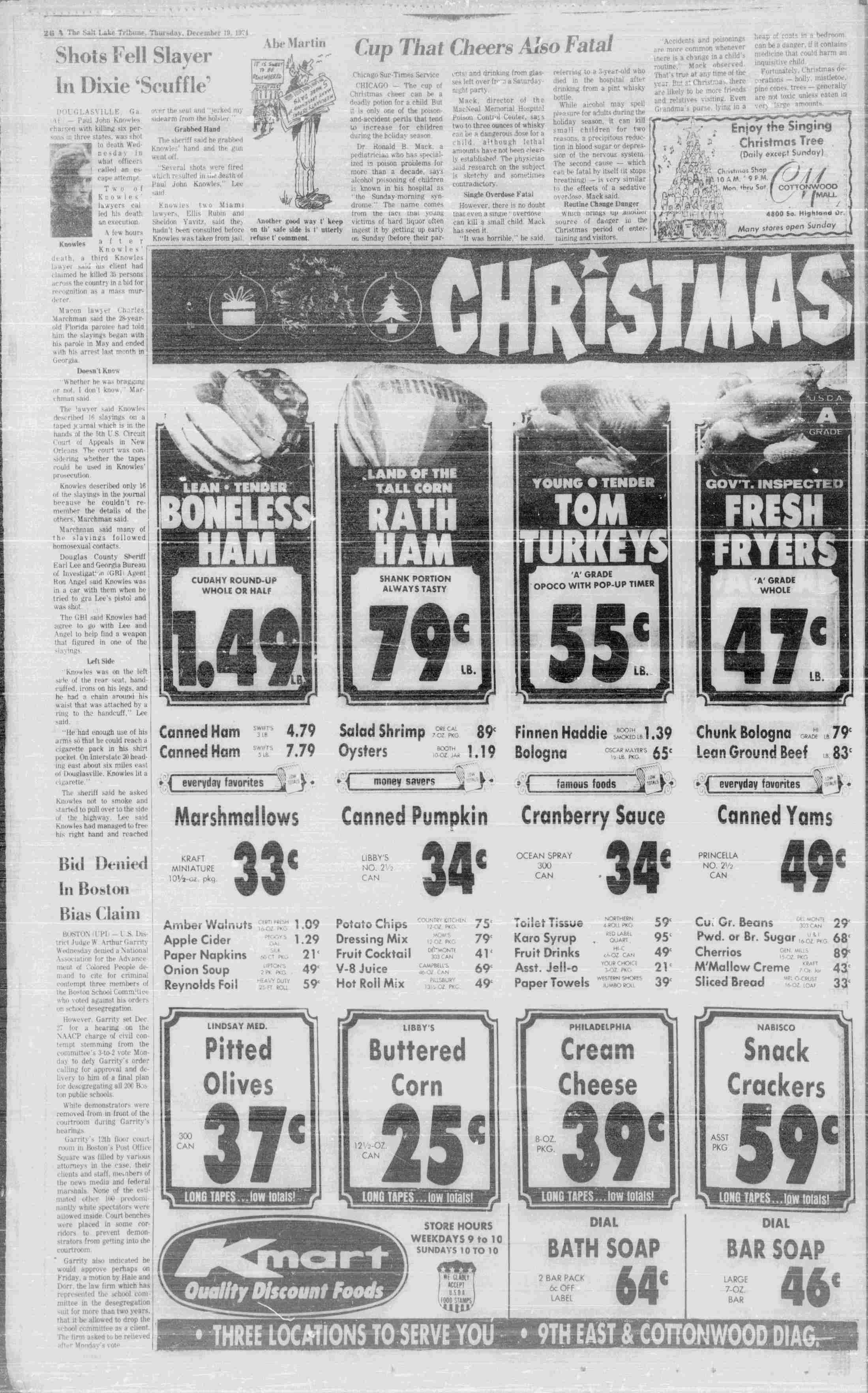
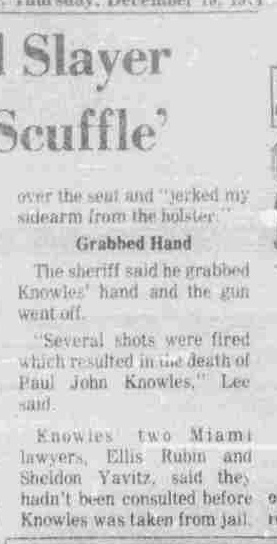
Transcription
Transcribed word for word from the page scan. Original spelling, punctuation, capitalisation and typographical errors have been kept exactly as printed. Unreadable words are marked [illegible]. Nothing has been modernised or corrected.
Shots Fell Slayer In Dixie 'Scuffle'
DOUGLASVILLE, Ga. (AP) — Paul John Knowles, charged with killing six persons in three states, was shot to death Wednesday in what officers called an escape attempt.
Two of Knowles' lawyers called his death an execution.
A few hours after Knowles' death, a third Knowles lawyer said his client had claimed he killed 35 persons across the country in a bid for recognition as a mass murderer.
Macon lawyer Charles Marchman said the 28-year-old Florida parolee had told him the slayings began with his parole in May and ended with his arrest last month in Georgia.
Doesn't Know
"Whether he was bragging or not, I don't know," Marchman said.
The lawyer said Knowles described 16 slayings on a taped journal which is in the hands of the 5th U.S. Circuit Court of Appeals in New Orleans. The court was considering whether the tapes could be used in Knowles' prosecution.
Knowles described only 16 of the slayings in the journal because he couldn't remember the details of the others, Marchman said.
Marchman said many of the slayings followed homosexual contacts.
Douglas County Sheriff Earl Lee and Georgia Bureau of Investigation (GBI) Agent Ron Angel said Knowles was in a car with them when he tried to gra Lee's pistol and was shot.
The GBI said Knowles had agree to go with Lee and Angel to help find a weapon that figured in one of the slayings.
Left Side
"Knowles was on the left side of the rear seat, handcuffed, irons on his legs, and he had a chain around his waist that was attached by a ring to the handcuff," Lee said.
"He had enough use of his arms so that he could reach a cigarette pack in his shirt pocket. On Interstate 20 heading east about six miles east of Douglasville, Knowles lit a cigarette."
The sheriff said he asked Knowles not to smoke and started to pull over to the side of the highway. Lee said Knowles had managed to free his right hand and reached over the seat and "jerked my sidearm from the holster."
Grabbed Hand
The sheriff said he grabbed Knowles' hand and the gun went off.
"Several shots were fired which resulted in the death of Paul John Knowles," Lee said.
Knowles two Miami lawyers, Ellis Rubin and Sheldon Yavitz, said they hadn't been consulted before Knowles was taken from jail.
[Photo caption] Knowles
Notes: Kept as printed: "tried to gra Lee's pistol"; "had agree to go"; "Knowles two Miami lawyers" without an apostrophe. Several words are letter-spaced to fill short lines beside the photograph. The scan is grainy, and "Investigation" is partly broken but readable. The article runs down column 1 and continues at the top of column 2, so it is supplied as ARTICLE-CROP.jpg (column 1, with the headline start) and ARTICLE-CROP-PART-2.jpg (the top of column 2, with the rest of the headline). The 1974 issue shows "(AP)" partly broken. No words were illegible.