SHE MURDERED FOR BEAUTY: THE HARTFORD REPUBLICAN, NOVEMBER 30, 1894
By the 1890s, the countess had become a horror story, and American readers got it secondhand. In late 1894 a tale went round the country's papers about a German book then in press in Breslau, and on November 30 The Hartford Republican, a Kentucky weekly, ran a version credited to the Pennsylvania Grit. Its subject was Elizabeth Bathory, the Hungarian noblewoman whom the headline accused of murdering "for beauty." She had been dead for close to three hundred years.
The feature opens on the legend in its classic form: a maid's blood spattering the countess's face, and the discovery that it left her skin "much whiter and softer than it had been before." From there it piles on scenes of torture told as plain fact: a Christmas supper for 25 girls led into underground cells, a girl smeared with honey and left to the wasps, another kept all night on a tower in a snowstorm. A servant it calls Fierko goes out into the countryside to bring back more girls.
The ending is a rescue. George Thurzo, said here to be her cousin and the governor of the province, warns her, then comes with officers at Christmas and finds 20 young women tied to the cellar walls. Bathori is arrested but spared death because of her rank, and the paper has her die of starvation after 31 years in a fortress, having "killed over 650 girls."
This is a later feature, written almost three centuries after the events and drawn from a forthcoming book, not news or a record of any proceeding, and little of it is history. The blood baths first appear in print in 1729, more than a century after her death. The 650 figure was one witness's hearsay about a book never produced. Her husband, cast here as an accomplice, died in 1604, before the arrest; she was held at Čachtice Castle, not a fortress at "Esej," and died on August 21, 1614, not 1641. Thurzó was Palatine of Hungary. She was never charged or tried; four of her servants were tried at Bytča, and three were executed in January 1611.
Published on November 30, 1894, this page of The Hartford Republican is in the public domain in the United States. The story itself is a reprint, signed at the foot to the Pennsylvania Grit with no writer's name. The scan is the Library of Congress copy from Chronicling America, and the citation and the Library's rights statement are printed beneath it.
The story fills the first column of page 4 and carries over to the top of the second, so it is shown in two crops, and both parts were transcribed in full, word for word. Nothing was illegible. The compositor's errors stand: "Complextion," "subteranean pasages," "stood, nute," "govenor" beside "governor," "dangerous and passages" for what was probably dungeons, and the garbled credit "Pensylvania Grir." Words crowded together by tight spacing have been given normal spaces, and words broken at line ends have been joined.

Transcription
Transcribed word for word from the page scan. Original spelling, punctuation, capitalisation and typographical errors have been kept exactly as printed. Unreadable words are marked [illegible]. Nothing has been modernised or corrected.
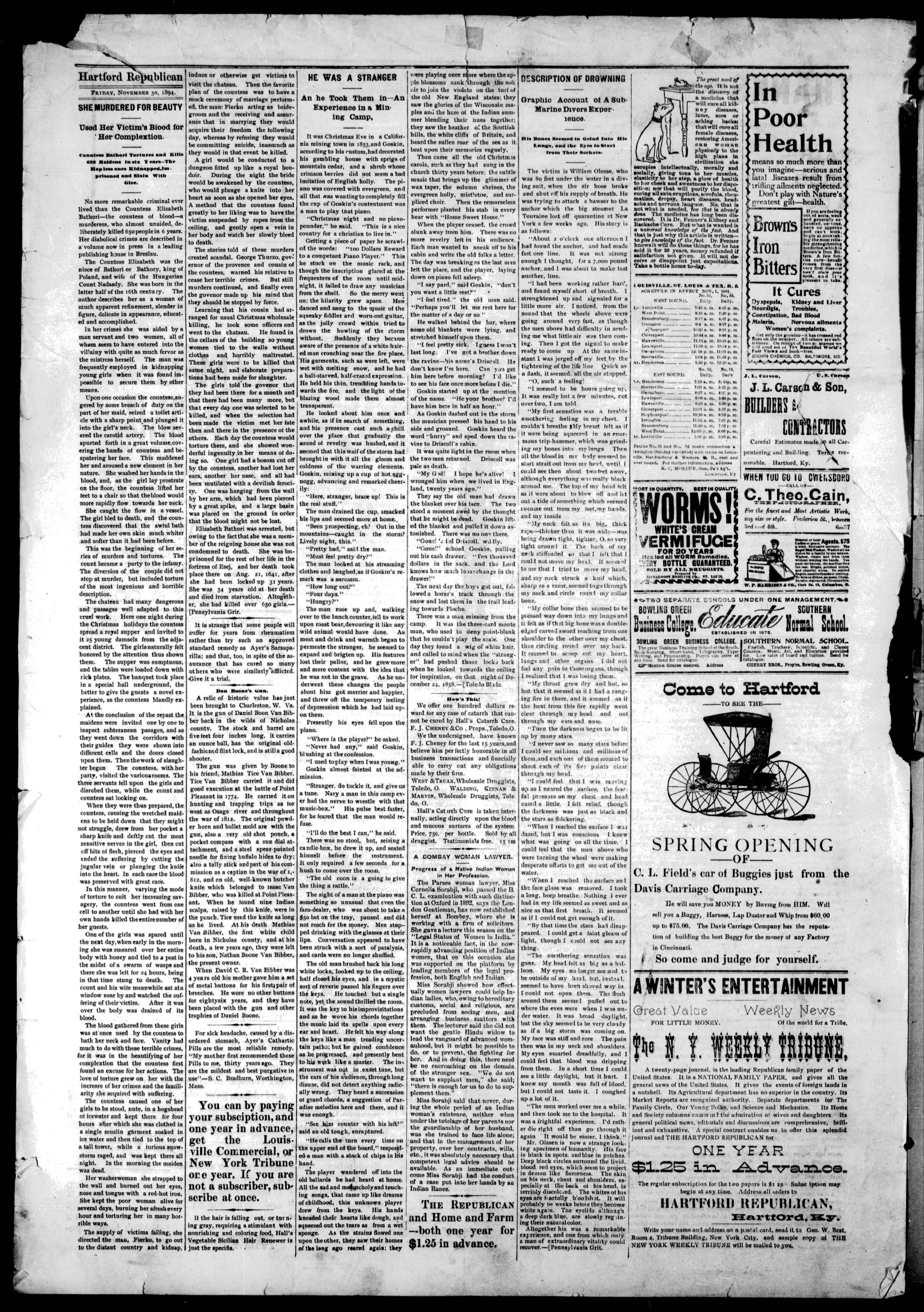
SHE MURDERED FOR BEAUTY
Used Her Victim's Blood for Her Complextion.
Countess Bathori Tortures and Kills 650 Maidens in six Years—The Hapless ones Kidnapped, Imprisoned and Slain With Glee.
No more remarkable criminal ever lived than the Countess Elizabeth Bathori—the countess of blood—a murderess, who almost unaided, deliberately killed 650 people in 6 years. Her diabolical crimes are described in a volume now in press in a leading publishing house in Breslau.
The Countess Elizabeth was the niece of Bathori or Bathory, king of Poland, and wife of the Hungarian Count Nadasdy. She was born in the latter half of the 16th century. The author describes her as a woman of much apparent refinement, slender in figure, delicate in appearance, educated and accomplished.
In her crimes she was aided by a man servant and two women, all of whom seem to have entered into the villainy with quite as much fervor as the mistress herself. The man was frequently employed in kidnapping young girls when it was found impossible to secure them by other means.
Upon one occasion the countess,angered by some breach of duty on the part of her maid, seized a toilet article with a sharp point and plunged it into the girl's neck. The blow severed the carotid artery. The blood spurted forth in a great volume,covering the hands of countess and bespatering her face. This maddened her and aroused a new element in her nature. She washed her hands in the blood, and, as the girl lay prostrate on the floor, the countess lifted her feet to a chair so that the blood would more rapidly flow towards her neck.
She caught the flow in a vessel. The girl bled to death, and the countess discovered that the awful bath had made her own skin much whiter and softer than it had been before.
This was the beginning of her series of murders and tortures. The count became a party to the infamy. The diversion of the couple did not stop at murder, but included torture of the most ingenious and horrible description.
The chateau had many dangerous and passages well adapted to this cruel work. Here one night during the Christmas holidays the countess spread a royal supper and invited to it 25 young damsels from the adjacent district. The girls naturally felt honored by the attention thus shown them. The supper was sumptuous, and the tables were loaded down with rich plates. The banquet took place in a special hall underground, the better to give the guests a novel experience, as the countess blandly explained.
At the conclusion of the repast the maidens were invited one by one to inspect subteranean pasages, and as they went down the corridors with their guides they were shown into different cells and the doors closed upon them. Then the work of slaughter began The countess, with her party, visited the various rooms. The three servants fell upon the girls and disrobed them, while the count and countess sat looking on.
When they were thus prepared, the countess, causing the wretched maidens to be held down that they might not struggle, drew from her pocket a sharp knife and deftly cut the most sensitive nerves in the girl, then cut off bits of flesh, pierced the eyes and ended the suffering by cutting the jugular vein or plunging the knife into the heart. In each case the blood was preserved with great care.
In this manner, varying the mode of torture to suit her increasing savagery, the countess went from one cell to another until she had with her own hands killed the entire number of her guests.
One of the girls was spared until the next day,when early in the morning she was smeared over her entire body with honey and tied to a post in the midst of a swarm of wasps and there she was left for 24 hours, being in that time stung to death. The count and his wife meanwhile sat at a window near by and watched the suffering of their victim. After it was over the body was drained of its blood.
The blood gathered from these girls was at once used by the countess to bath her neck and face. Vanity had much to do with these terrible crimes, for it was in the beautifying of her complextion that the countess first found an excuse for her actions. The love of torture grew on her with the increase of her crimes and the familiarity she acquired with suffering.
The countess caused one of her girls to be stood, nute, in a hogshead of icewater and kept there for four hours after which she was clothed in a single muslin garment soaked in ice water and then tied to the top of a tall tower, while a furious snowstorm raged, and was kept there all night. In the morning the maiden was dead.
Her washerwoman she strapped to the wall and burned out her eyes, nose and tongue with a red-hot iron. She kept the poor woman alive for several days, burning her afresh every hour and torturing her in many horrible ways.
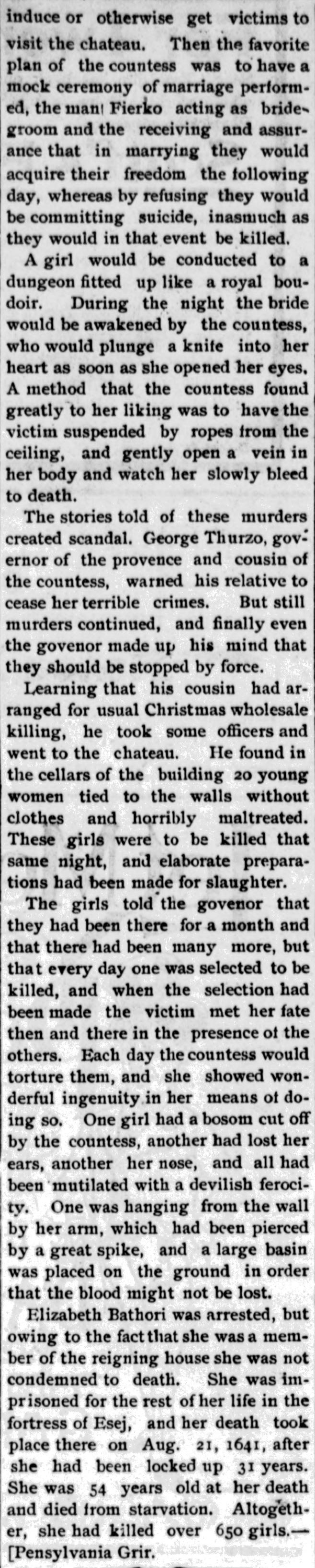
The supply of victims failing, she directed the man, Fierko, to go out to the distant country and kidnap, induce or otherwise get victims to visit the chateau. Then the favorite plan of the countess was to have a mock ceremony of marriage performed, the man Fierko acting as bridegroom and the receiving and assurance that in marrying they would acquire their freedom the following day, whereas by refusing they would be committing suicide, inasmuch as they would in that event be killed.
A girl would be conducted to a dungeon fitted up like a royal boudoir. During the night the bride would be awakened by the countess, who would plunge a knife into her heart as soon as she opened her eyes. A method that the countess found greatly to her liking was to have the victim suspended by ropes from the ceiling, and gently open a vein in her body and watch her slowly bleed to death.
The stories told of these murders created scandal. George Thurzo, governor of the provence and cousin of the countess, warned his relative to cease her terrible crimes. But still murders continued, and finally even the govenor made up his mind that they should be stopped by force.
Learning that his cousin had arranged for usual Christmas wholesale killing, he took some officers and went to the chateau. He found in the cellars of the building 20 young women tied to the walls without clothes and horribly maltreated. These girls were to be killed that same night, and elaborate preparations had been made for slaughter.
The girls told the govenor that they had been there for a month and that there had been many more, but that every day one was selected to be killed, and when the selection had been made the victim met her fate then and there in the presence of the others. Each day the countess would torture them, and she showed wonderful ingenuity in her means of doing so. One girl had a bosom cut off by the countess, another had lost her ears, another her nose, and all had been mutilated with a devilish ferocity. One was hanging from the wall by her arm, which had been pierced by a great spike, and a large basin was placed on the ground in order that the blood might not be lost.
Elizabeth Bathori was arrested, but owing to the fact that she was a member of the reigning house she was not condemned to death. She was imprisoned for the rest of her life in the fortress of Esej, and her death took place there on Aug. 21, 1641, after she had been locked up 31 years. She was 54 years old at her death and died from starvation. Altogether, she had killed over 650 girls.—[Pensylvania Grir.
Notes: SUBSTITUTION. The first-choice article ("SHE BATHED IN BLOOD", The Morning News, Savannah, 14 October 1894, page 9) runs across six full columns at roughly 3,300–3,500 words, above the 3,000-word limit, so the listed alternative has been used. This version is a shorter rewrite of the same story, credited at the foot to "[Pensylvania Grir." (meaning the Pennsylvania Grit). The article fills column 1 below the date line "Friday, November 30, 1894." (which is excluded) and continues at the top of column 2, ending above a patent-medicine paragraph ("It is strange that some people…"). Because a single rectangle would take in that advertising matter and the item below it, the story is supplied as ARTICLE-CROP.jpg (column 1) and ARTICLE-CROP-PART-2.jpg (column 2). Printed errors are kept as printed: "Complextion"/"complextion", "Victim's", "bespatering", "dangerous and passages" (apparently for "dungeons and passages"), "subteranean pasages", "slaughter began The countess" (no full stop), "to bath her neck", "stood, nute," (for "nude"), "the receiving and assurance" (garbled in print), "provence", "govenor" (twice) beside "governor", "for usual Christmas wholesale killing", "Esej", "Pensylvania Grir." The missing spaces after commas in "countess,angered", "volume,covering" and "day,when" are as printed. Some other word spaces are very tight in the type (e.g. "650people", "theblood", "girlsnaturally"); these have been given normal spacing, since they are spacing faults rather than spelling. A stray mark after "the man" before "Fierko" in column 2 is not a letter and has been ignored. Line-end hyphenation from column setting has been joined (e.g. "de-/liberately", "an-/gered", "se-/ries", "assur-/ance", "Altogeth-/er"); "red-hot" and "snow-/storm" (printed "snow-" at a line end) — the latter has been joined as "snowstorm". The paper is a Kentucky weekly; text is lightly mottled but fully readable. No [illegible] marks needed.