RAPIST FACES INQUIRY IN 3 OTHER SLAYINGS: EVENING STAR, NOVEMBER 1, 1958
Harvey Glatman had already led detectives into the desert. Before dawn on October 31, 1958, the television repairman took them to two graves 26 miles apart in sandy country east of San Diego, where Shirley Ann Bridgeford, 24, and Ruth Rita Mercado, 24, lay. A body found the previous December in neighboring Riverside County was believed to be the third woman he admitted killing, Judy Ann Dull, 19. Then police drove him to Los Angeles to be booked on suspicion of murder, and the Associated Press found a man in a talking mood. "I'm in as deep as I can get," he said. "There isn't anything worse can happen to me."
The Evening Star in Washington printed the wire story on November 1 under a headline about three more deaths. Police meant to question him about Marjorie Hipperson, 24, a nurse strangled with a stocking in her Los Angeles apartment in June 1957, and Ruth Goldsmith, 50, choked with a stocking in hers that April. A sheriff's lieutenant, C. W. McGowan, said "we are by no means satisfied" that Glatman had not killed Jean Ellroy, 43, an El Monte nurse found strangled beside a school playground the previous July. Glatman had denied knowing anything of her death shortly before he confessed to the others. Of California's way of executing men, he said: "I guess they can only give me one shot of gas."
His own words fill the rest. He had been caught on Monday night near Santa Ana, when a highway patrolman on a motorcycle came upon him struggling beside a car with a 28-year-old model he meant to make his fourth victim. "I really didn't like to kill," he told a newsman. "I was afraid they'd identify me." Asked why he used rope when he carried a pistol, he said: "Ever since I was a child I have been fascinated by rope." The last word goes to his mother in Denver, who sobbed when she heard: "Not my boy! Not my boy! He was always so good."
Filed in the first days after the arrest, this wire story sets police suspicion beside Glatman's own admissions, and the two are not the same thing. Nothing in it ties him to Marjorie Hipperson or Ruth Goldsmith beyond the plan to question him, and he was later cleared of Jean Ellroy's killing. He pleaded guilty in San Diego County to the murders of Shirley Ann Bridgeford and Ruth Rita Mercado and was sentenced to death in December 1958; he confessed to killing Judy Ann Dull but was never tried for her. He died in the gas chamber at San Quentin on September 18, 1959. The woman he attacked near Santa Ana survived, and the paper printed her name.
Issued on November 1, 1958, this Evening Star is too recent for the ninety-five-year rule to settle its status. The Library of Congress believes it is in the public domain while warning that papers of this period "may contain some copyrighted third-party material"; nothing in the article indicates syndicated or separately copyrighted matter. The scan comes from the Library's Chronicling America collection, and the citation and rights statement follow it.
The text is complete and was read word for word from clean, well-inked type; nothing is marked illegible. The headline and the word "frankfurters" are both split by the column turn in the scan and have been joined without loss. The paper's style for running speech is kept, with no closing quotation mark at the end of a paragraph that continues, and the mother's trailing points are set as spaced dots. The crop also takes in a marriage-license list and other stories, none of them transcribed.
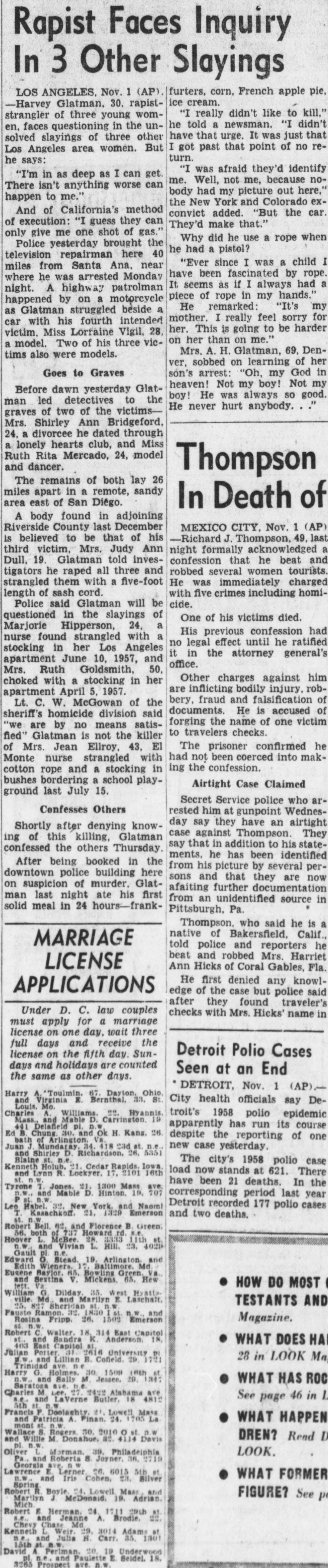
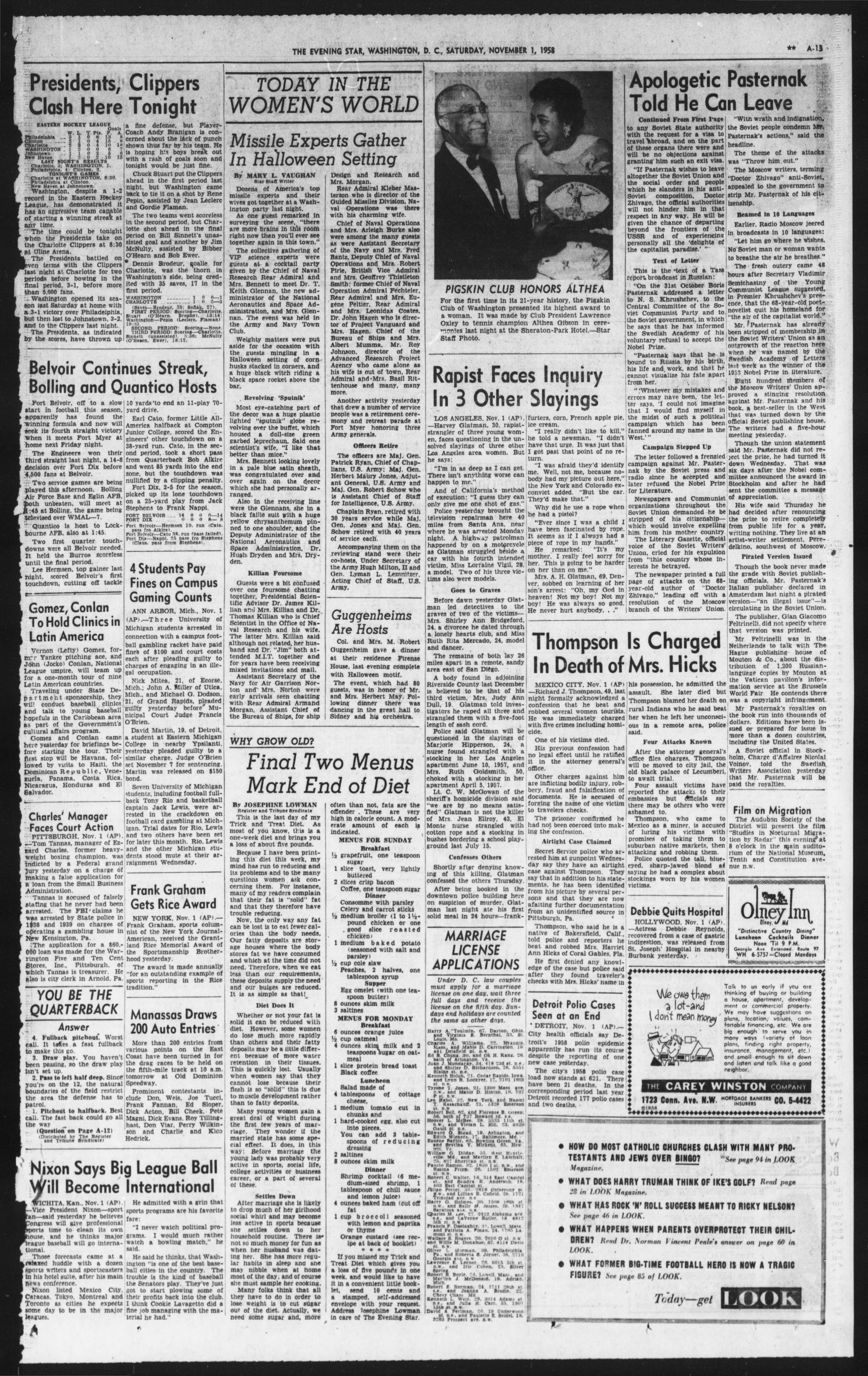
Transcription
Transcribed word for word from the page scan. Original spelling, punctuation, capitalisation and typographical errors have been kept exactly as printed. Unreadable words are marked [illegible]. Nothing has been modernised or corrected.
Rapist Faces Inquiry In 3 Other Slayings
LOS ANGELES, Nov. 1 (AP).—Harvey Glatman, 30, rapist-strangler of three young women, faces questioning in the unsolved slayings of three other Los Angeles area women. But he says:
"I'm in as deep as I can get. There isn't anything worse can happen to me."
And of California's method of execution: "I guess they can only give me one shot of gas."
Police yesterday brought the television repairman here 40 miles from Santa Ana, near where he was arrested Monday night. A highway patrolman happened by on a motorcycle as Glatman struggled beside a car with his fourth intended victim, Miss Lorraine Vigil, 28, a model. Two of his three victims also were models.
Goes to Graves
Before dawn yesterday Glatman led detectives to the graves of two of the victims—Mrs. Shirley Ann Bridgeford, 24, a divorcee he dated through a lonely hearts club, and Miss Ruth Rita Mercado, 24, model and dancer.
The remains of both lay 26 miles apart in a remote, sandy area east of San Diego.
A body found in adjoining Riverside County last December is believed to be that of his third victim, Mrs. Judy Ann Dull, 19. Glatman told investigators he raped all three and strangled them with a five-foot length of sash cord.
Police said Glatman will be questioned in the slayings of Marjorie Hipperson, 24, a nurse found strangled with a stocking in her Los Angeles apartment June 10, 1957, and Mrs. Ruth Goldsmith, 50, choked with a stocking in her apartment April 5, 1957.
Lt. C. W. McGowan of the sheriff's homicide division said "we are by no means satisfied" Glatman is not the killer of Mrs. Jean Ellroy, 43, El Monte nurse strangled with cotton rope and a stocking in bushes bordering a school playground last July 15.
Confesses Others
Shortly after denying knowing of this killing, Glatman confessed the others Thursday.
After being booked in the downtown police building here on suspicion of murder, Glatman last night ate his first solid meal in 24 hours—frankfurters, corn, French apple pie, ice cream.
"I really didn't like to kill," he told a newsman. "I didn't have that urge. It was just that I got past that point of no return.
"I was afraid they'd identify me. Well, not me, because nobody had my picture out here," the New York and Colorado ex-convict added. "But the car. They'd make that."
Why did he use a rope when he had a pistol?
"Ever since I was a child I have been fascinated by rope. It seems as if I always had a piece of rope in my hands."
He remarked: "It's my mother. I really feel sorry for her. This is going to be harder on her than on me."
Mrs. A. H. Glatman, 69, Denver, sobbed on learning of her son's arrest: "Oh, my God in heaven! Not my boy! Not my boy! He was always so good. He never hurt anybody. . ."
Transcriber's notes
- Readability: Excellent. The type is clean and well inked throughout both columns, and the two-line display headline is sharp. No [illegible] markers were needed.
- The headline is set across both columns. The crop splits it: column 1 carries "Rapist Face" / "In 3 Other" and column 2 carries "es Inquiry" / "Slayings". The two halves have been joined to give the headline as printed, "Rapist Faces Inquiry / In 3 Other Slayings".
- The word "frankfurters" is likewise broken by the column turn — column 1 ends "frank-" and column 2 begins "furters" — and has been joined without duplicating the break.
- No printers' errors were found. Period usage kept as printed: the open quotation at "I really didn't like to kill," runs on into the next paragraph without a closing mark before "I was afraid they'd identify me.", which is the paper's normal style for continued speech; the trailing ellipsis in the mother's quotation is printed as spaced points, ". . .", and has been kept that way.
- The crop is a rectangle and carries unrelated matter inside it. Column 1 breaks off after "solid meal in 24 hours—frank-" and the rest of that column, filling tiles c1_002960 through c1_004440, is a separate daily feature headed "MARRIAGE LICENSE APPLICATIONS" with its italic explanatory note about D. C. law and a long list of named applicants and addresses. None of that has been transcribed.
- There is no photograph or engraving in the article, no jump line, and the story ends cleanly with the mother's quotation; a horizontal rule closes it at the foot of tile c2_000740.