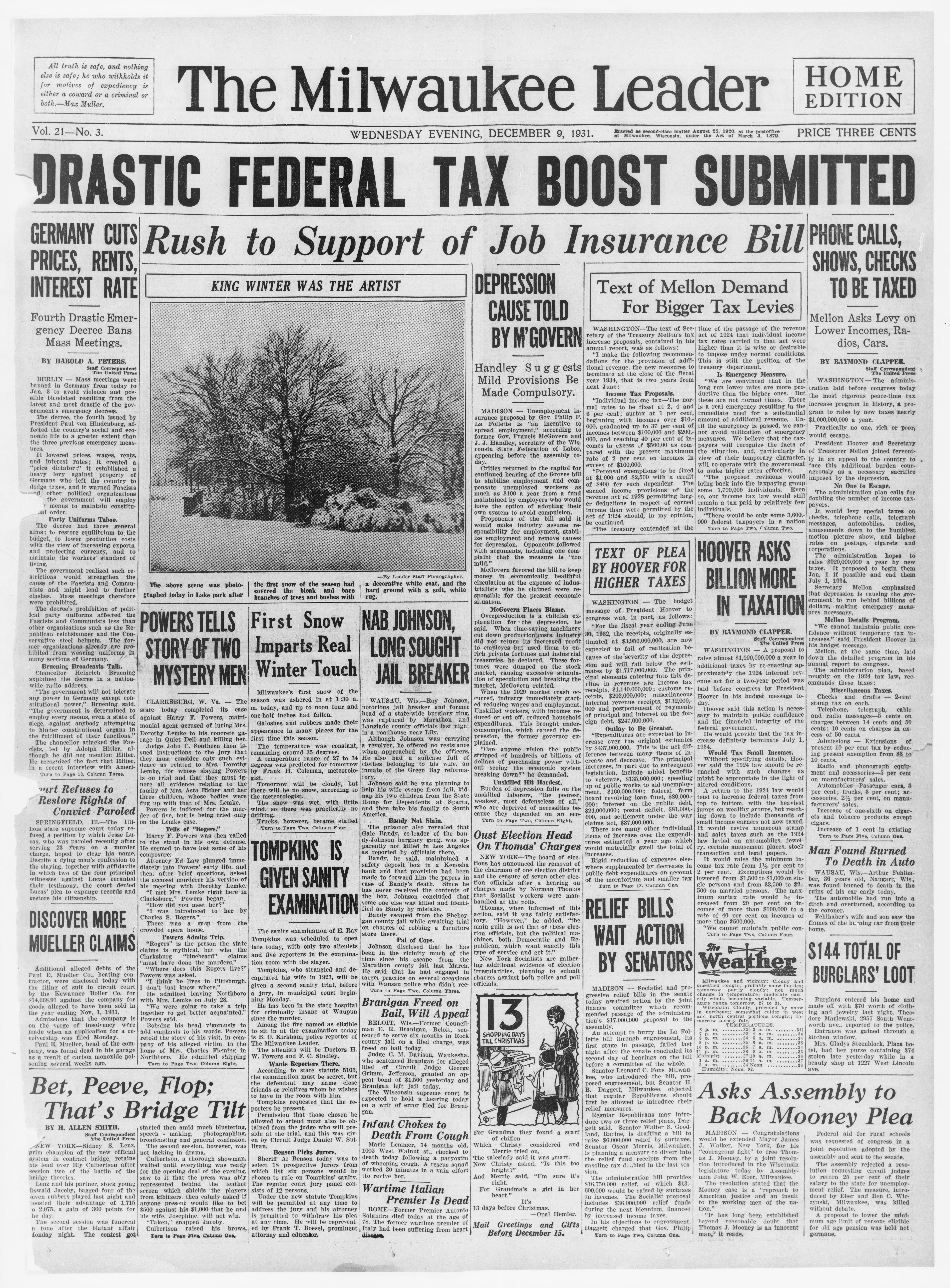
POWERS TELLS STORY OF TWO MYSTERY MEN: THE MILWAUKEE LEADER, DECEMBER 9, 1931
The state had rested, and Harry Powers walked to the witness stand in a Clarksburg opera house to name a man the prosecution said did not exist. The Harrison County courthouse was being rebuilt, so the trial was heard at Moore's Opera House, and the seats were full. He was on trial for the murder of Dorothy Lemke, a fifty-year-old divorced nurse from Northborough, Massachusetts, whose body had been dug up beside his garage at Quiet Dell. Asked how he had met her, Powers said: "I was introduced to her by Charles S. Rogers." The Milwaukee Leader caught the sound the room made: "There was a gasp from the crowded opera house."
Before he spoke, Judge John C. Southern had given the jury its orders. Five bodies had come out of the ground at Quiet Dell: Dorothy Lemke's, and those of Asta Eicher, a widow from Park Ridge, Illinois, and her three children, Greta, fourteen, Harry, twelve, and Annabel, nine. Powers stood indicted for all five killings and was on trial for one, so the jurors were told to weigh only the evidence about Mrs. Lemke and to put the Eichers out of their minds. Then his lawyer, Ed Law, took him quickly through his early life and on to the meeting with Lemke.
Rogers, the paper explains, was the man the state called mythical and the one Powers said "must have done the murders." Where did he live? "I think he lives in Pittsburgh. I don't just know where." Powers admitted leaving Northboro with Mrs. Lemke on July 28. "We were going to take a trip together to get better acquainted," he said. He was bobbing his head for emphasis, retelling a visit the two of them had paid to a house in Northboro, when the column ran out of room in the middle of a sentence and sent its readers to page two.
This front-page wire account of one day's testimony stops partway through. Only the page-one portion is reproduced; the continuation on page two was not captured, so the second of the headline's two mystery men never appears here. The story about Rogers was Powers's own, given from the stand after he had confessed, and no such man was ever shown to exist. On December 12, 1931, the jury convicted him of the first-degree murder of Dorothy Lemke, and he was hanged at Moundsville on March 18, 1932. The deaths of Asta Eicher and her children were never tried. The paper's "Northboro" is Northborough, Massachusetts.
Because The Milwaukee Leader for December 9, 1931, is less than ninety-five years old, its status rests on the Library of Congress's judgment: the Library believes papers of this age in Chronicling America are in the public domain but cautions that they "may contain some copyrighted third-party material." Nothing in this article indicates syndicated or separately copyrighted matter. The scan is the Library's own, and its citation and rights statement sit under it.
The transcription is complete as far as page one goes and needed no illegible marks; ink damage in the last lines blurs "retold" and "Bobbing" without hiding them. The paper's punctuation is kept, including the stray period in "to add emphasis to his words. Powers retold," and its lower-case Clarksburg "bluebeard." The text breaks off at "He admitted shipping," above the printed jump line, "Turn to Page Two, Column Eight." What followed on page two is not transcribed.
Transcription
Transcribed word for word from the page scan. Original spelling, punctuation, capitalisation and typographical errors have been kept exactly as printed. Unreadable words are marked [illegible]. Nothing has been modernised or corrected.
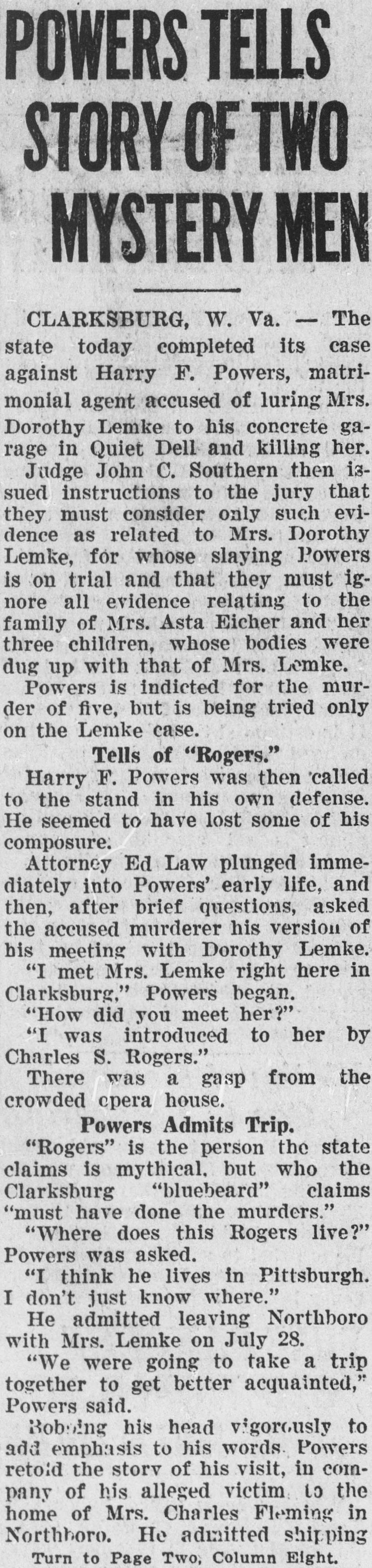
POWERS TELLS STORY OF TWO MYSTERY MEN
CLARKSBURG, W. Va. — The state today completed its case against Harry F. Powers, matrimonial agent accused of luring Mrs. Dorothy Lemke to his concrete garage in Quiet Dell and killing her.
Judge John C. Southern then issued instructions to the jury that they must consider only such evidence as related to Mrs. Dorothy Lemke, for whose slaying Powers is on trial and that they must ignore all evidence relating to the family of Mrs. Asta Eicher and her three children, whose bodies were dug up with that of Mrs. Lemke.
Powers is indicted for the murder of five, but is being tried only on the Lemke case.
Tells of "Rogers."
Harry F. Powers was then called to the stand in his own defense. He seemed to have lost some of his composure.
Attorney Ed Law plunged immediately into Powers' early life, and then, after brief questions, asked the accused murderer his version of his meeting with Dorothy Lemke.
"I met Mrs. Lemke right here in Clarksburg," Powers began.
"How did you meet her?"
"I was introduced to her by Charles S. Rogers."
There was a gasp from the crowded opera house.
Powers Admits Trip.
"Rogers" is the person the state claims is mythical, but who the Clarksburg "bluebeard" claims "must have done the murders."
"Where does this Rogers live?" Powers was asked.
"I think he lives in Pittsburgh. I don't just know where."
He admitted leaving Northboro with Mrs. Lemke on July 28.
"We were going to take a trip together to get better acquainted," Powers said.
Bobbing his head vigorously to add emphasis to his words. Powers retold the story of his visit, in company of his alleged victim, to the home of Mrs. Charles Fleming in Northboro. He admitted shipping
Turn to Page Two, Column Eight.
Transcriber's notes
- Readability: Very good. The type is heavy and clear throughout; only the last two lines of the final tile show ink damage ("retold", "Bobbing"), but the words remain readable. No [illegible] markers were needed.
- Printers' errors and period usage kept as printed: "Bobbing his head vigorously to add emphasis to his words. Powers retold the story..." — the period after "words" where a comma is expected is as printed. "defense" (American spelling) kept.
- Lower-case style for the nickname kept as printed: the Clarksburg "bluebeard".
- The headline "POWERS TELLS / STORY OF TWO / MYSTERY MEN" is set in three lines within the single column and is followed by a short rule; the two sub-headlines "Tells of 'Rogers.'" and "Powers Admits Trip." are centred over the column and each carry a full stop as printed.
- The article breaks off mid-sentence at "He admitted shipping" and carries the jump line "Turn to Page Two, Column Eight." as printed; the continuation on page two is not in these tiles.
- The crop is clean — no unrelated articles or advertisements are visible at the edges in any of the five tiles.
- Tile note: the files supplied for this article are named c1_000000.png, c1_000819.png, c1_001638.png, c1_002457.png and c1_003276.png (a 819-pixel stride), not the 740-pixel stride given in the task list. The five tiles are consecutive and overlap correctly, so the whole column is covered.