POISONER OF 4 CHILDREN MAY BE OWN VICTIM: THE OMAHA MORNING BEE, APRIL 17, 1925
She told it lying on a jail cot, in a droning monotone, while her nineteen-year-old daughter stood at the foot of the cot and begged her not to. Anna Cunningham of Gary, Indiana, a widow the paper gives as forty-seven, had been arrested after her son David was found to be suffering from arsenic poisoning, and in the jail at Crown Point she gave the account the International News Service sent out on April 16, 1925. The Omaha Morning Bee ran it the next day across four columns of page 5, under a headline that claimed more than the story did: "Poisoner of 4 Children May Be Own Victim."
The confession, as the paper sets it down, is about love, not money. Her husband had died, and she had brooded over it for two years. In 1920, she said, she bought twenty-five cents' worth of poison in Gary, and with it she killed Isabelle that year, Charles in 1922 and Walter in 1923, each time spreading arsenic on bread under a layer of butter and swallowing an equal dose herself, which never killed her. "Something told me to take the one I loved best with me," she said. She denied poisoning her husband or her eldest son, Harry. Every one of the children had been insured, and she denied that the money had played any part.
The scene with Mae is the center of the piece. "Don't say anything, mother," the girl pleaded, "these people just want to get a confession out of you." Her mother answered calmly that she was going to talk, that she was tired of lying there and did not care what became of her. Then she came to David. She had meant to give him some, she said, and wait to see whether he died before she took any herself. "But he hasn't died yet." He was in Columbus Hospital in Chicago, fighting for his life, and he survived.
This is wire copy, and several of its details differ from other reports of 1925. It gives her age as forty-seven, where other accounts give forty-nine; its headline counts four children while its own text says three; and its insurance figures for Charles ($800) and Walter ($230) differ from the sums reported elsewhere. It places the confession before Mae "late last night," the night before its April 16 dateline, while other accounts put that scene on the evening of April 16. In July 1925, after she repudiated the confession, a Lake County jury convicted her of one murder, Walter's, and she was sentenced to life; in June 1933 she was paroled after the prison board concluded she was innocent of it. The other deaths were never tried.
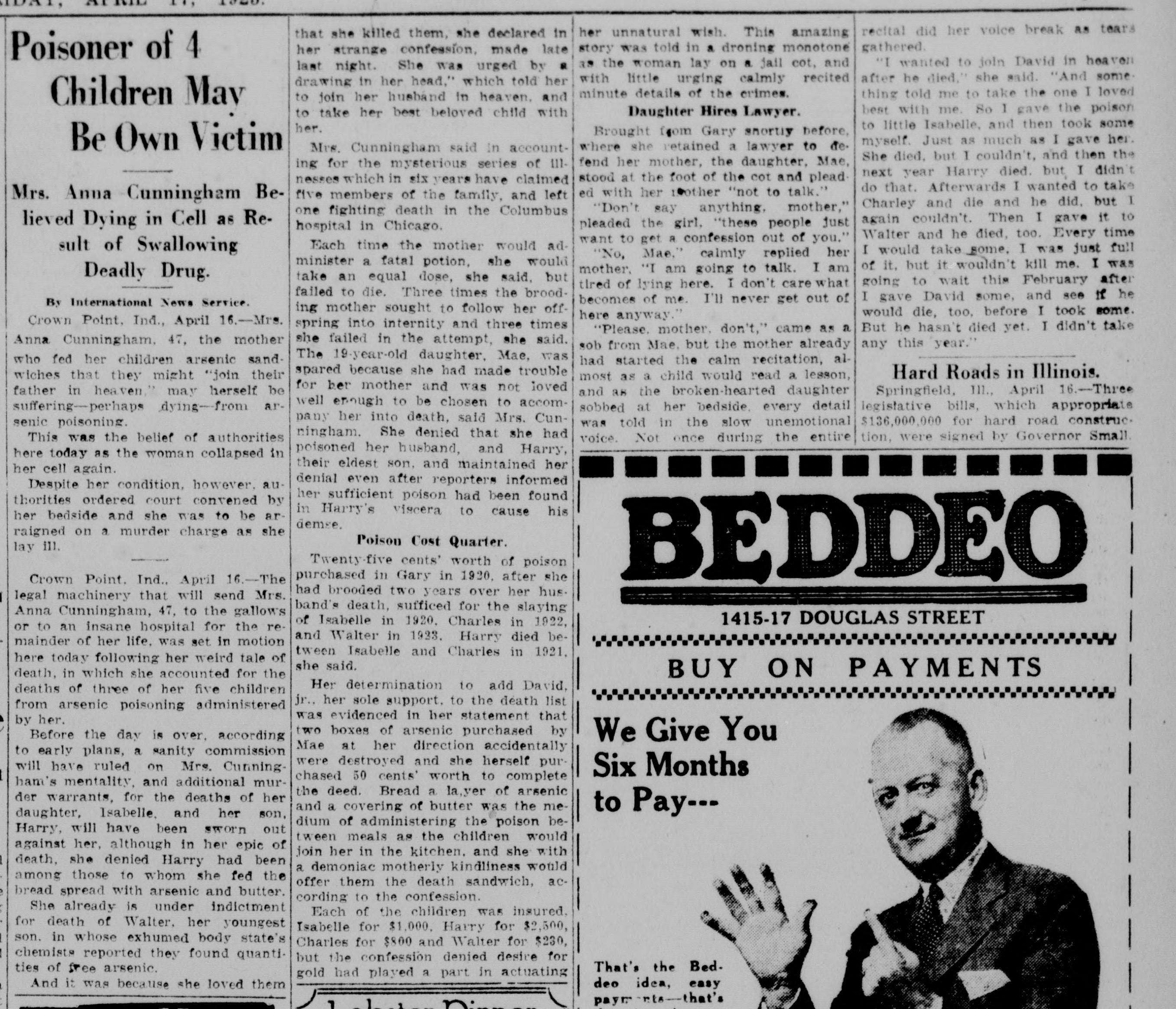
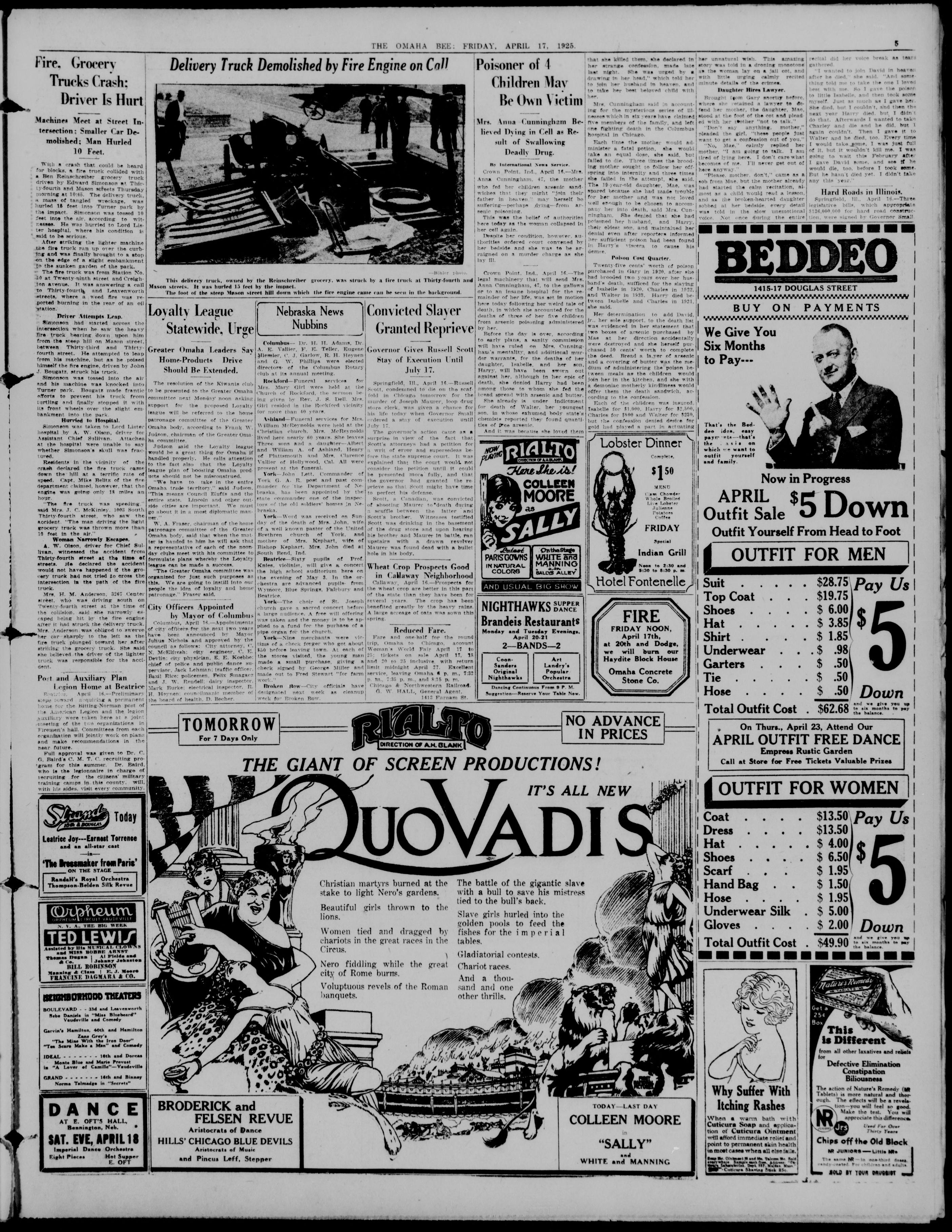
The Omaha Morning Bee for April 17, 1925, is more than ninety-five years old and in the public domain in its entirety. The scan is the Library of Congress copy in Chronicling America, and the citation and the Library's rights statement are printed beneath it. Because the story runs down two columns and then across the tops of two more, the crop also takes in an unrelated brief headed "Hard Roads in Illinois" and part of a furniture advertisement; neither belongs to the article.
The transcription follows the scan word for word, and no word was illegible. The paper's mistakes are left as printed: "internity," "his demse," a quotation that closes after "a drawing in her head" without ever opening, and one sentence, beginning "Mrs. Cunningham said in accounting," that never finishes. A few letters damaged by poor inking, in "from," "shortly" and "layer," are set as the words intended. The text reads down column 5, then column 6, then across the tops of columns 7 and 8, and all of it is here.
Transcription
Transcribed word for word from the page scan. Original spelling, punctuation, capitalisation and typographical errors have been kept exactly as printed. Unreadable words are marked [illegible]. Nothing has been modernised or corrected.
Poisoner of 4 Children May Be Own Victim
Mrs. Anna Cunningham Believed Dying in Cell as Result of Swallowing Deadly Drug.
By International News Service.
Crown Point, Ind., April 16.—Mrs. Anna Cunningham, 47, the mother who fed her children arsenic sandwiches that they might "join their father in heaven," may herself be suffering—perhaps dying—from arsenic poisoning.
This was the belief of authorities here today as the woman collapsed in her cell again.
Despite her condition, however, authorities ordered court convened by her bedside and she was to be arraigned on a murder charge as she lay ill.
Crown Point, Ind., April 16.—The legal machinery that will send Mrs. Anna Cunningham, 47, to the gallows or to an insane hospital for the remainder of her life, was set in motion here today following her weird tale of death, in which she accounted for the deaths of three of her five children from arsenic poisoning administered by her.
Before the day is over, according to early plans, a sanity commission will have ruled on Mrs. Cunningham's mentality, and additional murder warrants, for the deaths of her daughter, Isabelle, and her son, Harry, will have been sworn out against her, although in her epic of death, she denied Harry had been among those to whom she fed the bread spread with arsenic and butter.
She already is under indictment for death of Walter, her youngest son, in whose exhumed body state's chemists reported they found quantities of free arsenic.
And it was because she loved them that she killed them, she declared in her strange confession, made late last night. She was urged by a drawing in her head," which told her to join her husband in heaven, and to take her best beloved child with her.
Mrs. Cunningham said in accounting for the mysterious series of illnesses which in six years have claimed five members of the family, and left one fighting death in the Columbus hospital in Chicago.
Each time the mother would administer a fatal potion, she would take an equal dose, she said, but failed to die. Three times the brooding mother sought to follow her offspring into internity and three times she failed in the attempt, she said. The 19-year-old daughter, Mae, was spared because she had made trouble for her mother and was not loved well enough to be chosen to accompany her into death, said Mrs. Cunningham. She denied that she had poisoned her husband, and Harry, their eldest son, and maintained her denial even after reporters informed her sufficient poison had been found in Harry's viscera to cause his demse.
Poison Cost Quarter.
Twenty-five cents' worth of poison purchased in Gary in 1920, after she had brooded two years over her husband's death, sufficed for the slaying of Isabelle in 1920, Charles in 1922, and Walter in 1923. Harry died between Isabelle and Charles in 1921, she said.
Her determination to add David, jr., her sole support, to the death list was evidenced in her statement that two boxes of arsenic purchased by Mae at her direction accidentally were destroyed and she herself purchased 50 cents' worth to complete the deed. Bread a layer of arsenic and a covering of butter was the medium of administering the poison between meals as the children would join her in the kitchen, and she with a demoniac motherly kindliness would offer them the death sandwich, according to the confession.
Each of the children was insured, Isabelle for $1,000, Harry for $2,500, Charles for $800 and Walter for $230, but the confession denied desire for gold had played a part in actuating her unnatural wish. This amazing story was told in a droning monotone as the woman lay on a jail cot, and with little urging calmly recited minute details of the crimes.
Daughter Hires Lawyer.
Brought from Gary shortly before, where she retained a lawyer to defend her mother, the daughter, Mae, stood at the foot of the cot and pleaded with her mother "not to talk."
"Don't say anything, mother," pleaded the girl, "these people just want to get a confession out of you."
"No, Mae," calmly replied her mother, "I am going to talk. I am tired of lying here. I don't care what becomes of me. I'll never get out of here anyway."
"Please, mother, don't," came as a sob from Mae, but the mother already had started the calm recitation, almost as a child would read a lesson, and as the broken-hearted daughter sobbed at her bedside, every detail was told in the slow unemotional voice. Not once during the entire recital did her voice break as tears gathered.
"I wanted to join David in heaven after he died," she said. "And something told me to take the one I loved best with me. So I gave the poison to little Isabelle, and then took some myself. Just as much as I gave her. She died, but I couldn't, and then the next year Harry died, but I didn't do that. Afterwards I wanted to take Charley and die and he did, but I again couldn't. Then I gave it to Walter and he died, too. Every time I would take some, I was just full of it, but it wouldn't kill me. I was going to wait this February after I gave David some, and see if he would die, too, before I took some. But he hasn't died yet. I didn't take any this year."
Notes on the print, kept as printed: the headline figure is "4" though the text says three of her five children; "urged by a drawing in her head,"" has a closing quotation mark with no opening one; "internity"; "his demse"; "Mrs. Cunningham said in accounting for ... in Chicago." is an incomplete sentence as printed. Broken type set as the intended letter (an inking defect, not a misprint): "from" (r broken), "shortly" (h broken), "layer" (a stray mark between a and y). The article runs over four columns; it reads down column 5, then 6, then the top of 7 and 8. The rectangle crop also takes in an unrelated brief, "Hard Roads in Illinois," at the foot of column 8 and a furniture advertisement below columns 7–8; neither is part of the article. No words were illegible.