POISONED SIX HUNDRED: ST. PAUL DAILY GLOBE, JULY 20, 1890
By 1890 the woman remembered as Giulia Tofana had been dead for well over two centuries, and her story had long since become a tale told for the pleasure of a shudder. On July 20 of that year the St. Paul Daily Globe gave more than a column on page 11 to a piece from the British magazine Chambers' Journal under the headline "POISONED SIX HUNDRED." It opens on the Italy of the petty principalities, "when the most brutal selfishness and most cringing servility went hand in hand," and introduces "a woman, by name Tofana, a native of Palermo," who owned the recipe for a liquid "clear, tasteless, colorless and odorless," four to eight drops of which, the writer says, were fatal.
The writer walks through a husband's death dose by dose, from a little languor to the third drop that "would prostrate the vigorous man," while a "beautiful Medea" cooks his invalid's diet with her own hands and then demands a post-mortem to clear her name. From there the story moves to Rome, where Tofana's supposed partner, an old sorceress called Hieronyma Spara, runs a gang of poisoners until a lady agrees to play decoy for the police. Under torture Spara cries out, "Where are the Roman princes, nobles and knights who have made use of my art?" Pope Alexander VII sends her and her confederates to execution, and the writer dates the end of the band to 1658.
Tofana herself, in this version, is still loose. She is found at last to be a chatty little old woman carrying flasks labeled "Manna of St. Nicholas of Bari," which no customs officer dared touch, and she flees into a convent with the right of sanctuary. The viceroy of Naples drags her out by force in 1709; under torture she confesses "to no fewer than 600 murders!" and is strangled. The piece ends in a laboratory rather than on a scaffold, running through guesses at the poison's makeup, from the saliva of mad people to arsenic, and boasting that a modern toxicologist could detect any fatal dose.
This is a later feature, written in a British magazine and reprinted in Minnesota centuries after the events, and nearly everything it tells as history is legend. Giulia Tofana, whose married name was Giulia Mangiardi, was never charged, tried or convicted; she died in Rome in 1651, apparently of natural causes, and her name surfaced only in testimony of 1659 naming her as the maker and seller of a poison. The paper's "Hieronyma Spara" was Gironima Spana, her stepdaughter, not a sorceress she met; Spana and four others, among them Graziosa Farina ("Gratiosa" here), were hanged in Rome on July 5, 1659, not 1658. No document ties Giulia to Naples in 1709, and the 600 has no documentary basis. No killing by her own hand is established.
Chambers' Journal is credited at the head of the text, with no byline, and the St. Paul Daily Globe printed it in 1890; the page is in the public domain in the United States. The scan comes from Chronicling America at the Library of Congress, and the citation and the Library's rights statement are printed beneath it.
The story runs the full length of column 4 under its four-part headline and finishes at the top of column 5, and both crops are transcribed in full, ending at "after death." No word was too damaged to read; the ink blots on the page hide no letters. The compositor's slips are kept: "Poisou" in the last deck, "Tolana" and "Tofano" for Tofana, "custon," "stictest" and "administored." So are the paper's names for the viceroy, "Thaun" (usually Daun), and the imperial physician, "Giuelli" (usually Garelli). Words run together in the type, as in "takenand putto," have been given their normal spaces.

Transcription
Transcribed word for word from the page scan. Original spelling, punctuation, capitalisation and typographical errors have been kept exactly as printed. Unreadable words are marked [illegible]. Nothing has been modernised or corrected.
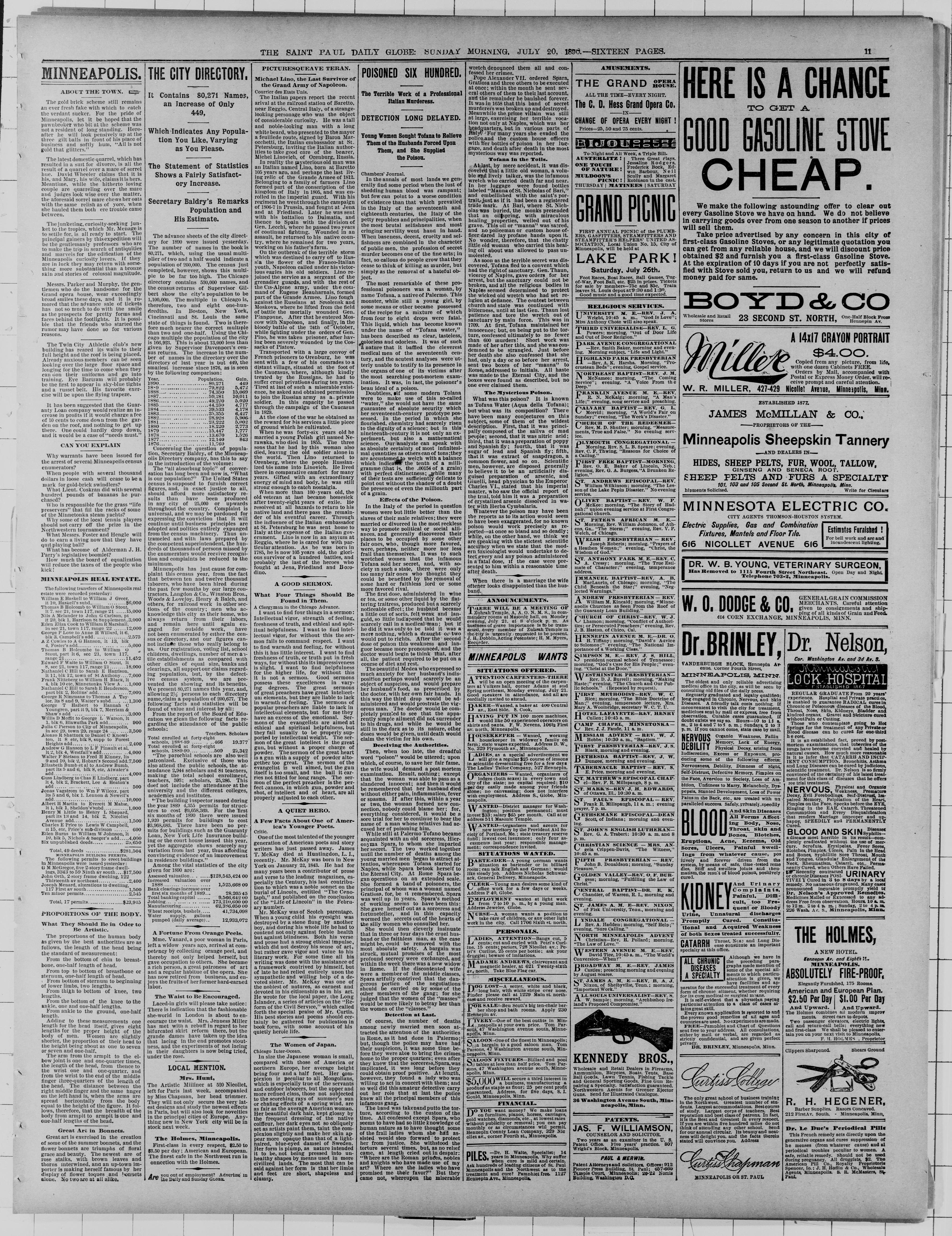
POISONED SIX HUNDRED.
The Terrible Work of a Professional Italian Murderess.
DETECTION LONG DELAYED.
Young Women Sought Tofana to Relieve Them of the Husbands Forced Upon Them, and She Supplied the Poisou.
Chambers' Journal.
In the annals of most lands we generally find some period when the lust of shedding human blood was rampant; but few can point to a worse condition of existence than that which prevailed in the Italy of the seventeenth and eighteenth centuries, the Italy of the petty republics and principalities, when the most brutal selfishness and most cringing servility went hand in hand. When baseness, deceit, cruelty and selfishness are combined in the character of public men, the profession of secret murder becomes one of the fine arts; in fact, so callous do people grow that they cease to think of killing as murder, but simply as the removal of a hateful object.
The most remarkable of these professional poisoners was a woman, by name Tofana, a native of Palermo. This monster, while still a young girl, by some means or other became possessed of the recipe for a mixture of which from four to eight drops were fatal. This liquid, which has become known under the name of "Tofana water," has been described as clear, tasteless, colorless and odorless. It was of such a nature that it baffled the cleverest medical men of the seventeenth century, and the acutest analyses were utterly unable to testify to its presence in the organs of one of its victims after the most searching post-mortem examination. It was, in fact, the poisoner's beau ideal of a poison.
Doubtless, if some modern Tolana were to make use of this so-called "water," she would not have the same guarantee of absolute security which her seventeenth-century prototype possessed. In the period in which she flourished, chemistry had scarcely risen to the dignity of a science; but in this nineteenth-century it is not only an experiment, but also a mathematical science. Our analyste can speak with as absolute certainty of most infinitesimal quantities as others can of tons;they are accustomed to weigh with a balance which indicates the tenth of a milligramme (that is, the .00154 of a grain) with perfect distinctness; while many of their tests are sufficiently delicate to point out without the shadow of a doubt the presence of even the millionth part of a grain.
Effects of the Poison.
In the Italy of the period in question women were but little better than the slaves of their male relatives; they were married or divorced in the most reckless way to promote political or social alliances, and generally discovered their places to be occupied by some other fair ones, who, though more favored, were, perhaps, neither more nor less frail than themselves. It was to such wretched women that the infamous Tofana sold her secret, and, with society in such a state, there were only too many fair ones who thought they could be benefited by the removal of some hard or faithless lord or some more favored rival.
The first dose, administered in wine or tea, or some other liquid by the flattering traitress, produced but a scarcely noticeable effect; the husband became a little out of sorts, felt weak and languid, so little indisposed that he would scarcely call in a medical man; but if he did it was only to be told it was a mere nothing, which a draught or two would put to rights. After the second dose of poison this weakness and languor became more pronounced, and the doctor would begin to think that, after all, the patient required to be put on a course of diet and rest.
The beautiful Medea who expressed so much anxiety for her husband's indisposition perhaps would scarcely be an object of suspicion, and would prepare her husband's food, as prescribed by the doctor, with her own fair hands. In this way the third drop would be administered and would prostrate the vigorous man. The doctor would be completely puzzled to see that the apparently simple ailment did not surrender to his drugs, and while he would be still in the dark as to its nature, other doses would be given, until death would claim the victim for his own.
Deceiving the Authorities.
Then, when too late, the dreadful word "poison" would be uttered; upon which, of course, to save her fair fame, the wife would demand a post mortem examination. Result, nothing; except that the woman was able to pass as a slandered innocent; and then it would be remembered that her husband died without either pain, inflammation, fever or spasms. If after this, within a year or two, the woman formed new connection, nobody could blame her; for, everything considered, it would be a sore trial for her to continue to bear the name of a man whose relatives had accused her of poisoning him.
While still at Palermo Tofano became acquainted with an old sorceress, Hieronyma Spara, to whom she imparted her secret. The two worked together until the number of deaths among the young married men began to attract attention, whereupon Tofana started for Naples, while Spara betook herself to the Eternal City. At Rome Spara began operations on an extended scale. She formed a band of poisoners, the principal of whom was a woman named Gratiosa. for, be it remembered. Spara was well up in years. Spara's method of working seems to have been this: She gave herself out as a sorceress and fortuneteller, and in this capacity wormed the secrets out of the hearts of the silly women who consulted her.
She would then cleverly insinuate that in three or four days the cruel husband or the faithless man, as the case might be, could be removed with the most absolute safety. A bargain was struck, mutual promises of the most profound secrecy were exchanged, and within the week there was a new widow in Rome. If the discontented wife were a member of the middle classes, Spara artfully contrived that the dangerous portion of the negotiations should be carried on by some of the other members of the gang; for she judged that the women of the "masses" would be more likely to betray her than the women of the "classes."
Detection at Last.
Of course, the number of deaths among newly married men soon attracted the attention of the authorities in Rome, as it had done in Palermo; but, though the police may have had their suspicions, it was some time before they were able to bring the crimes home to the proper quarters; even after they knew that the sorceress,Spara,was implicated, it was long before they could obtain proof positive. At length, however, they found a lady who was willing to act in concert with them; and so well did this amateur detective carry out her role that at last the police knew all the principal members of this infamous gang.
The band was taken and put to the torture, according to the custon of the time. All confessed except Spara, who seems to have had so little knowledge of human nature as to have thought some of the frail ladies whom she had assisted would step forward to protect her from justice. She withstood the torture several times, but, as no relief came, at length cried out in despair: "Where are the Roman princes, nobles and knights who have made use of my art? Where are the ladies who have promised me their favor?" But they came not, whereupon the miserable wretch denounced them all and confessed her crimes.
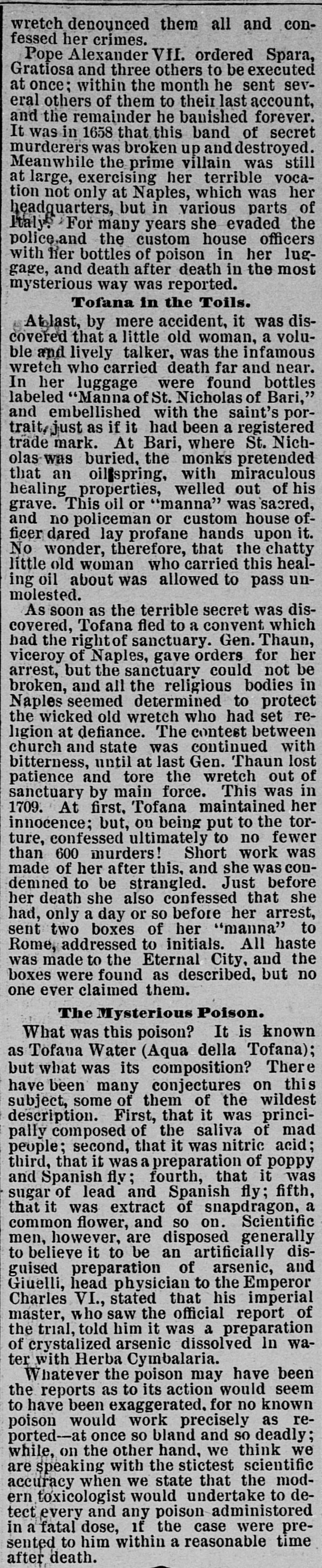
Pope Alexander VII. ordered Spara, Gratiosa and three others to be executed at once; within the month he sent several others of them to their last account, and the remainder he banished forever. It was in 1658 that this band of secret murderers was broken up and destroyed. Meanwhile the prime villain was still at large, exercising her terrible vocation not only at Naples, which was her headquarters, but in various parts of Italy. For many years she evaded the police and the custom house officers with her bottles of poison in her luggage, and death after death in the most mysterious way was reported.
Tofana in the Toils.
At last, by mere accident, it was discovered that a little old woman, a voluble and lively talker, was the infamous wretch who carried death far and near. In her luggage were found bottles labeled "Manna of St. Nicholas of Bari," and embellished with the saint's portrait, just as if it had been a registered trade mark. At Bari, where St. Nicholas was buried, the monks pretended that an oil spring, with miraculous healing properties, welled out of his grave. This oil or "manna" was sacred, and no policeman or custom house officer dared lay profane hands upon it. No wonder, therefore, that the chatty little old woman who carried this healing oil about was allowed to pass unmolested.
As soon as the terrible secret was discovered, Tofana fled to a convent which had the right of sanctuary. Gen. Thaun, viceroy of Naples, gave orders for her arrest, but the sanctuary could not be broken, and all the religious bodies in Naples seemed determined to protect the wicked old wretch who had set religion at defiance. The contest between church and state was continued with bitterness, until at last Gen. Thaun lost patience and tore the wretch out of sanctuary by main force. This was in 1709. At first, Tofana maintained her innocence; but, on being put to the torture, confessed ultimately to no fewer than 600 murders! Short work was made of her after this, and she was condemned to be strangled. Just before her death she also confessed that she had, only a day or so before her arrest, sent two boxes of her "manna" to Rome, addressed to initials. All haste was made to the Eternal City, and the boxes were found as described, but no one ever claimed them.
The Mysterious Poison.
What was this poison? It is known as Tofana Water (Aqua della Tofana); but what was its composition? There have been many conjectures on this subject, some of them of the wildest description. First, that it was principally composed of the saliva of mad people; second, that it was nitric acid; third, that it was a preparation of poppy and Spanish fly; fourth, that it was sugar of lead and Spanish fly; fifth, that it was extract of snapdragon, a common flower, and so on. Scientific men, however, are disposed generally to believe it to be an artificially disguised preparation of arsenic, and Giuelli, head physician to the Emperor Charles VI., stated that his imperial master, who saw the official report of the trial, told him it was a preparation of crystalized arsenic dissolved in water with Herba Cymbalaria.
Whatever the poison may have been the reports as to its action would seem to have been exaggerated, for no known poison would work precisely as reported—at once so bland and so deadly; while, on the other hand, we think we are speaking with the stictest scientific accuracy when we state that the modern toxicologist would undertake to detect every and any poison administored in a fatal dose, if the case were presented to him within a reasonable time after death.
Notes: Reprinted from Chambers' Journal (credited at the head of the text). The article fills the whole of column 4 under its four-part headline (main head "POISONED SIX HUNDRED.", decks "The Terrible Work of a Professional Italian Murderess.", "DETECTION LONG DELAYED." and "Young Women Sought Tofana to Relieve Them of the Husbands Forced Upon Them, and She Supplied the Poisou.") and continues at the top of column 5, ending at "after death." above a short rule. The rest of column 5 (a two-line filler joke and a Masonic meeting notice under "ANNOUNCEMENTS.", then classified advertisements) is excluded. Because a single rectangle across both columns would take in that matter, the story is supplied as ARTICLE-CROP.jpg (column 4) and ARTICLE-CROP-PART-2.jpg (top of column 5). Printed errors are kept as printed: "Poisou" (for Poison) in the last deck, "Tolana" (for Tofana) in "some modern Tolana", "Tofano" (for Tofana) in "While still at Palermo Tofano", "analyste", "tons;they" and "sorceress,Spara,was" (no spaces in print), "Gratiosa. for, be it remembered. Spara" (full stops as printed), "formed new connection" (article missing), "custon" (for custom), "Thaun" (the viceroy is usually named Daun), "Giuelli" (the physician is usually named Garelli), "crystalized", "stictest", "administored". The words "taken and put to" are run together in the type ("takenand putto"); normal word spaces have been given. An ink blot before "if" in "Doubtless, if" and a dark spot over "indicates" are print defects; neither hides a letter. An ink blot after "oil" in "oil spring" appears to be a raised space or quad; it has been read as a word space ("oil spring"). Line-end hyphenation from column setting has been joined (e.g. "gen-/erally", "sel-/fishness", "pro-/fessional", "ut-/terly", "exam-/ination", "dis-/covered", "Nich-/olas", "re-/ported"); hyphens within a line ("post-mortem", "so-called", "seventeenth-century", "nineteenth-century") are kept. On the lower part of ARTICLE-CROP.jpg the page is slightly skewed and a few specks of the neighbouring column show beyond the column rule at the right edge; no words from it are readable. Readability: good; no [illegible] marks needed.