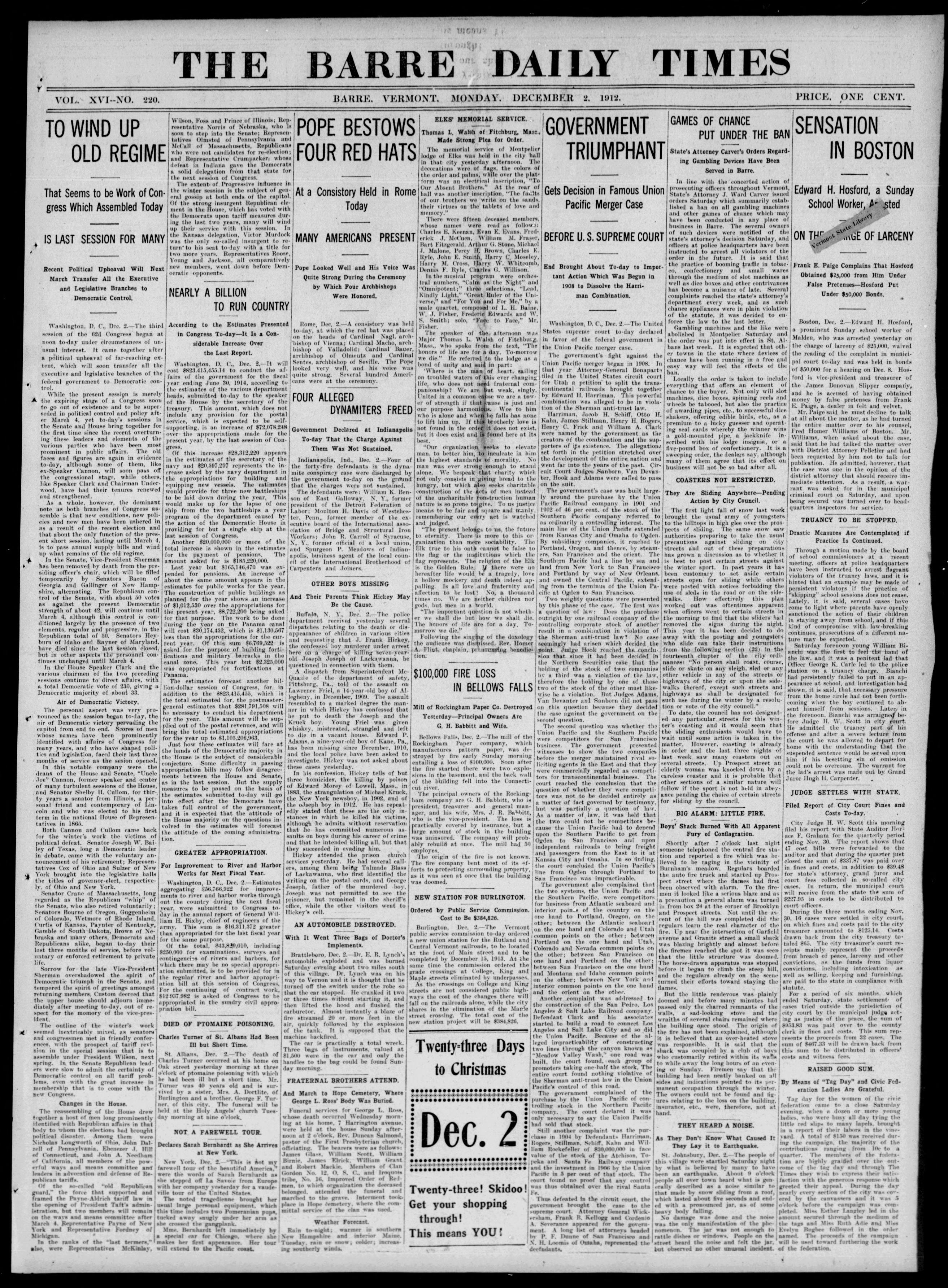
OTHER BOYS MISSING: THE BARRE DAILY TIMES, DECEMBER 2, 1912
On the first of December 1912, the telegrams started reaching Buffalo police headquarters from other cities. John Frank Hickey had confessed to killing seven-year-old Joseph Joseph of Lackawanna, and police in places far from Buffalo wanted to know whether their own dead and missing children belonged to him too. The Barre Daily Times in Vermont carried the dispatch on its front page the next day. It describes two of the requests. One came from Pittsburgh, about a fourteen-year-old boy in Allegheny who in December 1909 had been given whiskey, mistreated, strangled and left to die in a vacant house. The other concerned a nine-year-old boy from Kane, Pennsylvania, missing since December 1910.
The Pittsburgh case, the paper says, resembled "to a marked degree" the way Hickey had described killing Joey Joseph and the newsboy Michael Kruck. Hickey himself held to three. He had poisoned Edwin Morey, a pharmacist he worked with in Lowell, Massachusetts, in 1883; strangled Michael Kruck in New York in 1902; and killed the Joseph boy. He admitted "numerous assaults on boys" over the years and said he had meant to kill every one of them, but he insisted that those three were the only times he had. Nobody had yet put the new cases to him.
The day before the story ran, he went to services in the prison church and received callers. One was Talmade Blass of Lackawanna, the man who first identified the handwriting on the postcards about the missing boy. Another was George Joseph, the murdered boy's father. He was not allowed to see the prisoner. He waited in the sheriff's office while the other visitors were taken back to Hickey's cell, and that is where the dispatch leaves him.
This is a short wire dispatch from Buffalo, written before Hickey's trial, and it records requests from other police departments, not findings. Nothing in it ties him to the Allegheny assault or the Kane disappearance beyond a resemblance the paper reports, and nothing beyond his own three admissions was ever proved. He was convicted of one crime, the second-degree murder of Joey Joseph, in December 1912, after two jurors would not find him sane, and was sentenced to twenty years to life. The paper calls the first victim Edward Morey; his name was Edwin W. Morey. It dates the Joseph killing to 1912, but the boy disappeared on October 12, 1911, and his remains were found the following year.
Published in Vermont on December 2, 1912, The Barre Daily Times is more than ninety-five years old and in the public domain. The scan is the Library of Congress copy held in Chronicling America; the citation and the rights statement are printed below it, and the dispatch itself runs in the third column of the front page.
The transcription is complete and word for word, with no illegible marks. The compositor's slip "oJseph boy" is left in the third paragraph, and so is "Pittsburg," spelled without its final h. The witness's first name appears as "Talmade" and the dateline as "Buffalo, N. Y.," both exactly as printed, and the paper's "postal cards" is kept where a later writer would say postcards.
Transcription
Transcribed word for word from the page scan. Original spelling, punctuation, capitalisation and typographical errors have been kept exactly as printed. Unreadable words are marked [illegible]. Nothing has been modernised or corrected.
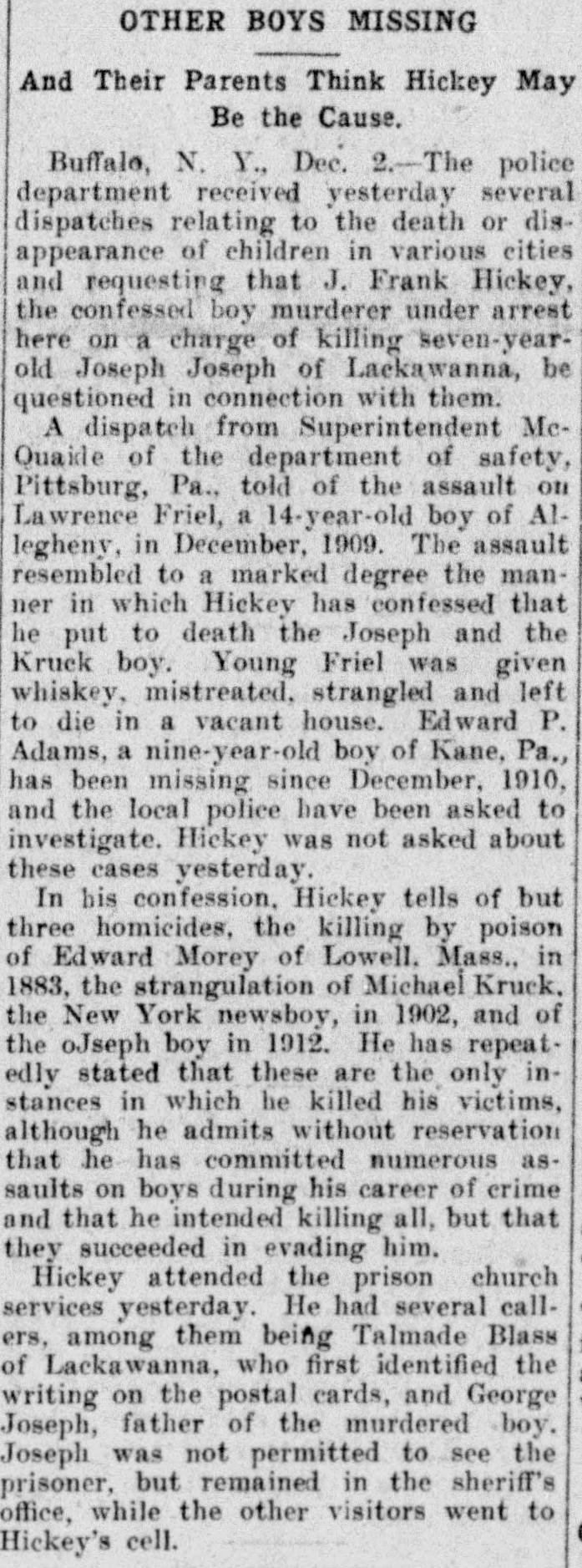
OTHER BOYS MISSING
And Their Parents Think Hickey May Be the Cause.
Buffalo, N. Y., Dec. 2.—The police department received yesterday several dispatches relating to the death or disappearance of children in various cities and requesting that J. Frank Hickey, the confessed boy murderer under arrest here on a charge of killing seven-year-old Joseph Joseph of Lackawanna, be questioned in connection with them.
A dispatch from Superintendent McQuaide of the department of safety, Pittsburg, Pa., told of the assault on Lawrence Friel, a 14-year-old boy of Allegheny, in December, 1909. The assault resembled to a marked degree the manner in which Hickey has confessed that he put to death the Joseph and the Kruck boy. Young Friel was given whiskey, mistreated, strangled and left to die in a vacant house. Edward P. Adams, a nine-year-old boy of Kane, Pa., has been missing since December, 1910, and the local police have been asked to investigate. Hickey was not asked about these cases yesterday.
In his confession, Hickey tells of but three homicides, the killing by poison of Edward Morey of Lowell, Mass., in 1883, the strangulation of Michael Kruck, the New York newsboy, in 1902, and of the oJseph boy in 1912. He has repeatedly stated that these are the only instances in which he killed his victims, although he admits without reservation that he has committed numerous assaults on boys during his career of crime and that he intended killing all, but that they succeeded in evading him.
Hickey attended the prison church services yesterday. He had several callers, among them being Talmade Blass of Lackawanna, who first identified the writing on the postal cards, and George Joseph, father of the murdered boy. Joseph was not permitted to see the prisoner, but remained in the sheriff's office, while the other visitors went to Hickey's cell.