OREGON DAD, 30, ADMITS KILLING 3 YOUNG WOMEN: THE SALT LAKE TRIBUNE, JUNE 29, 1969
"I did it," Jerome Brudos told the court, and with those words there would be no trial. Jerome Henry Brudos was thirty, a Salem electrician as the wire described him, a blond, stocky father of two young children, and he had been due before a jury on Monday for the murder of Karen Sprinker. Instead, in Marion County Circuit Court on Friday, June 27, 1969, he pleaded guilty to the first-degree murders of three young women: Karen Sprinker of Salem, Jan Susan Whitney of McMinnville and Linda Salee of Beaverton. Judge Val D. Sloper then sentenced him to three consecutive life terms in the Oregon State Penitentiary. Two days later the United Press International account ran on an inside page of The Salt Lake Tribune.
It was not the plea he had first entered. Brudos had answered all three indictments not guilty by reason of insanity. He changed his mind, his defense attorney told the court, after going over the evidence investigators had gathered and the reports of the court-appointed psychiatrists who examined him. One of his lawyers, Dale Drake, said those reports were "substantially the same," with apparently no conflicting diagnoses, and that they found Brudos knew the difference between right and wrong. What the evidence held, the story does not say. It included Polaroid photographs found in his garage of women living and dead, Karen Sprinker among them.
One paragraph carries a fourth name. Brudos, the paper said, was also linked to the murder of an unidentified victim believed to be Linda Slawson, nineteen, of Aloha. She sold encyclopedias door to door and had come to his house by mistake in January 1968. He confessed to killing her, but her body was never found, and he was never tried for her death. One of the women he pleaded guilty to killing was still missing that day as well. Jan Susan Whitney's body was recovered from the Willamette River near Independence a month after his conviction.
This is a brief United Press International dispatch, printed two days after the hearing, and it reports the plea rather than the crimes. It gives Karen Sprinker's age as nineteen; she was eighteen. It calls Brudos an electrician, where he worked as an electronics technician. Its crosshead "Decides to Change" sits over the paragraph about Linda Slawson, not the change of plea. What the court established is the three first-degree murders he admitted, of Karen Sprinker, Jan Susan Whitney and Linda Salee. His confession to Linda Slawson's killing was never tested in court.
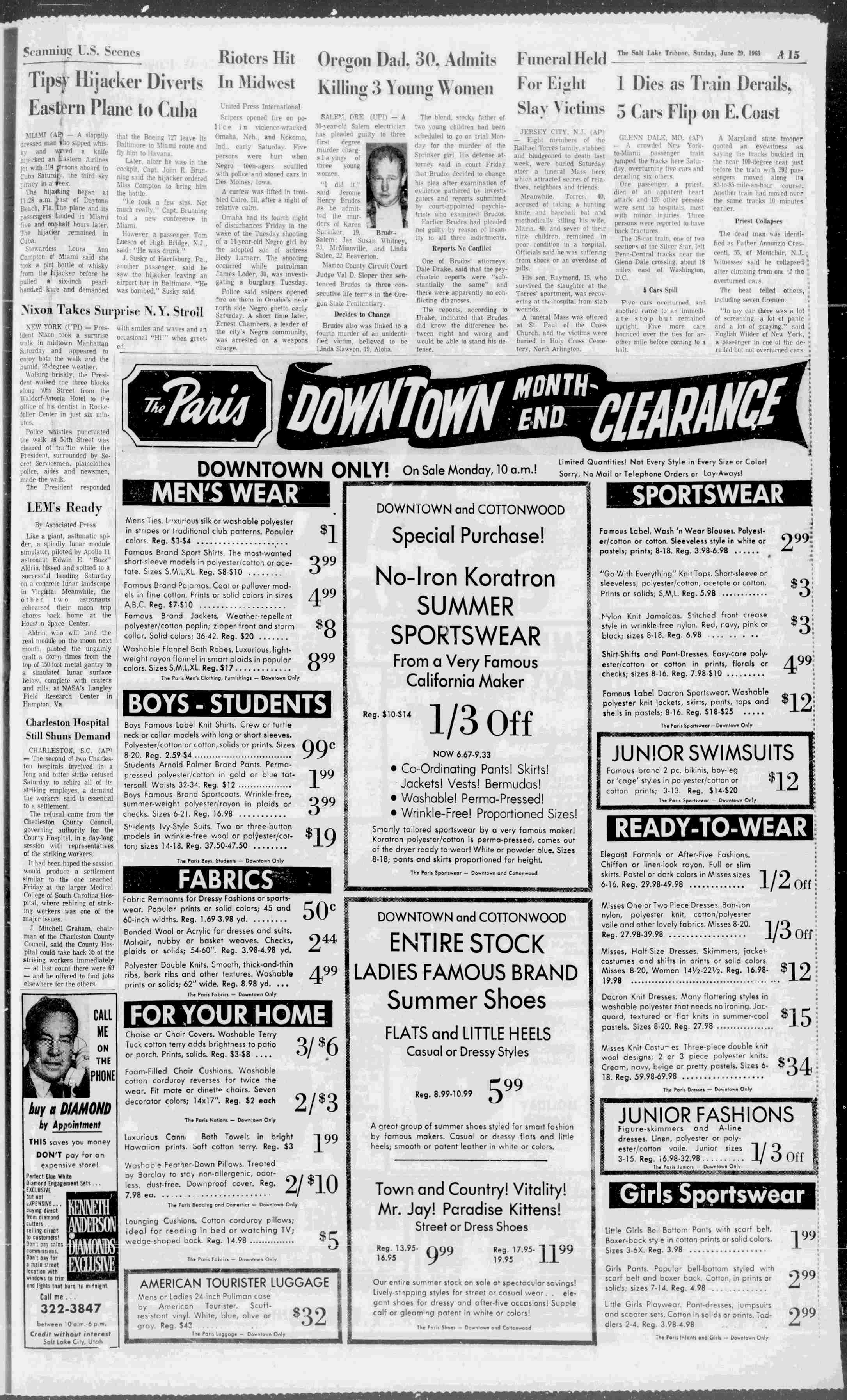
Published on June 29, 1969, on page A15 of The Salt Lake Tribune, this is United Press International copy with no staff byline. A search of every page of that issue turned up copyright notices only on syndicated New York Times Service and similar pieces, none on this story or the masthead, and before 1978 an American publication needed such a notice to keep its copyright. The scan was supplied by Utah Digital Newspapers, the University of Utah's J. Willard Marriott Library collection, which gives the issue its "No Copyright - United States" rating. The citation and rights statement follow the scan.
The scan is soft and lightly inked, and the S of "SALEM" is broken, but every word could be read under magnification, so no [illegible] marks appear in the transcription. The opening sentence is given exactly as it ran, "three first degree murder charges slayings of three young women," with a word lost where "charges" was broken across a line. The one-word photo caption is placed at the end.
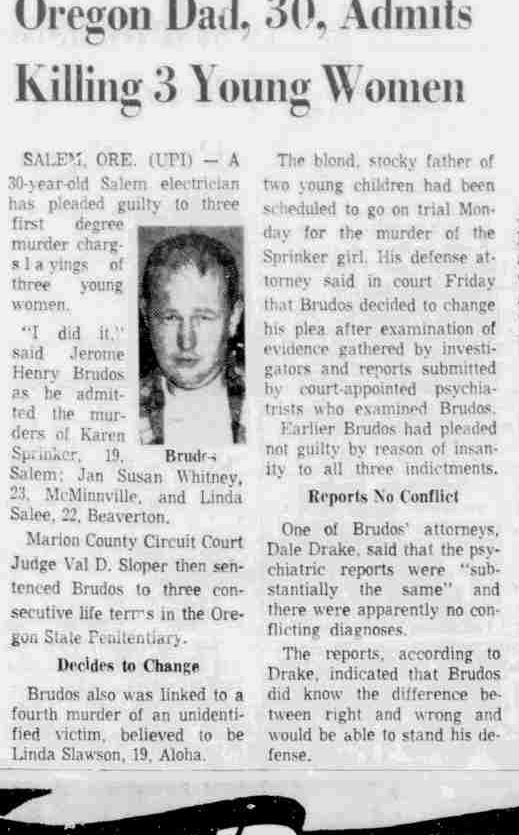
Transcription
Transcribed word for word from the page scan. Original spelling, punctuation, capitalisation and typographical errors have been kept exactly as printed. Unreadable words are marked [illegible]. Nothing has been modernised or corrected.
Oregon Dad, 30, Admits Killing 3 Young Women
SALEM, ORE. (UPI) — A 30-year-old Salem electrician has pleaded guilty to three first degree murder charges slayings of three young women.
"I did it," said Jerome Henry Brudos as he admitted the murders of Karen Sprinker, 19, Salem; Jan Susan Whitney, 23, McMinnville, and Linda Salee, 22, Beaverton.
Marion County Circuit Court Judge Val D. Sloper then sentenced Brudos to three consecutive life terms in the Oregon State Penitentiary.
Decides to Change
Brudos also was linked to a fourth murder of an unidentified victim, believed to be Linda Slawson, 19, Aloha.
The blond, stocky father of two young children had been scheduled to go on trial Monday for the murder of the Sprinker girl. His defense attorney said in court Friday that Brudos decided to change his plea after examination of evidence gathered by investigators and reports submitted by court-appointed psychiatrists who examined Brudos.
Earlier Brudos had pleaded not guilty by reason of insanity to all three indictments.
Reports No Conflict
One of Brudos' attorneys, Dale Drake, said that the psychiatric reports were "substantially the same" and there were apparently no conflicting diagnoses.
The reports, according to Drake, indicated that Brudos did know the difference between right and wrong and would be able to stand his defense.
[Photo caption] Brudos
Notes: "murder charges slayings of three young women" as printed: a word ("in" or "for the") has dropped out at the line break in "charg- / s l a yings". "slayings" is letter-spaced. The scan is soft and lightly inked, and the "S" of "SALEM" is broken; every word was readable at magnification, and no [illegible] markers were needed. The crosshead "Decides to Change" sits above a paragraph that is not about the change of plea. Kept as printed.