OFFICER ORDERS BODIES EXHUMED: SOUTH BEND NEWS-TIMES, SEPTEMBER 5, 1928
In the farm country west of St. Louis, Bertha Gifford was the neighbor who came when someone fell sick. She sat up in sickrooms, she cooked, and she went to the funerals, often enough that the papers had a name ready for her when the questions began: the "Good Samaritan." By the first week of September 1928 she was sitting in the Franklin County jail at Union, Missouri, and the state wanted to know how many of the people she had nursed were still in their graves for natural reasons.
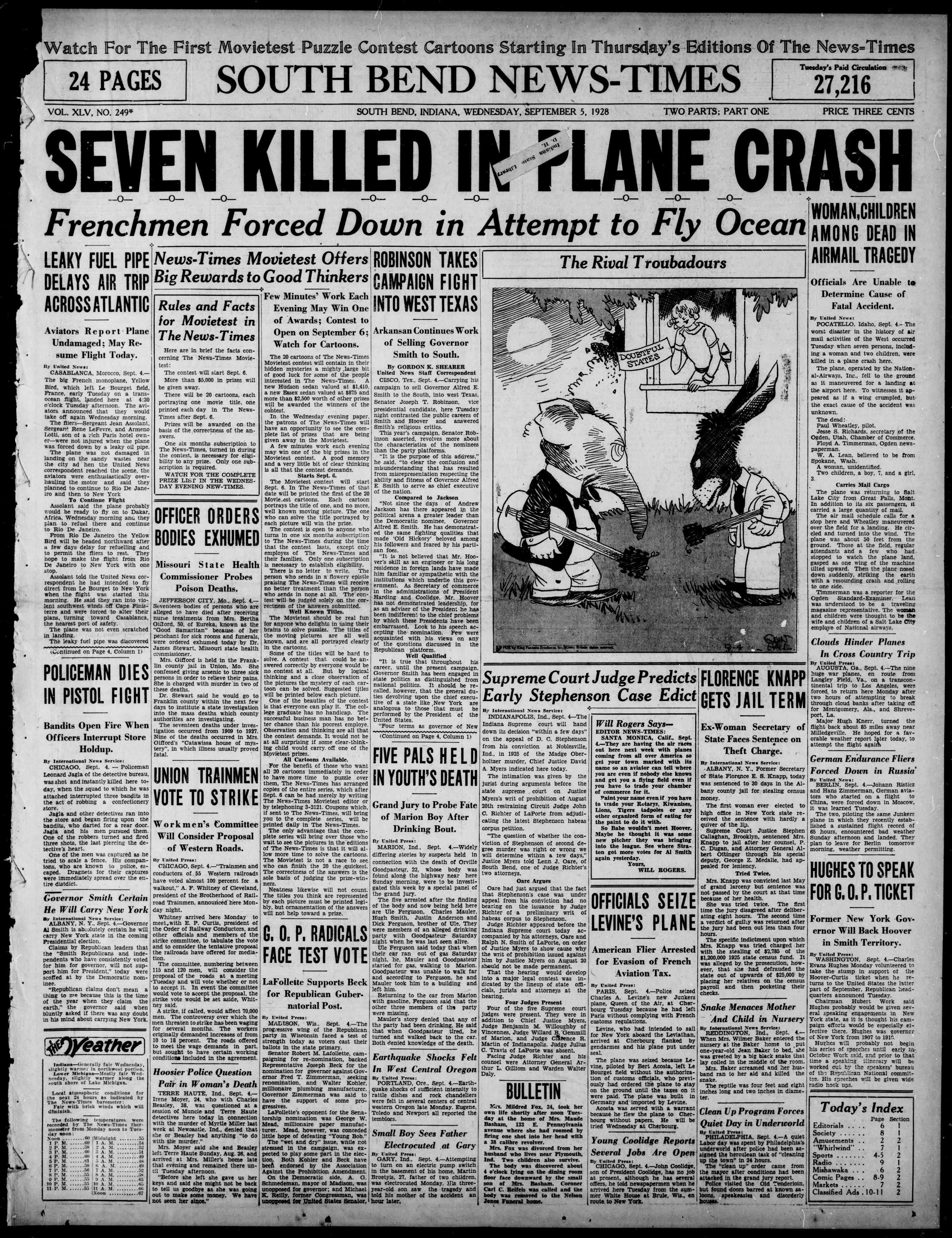
On September 4 Dr. James Stewart, the Missouri state health commissioner, ordered seventeen bodies exhumed. The South Bend News-Times put the dispatch on its front page the next morning. Every one of the seventeen, the paper said, had died after receiving what it called "nurse treatments" from Mrs. Gifford, and the deaths reached back nearly twenty years, from 1909 to 1927. Stewart meant to go to Franklin County himself within days and open a state inquiry beside the one the county was already running.
The column's sharpest phrase belongs to the farmhouse. Nine of the deaths, it says, had happened in her "Catawissa house of mystery," a place where illness usually ended in a funeral. Then come the two facts that had put her behind bars. She had confessed, the paper says, to giving arsenic to three sick people "in order to relieve their pains," and she now stood charged with murder in two of those deaths.
This short dispatch was written in the first weeks of the case, and it states as fact a confession that newspapers had reported and that Gifford denied, hysterically, the day after it was made public. The paper gives her age as 50; born on October 30, 1871, she was fifty-six. Gifford was never convicted of anything. Tried at Union, she was found not guilty by reason of insanity and committed to the state hospital at Farmington, where she died on August 20, 1951. Accounts differ on whether that trial covered two deaths or three. Arsenic was then sold freely and used in medicine, and how many of the seventeen deaths she caused, or whether she meant to, has never been settled.
The South Bend News-Times of September 5, 1928, was published more than ninety-five years ago, which puts it entirely in the public domain, free of any restriction. The scan comes from the Library of Congress through Chronicling America, and the full citation and rights statement are set beneath it.
The column is short, cleanly printed and complete, ending at a rule, and the transcription follows it word for word with nothing marked illegible. The paper's phrasing is untouched, including "nurse treatments" and "penchant for sick rooms and funerals," and so is its punctuation in "Catawissa house of mystery", where the comma falls outside the closing quotation mark.
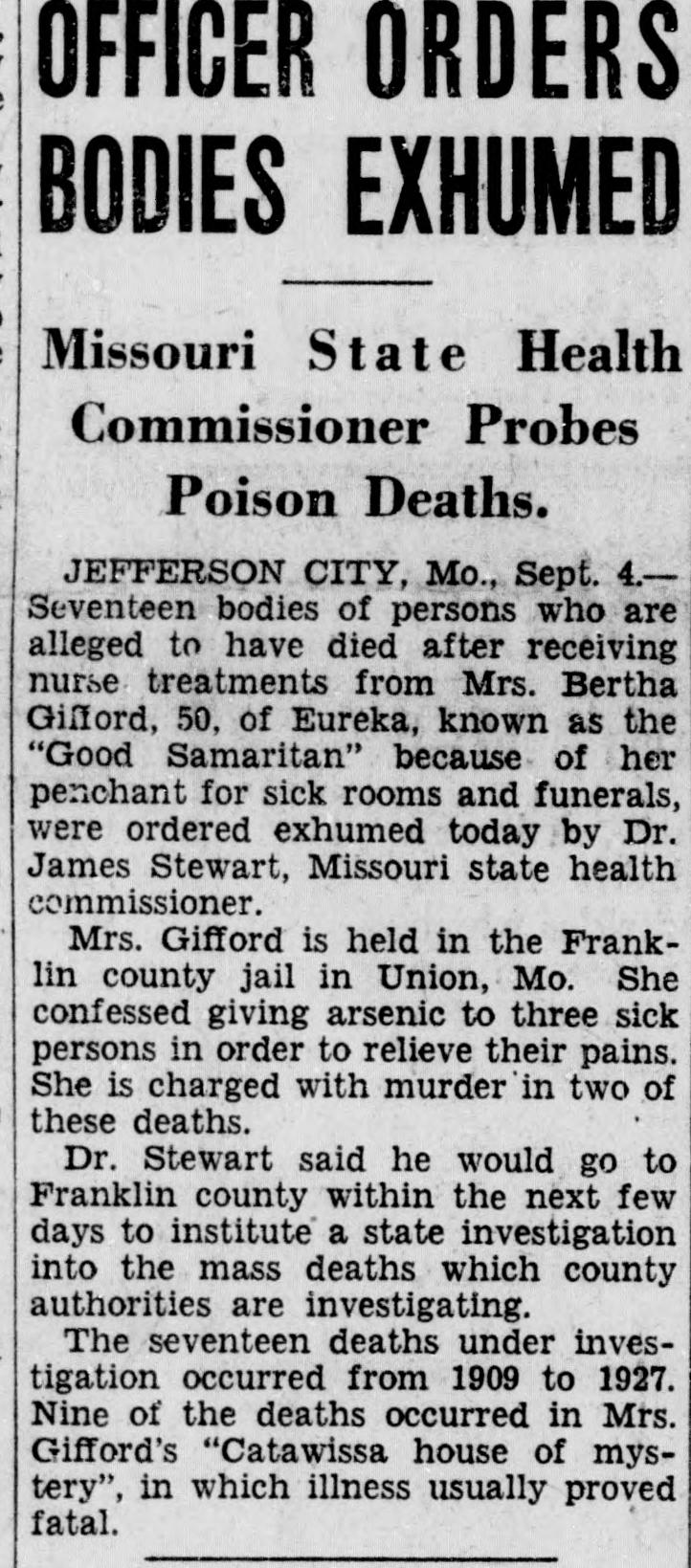
Transcription
Transcribed word for word from the page scan. Original spelling, punctuation, capitalisation and typographical errors have been kept exactly as printed. Unreadable words are marked [illegible]. Nothing has been modernised or corrected.
OFFICER ORDERS BODIES EXHUMED
Missouri State Health Commissioner Probes Poison Deaths.
JEFFERSON CITY, Mo., Sept. 4.—Seventeen bodies of persons who are alleged to have died after receiving nurse treatments from Mrs. Bertha Gifford, 50, of Eureka, known as the "Good Samaritan" because of her penchant for sick rooms and funerals, were ordered exhumed today by Dr. James Stewart, Missouri state health commissioner.
Mrs. Gifford is held in the Franklin county jail in Union, Mo. She confessed giving arsenic to three sick persons in order to relieve their pains. She is charged with murder in two of these deaths.
Dr. Stewart said he would go to Franklin county within the next few days to institute a state investigation into the mass deaths which county authorities are investigating.
The seventeen deaths under investigation occurred from 1909 to 1927. Nine of the deaths occurred in Mrs. Gifford's "Catawissa house of mystery", in which illness usually proved fatal.
Transcriber's notes
- Readability: very good. Clean type throughout, lightly greyed. No [illegible] markers were needed.
- Kept as printed: "nurse treatments", "penchant for sick rooms and funerals", and the quotation marks and comma placement in «"Catawissa house of mystery", in which», which puts the comma outside the closing quotation mark against the paper's usual style.
- The two nicknames in the piece — the "Good Samaritan" and the "Catawissa house of mystery" — are the contemporary press names for Gifford and for the farmhouse at Catawissa, Missouri, and are the reason the item is worth having.
- The article is self-contained in one column and ends at a rule.
- Gifford was tried in November 1928 for two of the deaths and found not guilty by reason of insanity; she died in the State Hospital at Farmington in 1951.