Phoenix Police Name Aaron Saucedo as the Serial Street Shooter and Charge Him in Nine Killings
Already jailed in the 2015 death of his mother’s boyfriend, the 23-year-old former bus driver was booked on 26 felony counts covering 12 shootings.
Published
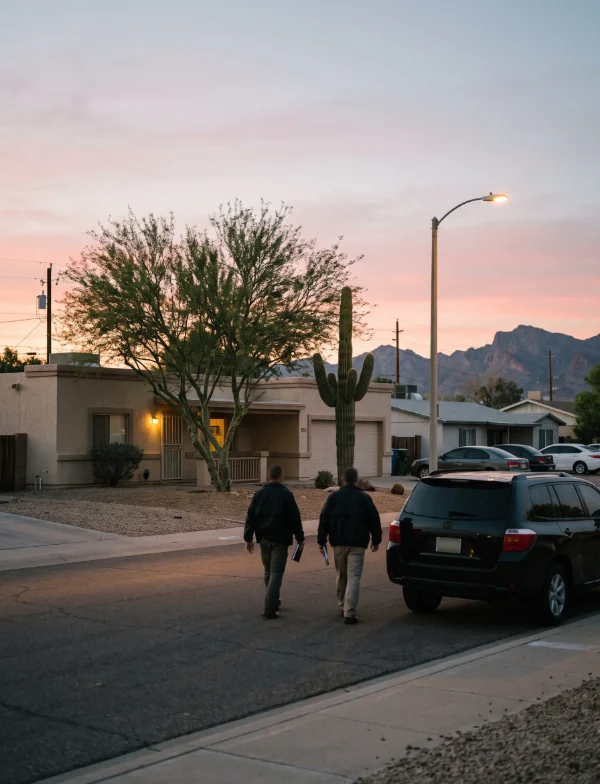
For more than a year the gunman picked his targets after dark in west Phoenix: people standing outside their homes, people sitting in parked cars. On Monday, May 8, 2017, Police Chief Jeri Williams stood beside the mayor and the county's top prosecutor and gave him a name. Aaron Juan Saucedo, 23, a former city bus driver, was booked on 26 felony counts, including homicide, assault and drive-by shooting, in the case Phoenix had come to call the Serial Street Shooter.
Saucedo was already in jail. Police had arrested him the month before in the August 2015 shooting of Raul Romero, 61, a man who had been in a relationship with his mother, found dead in his driveway. According to court documents, detectives traced a pistol Saucedo had sold to a pawn shop and matched it to evidence from that scene. He was charged with Romero's murder on April 21. Looking harder at him, investigators said, they tied him to the street shootings.
The case they described was larger than the one the city had feared. The investigation had focused on seven fatal shootings. Police now linked Saucedo to nine deaths in 12 shootings between August 2015 and July 2016, three more attacks and two more killings than first thought. All of them, Williams said, were random except Romero's. Police said that about four months after Romero's death, Jesse Olivas, 22, was shot in front of a home on New Year's Day 2016. On March 17 two teenage boys were shot at and one was hit in the arm; another shooting the next day killed no one. Diego Verdugo-Sanchez, 21, was killed on April 1, when his partner, Marina Smith, was seven months pregnant with their child. Krystal White died on April 19, Horacio de Jesus Pena on June 3, Manny Castro Garcia on June 10. On June 12 the gunman killed Angela Linner, Stefanie Ellis and Stefanie's 12-year-old daughter, Maleah. The last shooting, on July 11, 2016, missed a 21-year-old man and his 4-year-old nephew in their car.
"This case plagued our community for more than a year," Williams said, "and left behind a trail of victims that included mothers, sons, brothers, sisters and families still mourning the loss of their loved ones." She credited tips from the public. Police offered no motive.
One loose end ran back to another case. The killings had nothing to do with the 2015 freeway shootings that frightened Phoenix drivers, police said, but the state Department of Public Safety disclosed that the pistol Saucedo had pawned was the same type used on the freeways, a Hi-Point 9mm, and had been test-fired during that inquiry before it was returned to the pawn shop.
In Maryvale, the mostly Latino neighborhood that took the worst of the shootings, Rosa Pastrana, who ran a block watch group, said she was glad her children would be able to walk outside. Marina Smith said the arrest was at least some kind of news after a year in which detectives had kept her in the dark. At his first court appearance Saucedo told the judge, "I'm innocent." The charges were allegations, and no jury had heard them.
What this story covers. The announcement, the charges, the Romero arrest, the list of shootings and the statements of Chief Williams, Rosa Pastrana and Marina Smith come from a CBS News and Associated Press report published the night of May 8, 2017. The pawned pistol, the April 21 charge and the absence of a motive also appear in a CNN report syndicated by WTVR that day. Saucedo denied the charges; the police account set out here was untested in court.
Sources
- Serial killing suspect arrested in 9 deaths, police say, CBS News / Associated Press
- Phoenix police charge the Serial Street Shooter in 9 slayings, WTVR CBS 6 (CNN Wire)