NEW "OGRE" KILLED, ATE FIFTEEN HUMAN BEINGS, IS BELIEF: THE MILWAUKEE LEADER, DECEMBER 31, 1924
The Milwaukee Leader gave it six sentences on page five of its last morning edition of 1924, each one its own paragraph, as if no more could be said at a time. From Berlin came word that Karl Denke, a Silesian, "is believed to have killed and eaten 15 persons" near Münsterberg, and that he was dead. Police, the dispatch said, had been making "one gruesome discovery after another in Germany's new 'Haarmann case.'"
The discoveries the cable lists are the ones that made the case. Skin used to make suspenders and twine. Jars of pickled human flesh. Wandering workmen and youths lured to the house. The forensic record later filled in the rest: a box of meat in curing salt beside his bed, tubs of brine and pots of human fat, shoes, belts, braces and shoelaces made from tanned human skin, and the identity papers of a dozen traveling journeymen. It had all come apart because one man got away. On December 21 a homeless drifter, Vincenz Olivier, ducked a blow from a pickaxe, wrestled it free and ran into the street screaming.
Denke was arrested and hanged himself in his cell before anyone could question him. He left no statement, only the slips of paper on which he had written down the people he killed, with dates and the weights of the bodies. There were thirty-one names. The last was Olivier's, which left thirty dead by his own count, and examiners thought the true number higher. The papers called him the Silesian Haarmann, after Fritz Haarmann, sentenced to death in Hanover days before the flat was searched.
A brief wire dispatch, assembled from the first week's police reports, and it gets much of the detail wrong. It calls him Carl; he is usually given as Karl. It puts him on a lonely farm, though he lived in a ground-floor flat in the town, and finds the pickled flesh in a barn rather than in the flat. It dates his attack and his suicide to Christmas Eve; Olivier was attacked on December 21, and Denke was dead by December 22. The weapon was a pickaxe, not a spade. Its fifteen victims is the count of the moment; his own record listed thirty. Denke was never tried or convicted, because he died before the first interrogation.
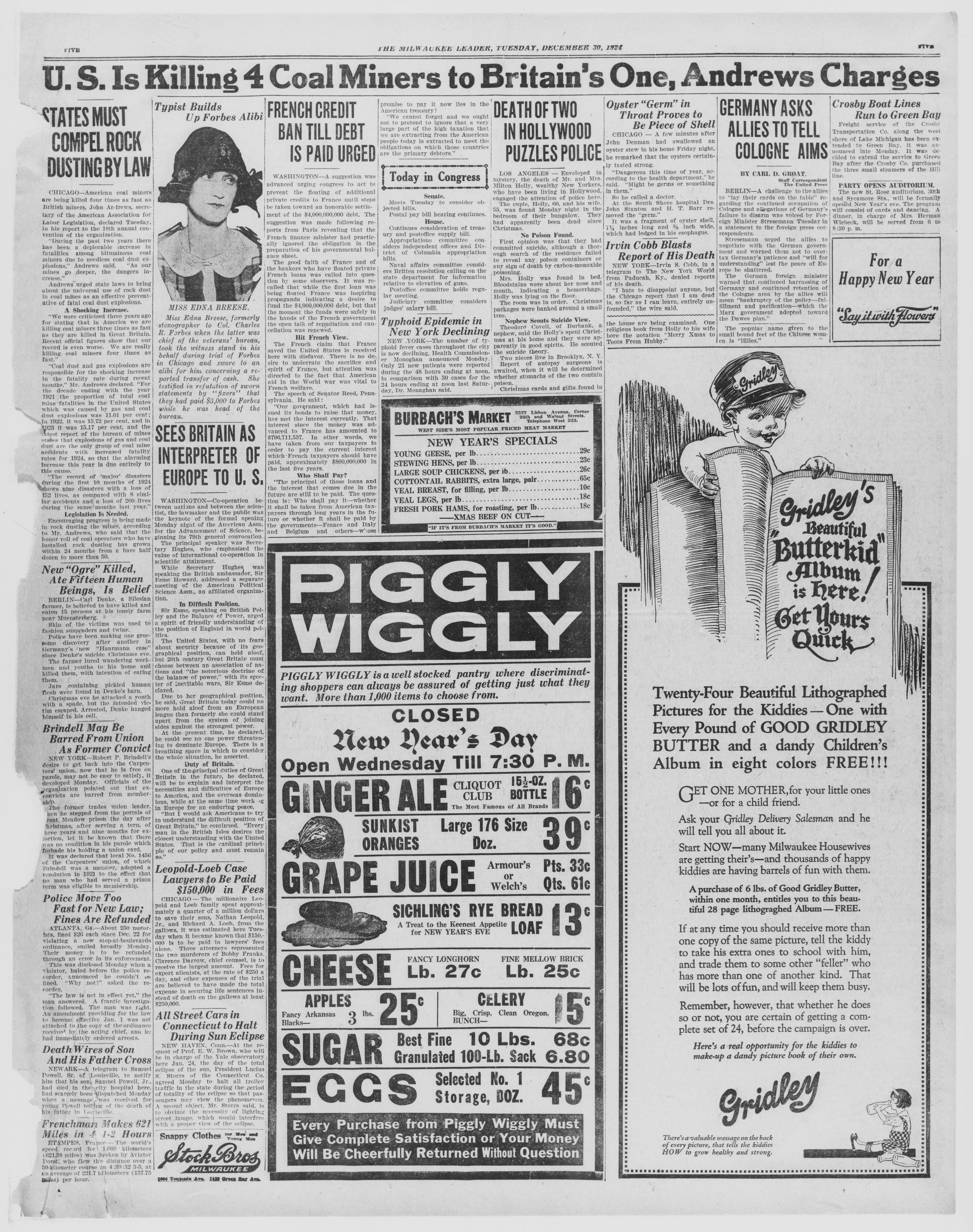
The Milwaukee Leader's morning edition of December 31, 1924, is more than ninety-five years old and in the public domain. The scan comes from the Library of Congress's Chronicling America collection, and the citation and rights statement are under it.
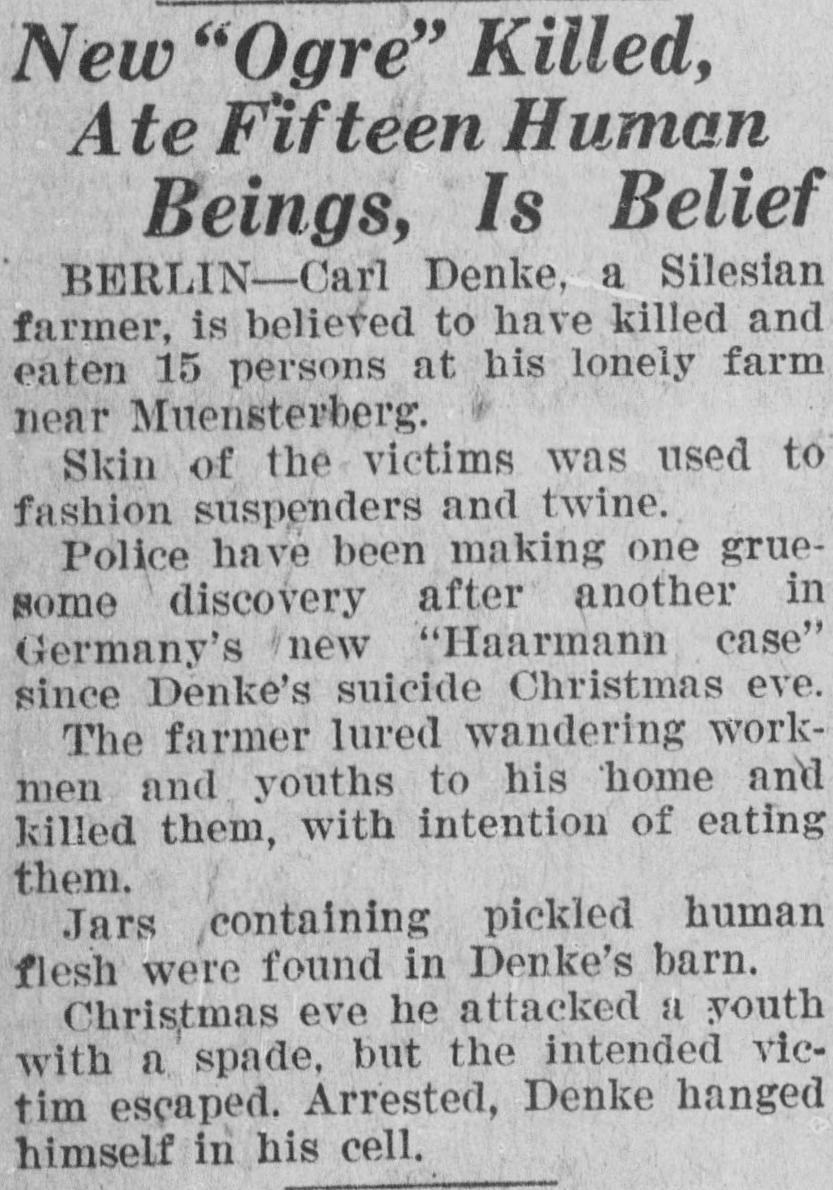
The type is large and clean, and the item is transcribed in full with nothing marked illegible. The paper's forms stand as printed: "Carl Denke," "Muensterberg" for Münsterberg, the town now called Ziębice in Poland, "Christmas eve" with a small e, and the quotation marks it put around "Ogre" and "Haarmann case." Everything above and below the item on the page is unrelated.
Transcription
Transcribed word for word from the page scan. Original spelling, punctuation, capitalisation and typographical errors have been kept exactly as printed. Unreadable words are marked [illegible]. Nothing has been modernised or corrected.
New "Ogre" Killed, Ate Fifteen Human Beings, Is Belief
BERLIN—Carl Denke, a Silesian farmer, is believed to have killed and eaten 15 persons at his lonely farm near Muensterberg.
Skin of the victims was used to fashion suspenders and twine.
Police have been making one gruesome discovery after another in Germany's new "Haarmann case" since Denke's suicide Christmas eve.
The farmer lured wandering workmen and youths to his home and killed them, with intention of eating them.
Jars containing pickled human flesh were found in Denke's barn.
Christmas eve he attacked a youth with a spade, but the intended victim escaped. Arrested, Denke hanged himself in his cell.
Transcriber's notes
- Readability: excellent. Large, clean type. No [illegible] markers were needed.
- Kept as printed: "Carl Denke" (he is usually given as Karl Denke, which is how SKC files him), "Muensterberg" for Münsterberg (now Ziębice, Poland), and the paper's quotation marks around "Ogre" and "Haarmann case".
- The paper dates the suicide to Christmas eve; Denke was arrested on 21 December 1924 and hanged himself in his cell the same night, so the Christmas eve date is the wire service's and is left as printed.
- The item is self-contained between rules; what sits above and below it on the page is unrelated.