MURDERER HOLMES HANGED: THE KIMBALL GRAPHIC, MAY 16, 1896
Nine days after Herman Webster Mudgett, the man the country knew as H. H. Holmes, dropped through the trap in Philadelphia's county prison, a weekly paper on the South Dakota prairie gave its readers the whole of his last morning in a single column. The Kimball Graphic ran the wire report on May 16, 1896, and it follows him hour by hour: woken twice at six because he was sleeping so soundly, two priests with the sacrament, a breakfast of eggs, toast and coffee, a dark pepper-and-salt suit, and the walk down the long corridor to the gallows at ten o'clock.
Then he spoke. Standing on the trap, Holmes admitted to the deaths of two women who had died, he said, "as the result of criminal operations," and denied, so that there would be "no misunderstanding hereafter," that he had killed Benjamin Pitezel or any of the three Pitezel children. Pitezel's murder was the one he had been convicted of and the one he was about to hang for. The paper sets that denial beside the confession he had published only weeks earlier, in which he claimed a score of victims, and its last paragraph names the two women as Julia Connor of Chicago and Emily Cigrand of Anderson, Indiana.
The report ends at the cemetery gate. The knot jammed after the drop and the doctors twisted his head from side to side before it came loose, and by three that afternoon the body lay in a vault at Holy Cross cemetery, with no service read. Of everything Holmes said about himself, the paid confessions included, these few sentences on the scaffold are among the last, spoken in front of witnesses with nothing left to sell.
This is a wire story reprinted by a small weekly, not the work of a reporter who was in the room, and it does not agree with itself on every detail. It gives the time of death as twenty minutes after the drop in one paragraph and fifteen in another, names two doctors as certifying death and then quotes a third as the prison physician, and calls him Howard W. Mudgett; his name was Herman Webster Mudgett. The two women he named are given here as Julia Connor and Emily Cigrand, spellings that other records give as Julia Conner and Emeline Cigrand. Holmes was convicted of one murder, Benjamin Pitezel's. The larger count the paper mentions rests on a confession he sold to the press, and nothing in this column proves it.
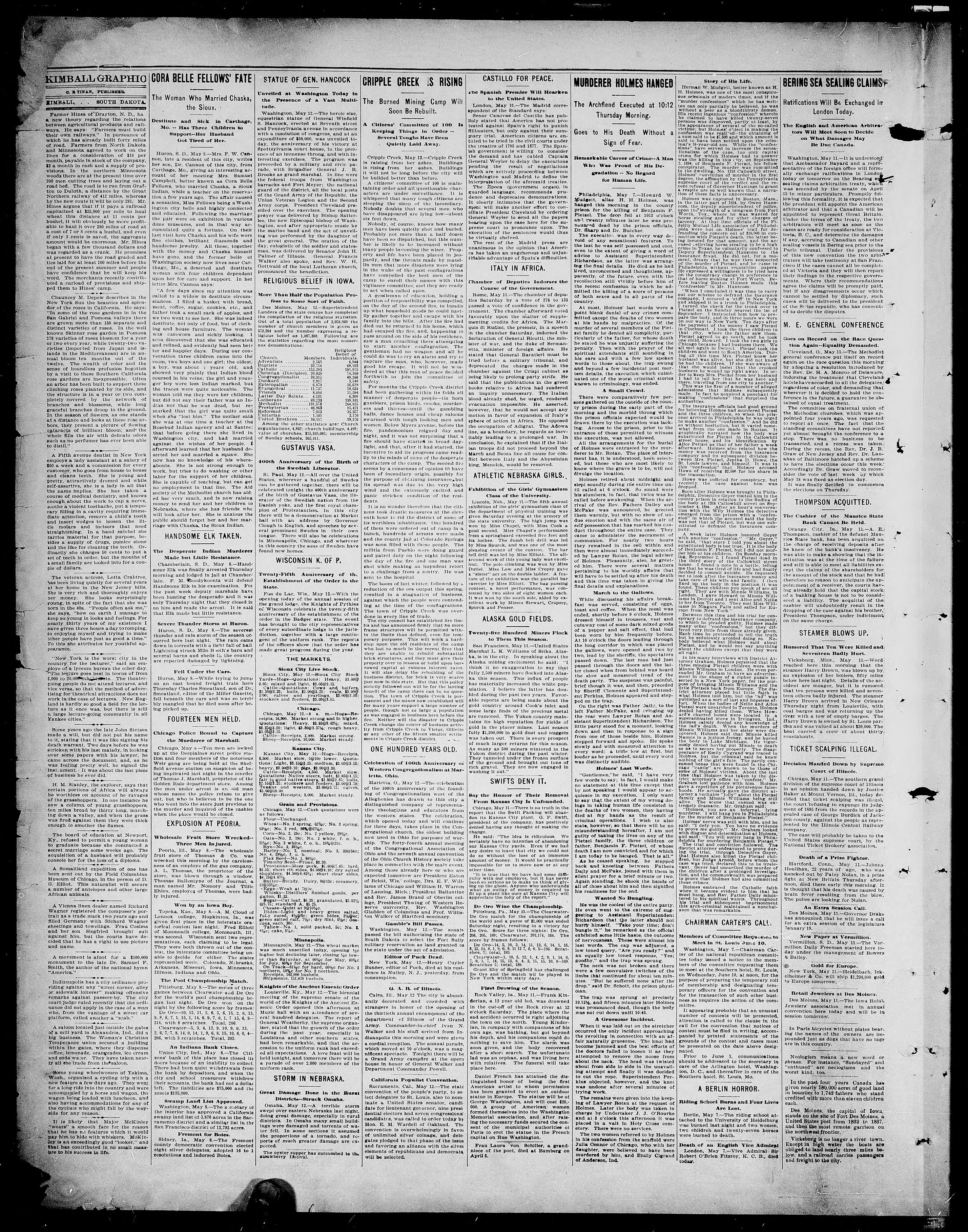
The Kimball Graphic was published in 1896, and the page is in the public domain. The scan comes from the Library of Congress, which holds the original in its Chronicling America collection; the full citation and the Library's rights statement sit under the scan below.
The transcription was made word for word from the scan, and the column is clean enough that nothing had to be marked illegible. Every misprint has been left where the compositor put it, including "1012 o'clock," "valt" for vault and the paper's spelling "Pietzel" throughout. The transcriber's notes at the end list each one.

Transcription
Transcribed word for word from the page scan. Original spelling, punctuation, capitalisation and typographical errors have been kept exactly as printed. Unreadable words are marked [illegible]. Nothing has been modernised or corrected.
MURDERER HOLMES HANGED
The Archfiend Executed at 10:12 Thursday Morning.
Goes to His Death Without a Sign of Fear.
Remarkable Career of Crime--A Man Who Was Proud of His Degradation -- No Regard for Human Life.
Philadelphia, May 7.—Howard W. Mudgett, alias H. H. Holmes, was hanged this morning in the county prison for the killing of Benjamin F. Pietzel. The drop fell at 1012 o'clock and twenty minutes later he was pronounced dead by the prison officials, Dr. Sharp and Dr. Butcher.
The execution was in every way devoid of any sensational features. To the last he was self possessed and cool, even to the extent of giving a word of advice to Assistant Superintendent Richardson, as the latter was arranging the final details. He died as he had lived, unconcerned and thoughtless, apparently, of the future, even with the recollection still vividly before him of the recent confession in which he admitted the killing of a score of persons of both sexes and in all parts of the country.
At most, Holmes' last words were a point blank denial of any crimes committed except the deaths of two women at his hands by malpractice. Of the murder of several members of the Pietzel family he denied all complicity, particularly of the father, for whose death he stated he was unjustly suffering the penalty. Then with the prayer of the spiritual attendants still sounding in his ears and with a few low spoken words to those about, the trap swung and beyond a few incidental post mortem details, the execution which culminated one of the worst criminal stories known to criminology, was ended.
A Small Crowd.
There were comparatively few persons gathered on the outside of the county prison during the early part of the morning and the morbid throng which the prison officials expected would be drawn there by the execution was lacking. Access to the prison, prior to the entrance of those permitted to witness the execution, was not allowed.
All the arrangements for the burial of Holmes were entrusted by the murderer to Mr. Rotan. The place of interment has, it is understood, been selected, but those who are most likely to know where the grave is to be, will not divulge the location.
Holmes retired about midnight and slept soundly during the entire time until called at 6 o'clock. So sound were his slumbers, in fact, that twice was he called before awakening. When the arrival of the Rev. Fathers Dailey and McPake was announced, he greeted them warmly, but with no show of undue emotion and with the same air of self possession that has marked his conduct throughout the entire case. They came to administer the sacrament of communion. For nearly two hours they remained in the cell within and then were almost immediately succeeded by Lawyer Rotan, the legal adviser of Holmes. Pleasantly, also, he greeted him. There were several matters pertaining to his worldly affairs that will have to be settled up after his death and this time was taken in giving the final details and explanations.
March to the Gallows.
While discussing his affairs breakfast was served, consisting of eggs, toast and coffee. When the meal was ended, shortly before 9 o'clock, Holmes dressed himself in trousers, vest and cutaway coat of some dark mixed goods of a pepper and salt effect, that had been worn by him frequently before. At 10 o'clock the doors leading through the long corridor in which was placed the gallows, were opened and two by two, lead by the sheriffs, the spectators passed down. The last man had just passed through the doors and the latter closed when from behind was heard the slow and measured tread of the death party. The suspense was painful, brief though it was, and then, preceded by Sheriff Clements and Superintendent Perkins, Holmes appeared and stepped on the trap.
On the right was Father Daily, to the left Father McPake, and bringing up the rear were Lawyer Rotan and Assistant Superintendent Richardson. The little party stood for a moment, looking down and then in response to a sign from one of those beside him, Holmes stepped forward and spoke. He spoke slowly and with measured attention to every word; a trifle low at first, but louder as he proceeded, until every word was distinctly audible.
Holmes' Last Words.
"Gentlemen,"he said, "I have very few words to say; in fact, I would make no statement at this time except that by not speaking I would appear to acquiesce in my execution. I only want to say that the extent of my wrong doings in taking human life consisted in the deaths of two women, they having died at my hands as the result of criminal operations. I wish to also state, however, so that there will be no misunderstanding hereafter, I am not guilty of taking the lives on any of the Pietzel family, the three children or father, Benjamin F. Pietzel, of whose death I am now convicted and for which I am today to be hanged. That is all."
As he ceased speaking, he stepped back and kneeling between Fathers Daily and McPake, joined with them in silent prayer for a brief minute or two. Again standing, he shook the hands of all of those about him and then signified his readiness for the end.
Wanted No Bungling.
He was the coolest of the entire party. He even went to the extreme of suggesting to Assistant Superintendent Richardson that the latter should not hurry himself. "Take your time; don't bungle it," he remarked as the official exhibited some little haste, the outcome of nervousness. These were almost his last words. The cap was adjusted, a low toned query, "Are you ready?" and an equally low toned response, "Yes; goodby," and the trap was sprung.
The neck was not broken and there were a few convulsive twitches of the limbs that continued for about ten minutes. "But he suffered none after the drop," said Dr. Schott, the prison physician.
The trap was sprung at precisely 10.12½, and fifteen minutes later Holmes was pronounced dead, though the body was not cut down until 10:45.
A Gruesome Incident.
When it was laid out on the stretcher occurred the only incident approaching the revolting in connection with an affair naturally gruesome. The knot had become jammed and the best efforts of the doctors failed to loosen it as they attempted to remove the noose from about the neck. The head was twisted about from side to side in the unavailing attempt and finally it was decided to cut the rope. Superintendent Perkins objected, however, and the knot was undone after several minutes of trying work.
The remains were given into the keeping of Lawyer Rotan at the request of Holmes. Later the body was taken in charge by Undertaker J. J. O'Rourke and at 3 o'clock this afternoon it was placed in a valt in Holy Cross cemetery. There were no services.
The two women referred to by Holmes in his confession from the scaffold were Julia Connor of Chicago, who with her daughter, were believed to have been murdered by him, and Emily Cigrand of Anderson, Ind.
Transcriber's notes
- Readability: very good. The column is clean, well inked and legible throughout. No words required an [illegible] marker.
- Printer's errors kept as printed: "1012 o'clock" (no colon), "Pietzel" throughout (the victim's name is more usually spelled Pitezel), "the lives on any of the Pietzel family", "goodby", "valt" for vault, "lead by the sheriffs". The paper spells the attending priest both "Dailey" and "Daily"; both forms are kept where each appears.
- The paper gives the prison physician as Dr. Schott in one place and names Dr. Sharp and Dr. Butcher in another; both are as printed.