MURDER FARM MAY OUTRIVAL GUNNESS FARM: THE MILWAUKEE LEADER, MAY 10, 1916
Franklin R. Andrews had been in the ground in Windsor, Connecticut, for nearly two years when they dug him up, and his body was almost perfectly preserved. There was so much arsenic in it, the authorities said, that the poison had worked as an embalming agent. In May 1916 that one finding turned the Archer Home for Elderly People into a crime scene, and on May 10 The Milwaukee Leader carried the news from Hartford on its front page, under a headline that set the case of Amy Archer-Gilligan against the most notorious murder farm in the country.
Officially no one was saying much. Unofficially, the paper learned, the authorities would not be surprised to find a "murder castle" in Windsor with more dead than Belle Gunness had buried at La Porte, and they were talking about exhuming all forty-eight people who had died in the home in five years. The families were not waiting. Relatives had already taken four residents out of the house, and three people who had paid $1,000 apiece for the lifetime care of residents who later died had filed attachments on the home, hoping to get their money back.
That $1,000 contract was where the prosecutors meant to find a motive. A resident paid once for care that would last the rest of their life, and as the authorities put it, the sooner the death, the larger the profit. Then came the poison book from a Windsor drugstore, recording many purchases by the woman who ran the home, among them two ounces of arsenic in May 1914 and a full pound the following month. Against all of it the column sets one closing line: she still said she was innocent.
This is an early wire report, filed in the first days of the case, and it says plainly that the authorities were not making direct statements; the talk of forty-eight exhumations and of outdoing the Gunness farm is the paper's account of what officials expected, not anything established. Only a handful of bodies were in fact exhumed, five in all, Andrews among them, and all five showed poison. Archer-Gilligan was charged with five murders but tried for one, Andrews's. Her 1917 conviction for first-degree murder and her death sentence were overturned on appeal, and at a second trial in 1919 she was given life for second-degree murder, whether by plea or verdict accounts disagree. No court ever ruled on the other deaths.
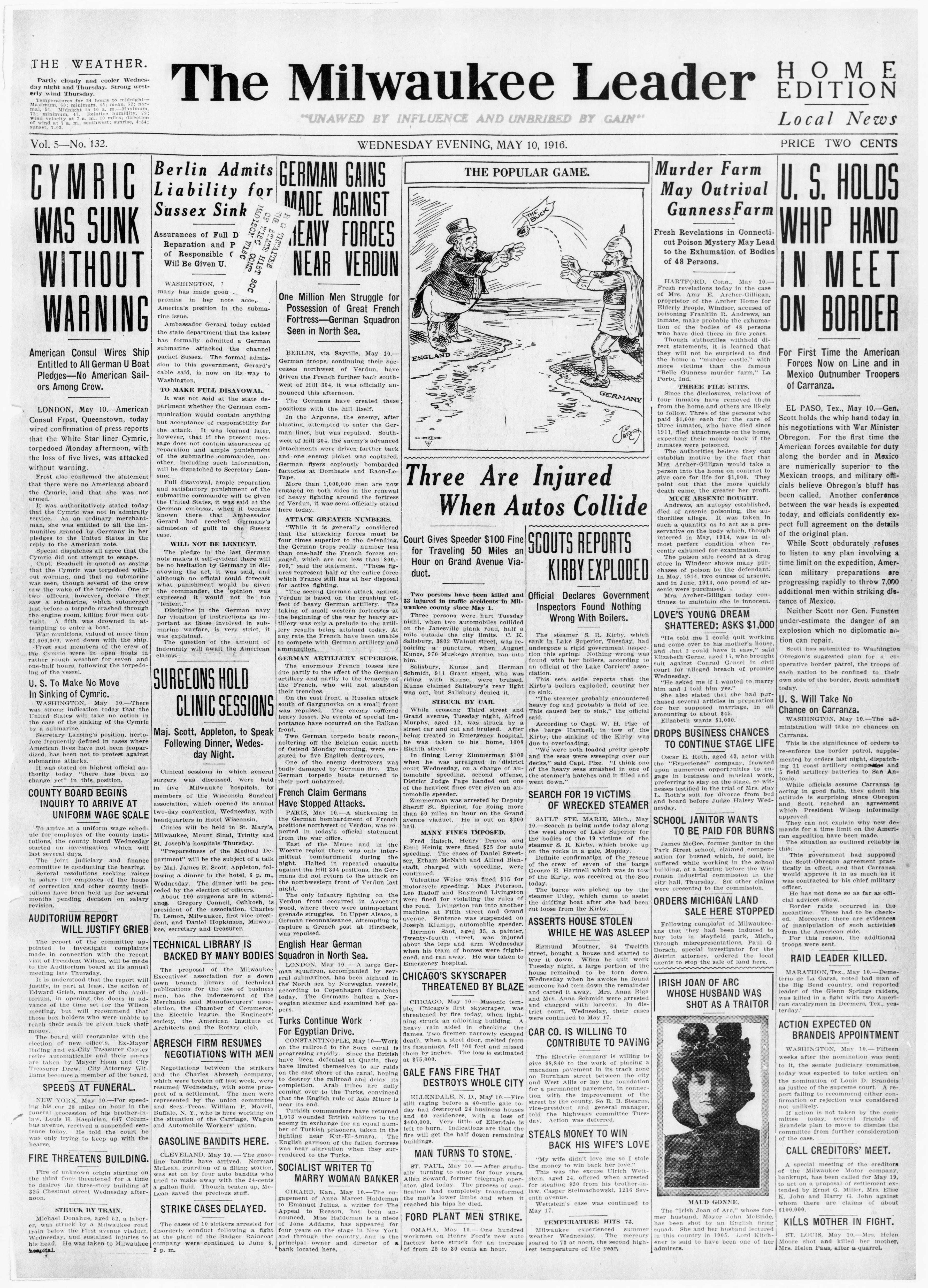
The Milwaukee Leader of May 10, 1916, is more than a century old and is in the public domain without any condition. The scan is the Library of Congress copy, from the Home Edition held in Chronicling America, and the citation and the Library's rights statement are printed below it in full.
Clean, well-inked type throughout meant the transcription could follow the column word for word with nothing marked illegible. The paper's own choices are kept: "outrival" in the headline, "La Porte" as two words, and the quotation marks it puts around "murder castle" and "Belle Gunness murder farm." The story is complete in this one column.
Transcription
Transcribed word for word from the page scan. Original spelling, punctuation, capitalisation and typographical errors have been kept exactly as printed. Unreadable words are marked [illegible]. Nothing has been modernised or corrected.
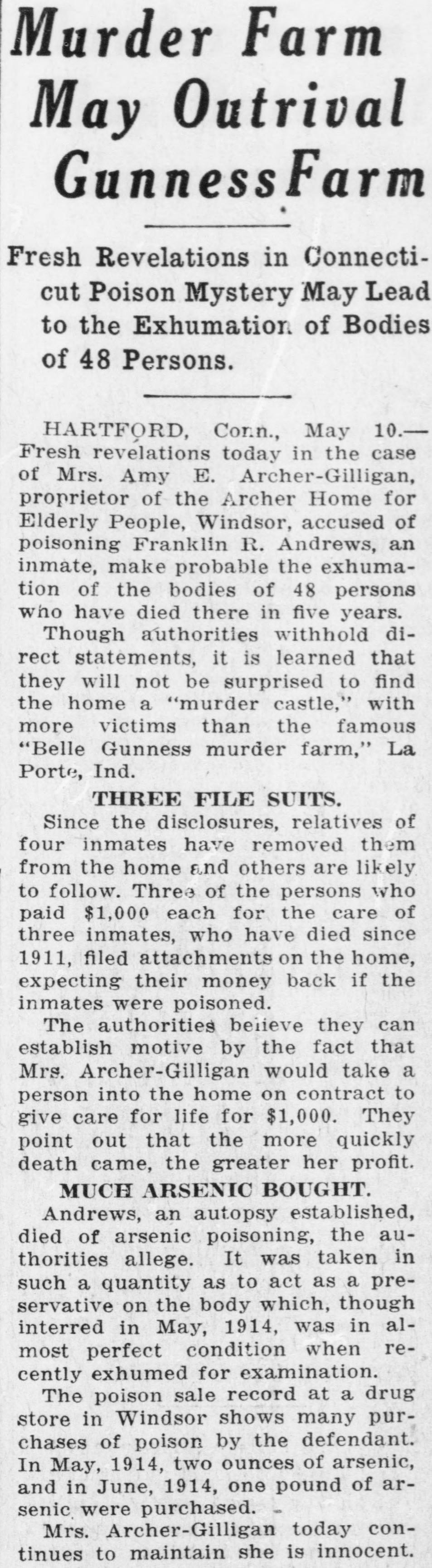
Murder Farm May Outrival Gunness Farm
Fresh Revelations in Connecticut Poison Mystery May Lead to the Exhumation of Bodies of 48 Persons.
HARTFORD, Conn., May 10.—Fresh revelations today in the case of Mrs. Amy E. Archer-Gilligan, proprietor of the Archer Home for Elderly People, Windsor, accused of poisoning Franklin R. Andrews, an inmate, make probable the exhumation of the bodies of 48 persons who have died there in five years.
Though authorities withhold direct statements, it is learned that they will not be surprised to find the home a "murder castle," with more victims than the famous "Belle Gunness murder farm," La Porte, Ind.
THREE FILE SUITS.
Since the disclosures, relatives of four inmates have removed them from the home and others are likely to follow. Three of the persons who paid $1,000 each for the care of three inmates, who have died since 1911, filed attachments on the home, expecting their money back if the inmates were poisoned.
The authorities believe they can establish motive by the fact that Mrs. Archer-Gilligan would take a person into the home on contract to give care for life for $1,000. They point out that the more quickly death came, the greater her profit.
MUCH ARSENIC BOUGHT.
Andrews, an autopsy established, died of arsenic poisoning, the authorities allege. It was taken in such a quantity as to act as a preservative on the body which, though interred in May, 1914, was in almost perfect condition when recently exhumed for examination.
The poison sale record at a drug store in Windsor shows many purchases of poison by the defendant. In May, 1914, two ounces of arsenic, and in June, 1914, one pound of arsenic were purchased.
Mrs. Archer-Gilligan today continues to maintain she is innocent.
Transcriber's notes
- Readability: excellent. Clean, well-inked type throughout. No [illegible] markers were needed.
- Kept as printed: the headline's spacing "GunnessFarm" (set without a word space), "outrival", "murder castle" and "Belle Gunness murder farm" in the paper's own quotation marks, and "La Porte" as two words.
- The paper spells the victim "Franklin R. Andrews"; court records give Franklin R. Andrews, so no variance arises here.
- The comparison drawn in the headline and second paragraph is to the Belle Gunness case at La Porte, Indiana, which is also in this batch of transcriptions (Milford chronicle, 8 May 1908).