MRS. HAHN'S SON MAKES FINAL PLEA TO GOVERNOR: THE WASHINGTON TIMES, DECEMBER 7, 1938
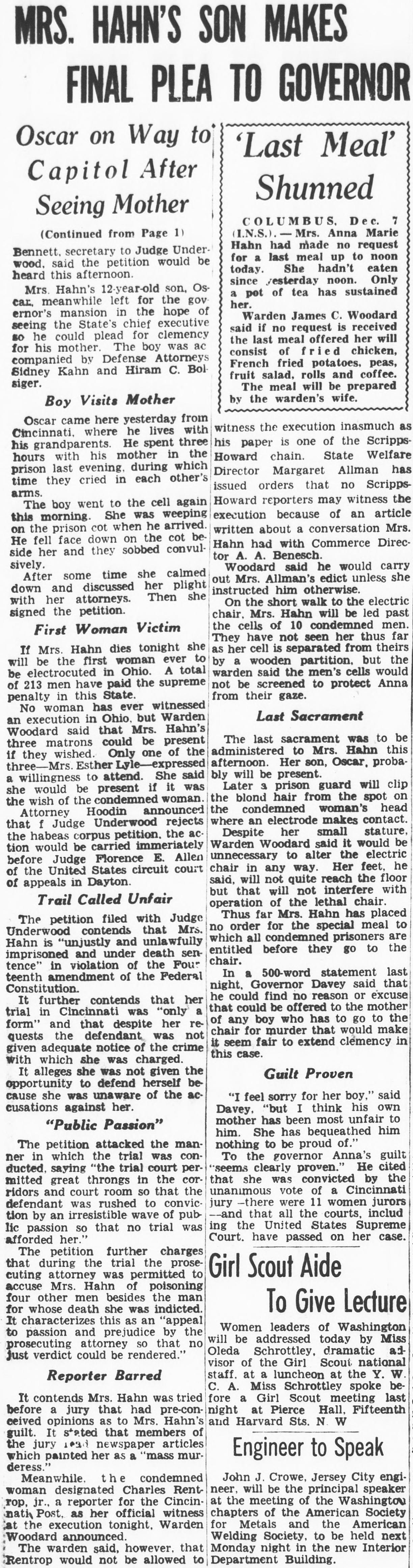
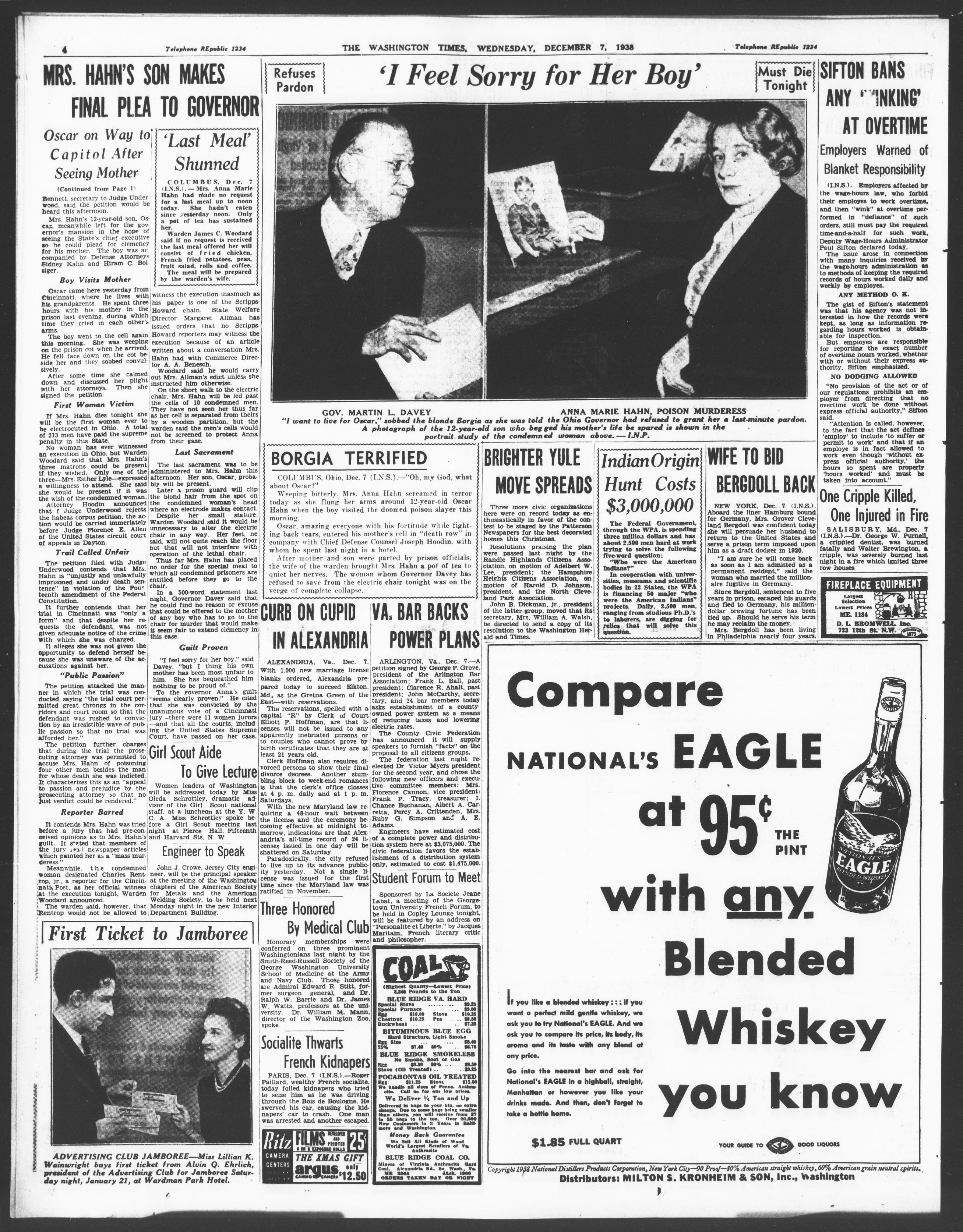
On the last day of Anna Marie Hahn's life her son came to the prison in Columbus, found her weeping on her cot, and fell face down beside her, and the two of them sobbed until she was calm enough to talk to her lawyers. Then she signed one more petition. The Washington Times printed the scene that afternoon, December 7, 1938, in the page-four continuation of a front-page story, while the boy was on his way to the governor's mansion with two defense attorneys to beg for her life.
The petition argued that she had never really been tried. Her Cincinnati trial, it said, was "only a form"; crowds had filled the courtroom and corridors until she was "rushed to conviction by an irresistible wave of public passion"; the prosecutor had been allowed to accuse her of poisoning four other men besides the one in the indictment; jurors had read newspaper stories painting her as a "mass murderess." Governor Martin L. Davey had already answered in a statement of five hundred words. "I feel sorry for her boy," he said, "but I think his own mother has been most unfair to him."
Around those two documents the prison went on getting ready. Warden Woodard said the chair would need no change for so small a woman, though her feet would not quite reach the floor, and that a guard would clip her blond hair where the electrode touched. She would walk past the cells of ten condemned men who had never seen her. Of her three matrons, only one, Mrs. Esther Lyle, was willing to be in the room. And the reporter Hahn chose as her witness was turned away, because the state had barred every Scripps-Howard man. If she died that night, the paper noted, she would be the first woman ever electrocuted in Ohio.
This is the second half of a story written before the execution, so it describes preparations and arguments, not her death; its opening ran on page one and is not here. She was electrocuted at the Ohio Penitentiary that evening and pronounced dead at 8:13. Hahn was convicted of one murder, that of Jacob Wagner, by a jury of eleven women and one man on November 6, 1937. The four other men the petition mentions were laid to her by the prosecution, but no jury ever weighed those deaths. The paper makes her son twelve and spells his name Oscar; born on May 31, 1925, he would have been thirteen, and his name is usually given as Oskar. The lawyer it calls Hiram C. Bolsiger appears elsewhere as Hiram Bosinger.
This issue of The Washington Times dates from 1938, inside the ninety-five-year line, and the Library of Congress, while it believes such papers are in the public domain, warns that they may contain some copyrighted third-party material. Nothing in this story points to syndicated or separately copyrighted matter. The scan is the Library's own, from Chronicling America, and the citation and rights statement are given in full under it.
The type is heavy and readable throughout, and nothing had to be marked illegible, though a few battered letters in "stated" and "read" were worked out from what survives of them on the page. The printer's slips are kept: the subhead "Trail Called Unfair," "f Judge Underwood" with its dropped letter, "immeriately," and "t h e" spaced out letter by letter. The transcription starts mid-sentence, where the story resumes from page one. A boxed sidebar headed "'Last Meal' Shunned" and two unrelated stories inside the crop were not transcribed.
Transcription
Transcribed word for word from the page scan. Original spelling, punctuation, capitalisation and typographical errors have been kept exactly as printed. Unreadable words are marked [illegible]. Nothing has been modernised or corrected.
MRS. HAHN'S SON MAKES FINAL PLEA TO GOVERNOR
Oscar on Way to Capitol After Seeing Mother
(Continued from Page 1)
Bennett, secretary to Judge Underwood, said the petition would be heard this afternoon.
Mrs. Hahn's 12-year-old son, Oscar, meanwhile left for the governor's mansion in the hope of seeing the State's chief executive so he could plead for clemency for his mother. The boy was accompanied by Defense Attorneys Sidney Kahn and Hiram C. Bolsiger.
Boy Visits Mother
Oscar came here yesterday from Cincinnati, where he lives with his grandparents. He spent three hours with his mother in the prison last evening, during which time they cried in each other's arms.
The boy went to the cell again this morning. She was weeping on the prison cot when he arrived. He fell face down on the cot beside her and they sobbed convulsively.
After some time she calmed down and discussed her plight with her attorneys. Then she signed the petition.
First Woman Victim
If Mrs. Hahn dies tonight she will be the first woman ever to be electrocuted in Ohio. A total of 213 men have paid the supreme penalty in this State.
No woman has ever witnessed an execution in Ohio, but Warden Woodard said that Mrs. Hahn's three matrons could be present if they wished. Only one of the three—Mrs. Esther Lyle—expressed a willingness to attend. She said she would be present if it was the wish of the condemned woman.
Attorney Hoodin announced that f Judge Underwood rejects the habeas corpus petition, the action would be carried immeriately before Judge Florence E. Allen of the United States circuit court of appeals in Dayton.
Trail Called Unfair
The petition filed with Judge Underwood contends that Mrs. Hahn is "unjustly and unlawfully imprisoned and under death sentence" in violation of the Fourteenth amendment of the Federal Constitution.
It further contends that her trial in Cincinnati was "only a form" and that despite her requests the defendant was not given adequate notice of the crime with which she was charged.
It alleges she was not given the opportunity to defend herself because she was unaware of the accusations against her.
"Public Passion"
The petition attacked the manner in which the trial was conducted, saying "the trial court permitted great throngs in the corridors and court room so that the defendant was rushed to conviction by an irresistible wave of public passion so that no trial was afforded her."
The petition further charges that during the trial the prosecuting attorney was permitted to accuse Mrs. Hahn of poisoning four other men besides the man for whose death she was indicted. It characterizes this as an "appeal to passion and prejudice by the prosecuting attorney so that no just verdict could be rendered."
Reporter Barred
It contends Mrs. Hahn was tried before a jury that had pre-conceived opinions as to Mrs. Hahn's guilt. It stated that members of the jury read newspaper articles which painted her as a "mass murderess."
Meanwhile, t h e condemned woman designated Charles Rentrop, jr., a reporter for the Cincinnati Post, as her official witness at the execution tonight, Warden Woodard announced.
The warden said, however, that Rentrop would not be allowed to witness the execution inasmuch as his paper is one of the Scripps-Howard chain. State Welfare Director Margaret Allman has issued orders that no Scripps-Howard reporters may witness the execution because of an article written about a conversation Mrs. Hahn had with Commerce Director A. A. Benesch.
Woodard said he would carry out Mrs. Allman's edict unless she instructed him otherwise.
On the short walk to the electric chair, Mrs. Hahn will be led past the cells of 10 condemned men. They have not seen her thus far as her cell is separated from theirs by a wooden partition, but the warden said the men's cells would not be screened to protect Anna from their gaze.
Last Sacrament
The last sacrament was to be administered to Mrs. Hahn this afternoon. Her son, Oscar, probably will be present.
Later a prison guard will clip the blond hair from the spot on the condemned woman's head where an electrode makes contact.
Despite her small stature, Warden Woodard said it would be unnecessary to alter the electric chair in any way. Her feet, he said, will not quite reach the floor but that will not interfere with operation of the lethal chair.
Thus far Mrs. Hahn has placed no order for the special meal to which all condemned prisoners are entitled before they go to the chair.
In a 500-word statement last night, Governor Davey said that he could find no reason or excuse that could be offered to the mother of any boy who has to go to the chair for murder that would make it seem fair to extend clemency in this case.
Guilt Proven
"I feel sorry for her boy," said Davey, "but I think his own mother has been most unfair to him. She has bequeathed him nothing to be proud of."
To the governor Anna's guilt "seems clearly proven." He cited that she was convicted by the unanimous vote of a Cincinnati jury —there were 11 women jurors —and that all the courts, including the United States Supreme Court, have passed on her case.
Transcriber's notes
- Readability: Very good for most of the article, good at worst. The body type is heavy and clean; the only real trouble is in tile c1_003700, where several letters are broken or filled by ink. No [illegible] markers were needed, but two words in that patch deserve recording: "It stated that members of" (the "t" of "stated" is battered and prints almost as an asterisk) and "members of the jury read newspaper articles" (the "r" and "e" of "read" are broken, leaving a mark that at first looks like a stray point; the word still resolves as "read" from the surviving letterforms, not from the sense).
- The main headline is set across both columns and the crop splits it. Column 1 carries "MRS. HAHN'S S" / "FINAL PLEA" and column 2 carries "SON MAKES" / "A TO GOVERNOR", the two halves overlapping on the final "A" of "PLEA". Joined as printed, it reads "MRS. HAHN'S SON MAKES / FINAL PLEA TO GOVERNOR". The three-line italic deck "Oscar on Way to / Capitol After / Seeing Mother" sits under the left half, in the measure of column 1 only.
- This page carries the continuation of the front-page story and the jump line is printed as part of the heading: "(Continued from Page 1)". The transcription accordingly begins in mid-sentence at "Bennett, secretary to Judge Underwood", which is where the jumped text resumes; the words before it stand on page 1 and are not in this crop.
- Printers' errors kept exactly as printed: the sub-head "Trail Called Unfair" (for "Trial"); "announced that f Judge Underwood rejects" (a dropped "i", for "if"); "the action would be carried immeriately" (for "immediately"); and "Meanwhile, t h e condemned woman", where "the" is set with spaces between the letters.
- Two words broken by a line end are printed without their hyphen and have been joined without duplicating the break: "ac" / "companied" (accompanied) in column 1, and "includ" / "ing" (including) in column 2. The hyphenated "pre-conceived" is as printed.
- Spellings and period forms kept as printed: "Warden Woodard" throughout (so spelled at every occurrence, including "Warden James C. Woodard"), "Charles Rentrop, jr.", "Benesch", "Bolsiger", "Hoodin", "court room" as two words, and the lower-case "amendment" in "the Fourteenth amendment of the Federal Constitution".
- Dashes: the paper sets a space before the dash in "a Cincinnati jury —there were 11 women jurors —and that all the courts", and that spacing has been kept.
- Factual note, stated neutrally with the transcription left as printed: the story says the Cincinnati jury had "11 women jurors", which matches the accepted record of eleven women and one man. The governor is named only as "Governor Davey" (Martin L. Davey of Ohio).
- The crop is a rectangle and carries unrelated matter in column 2. Between the headline and the resumption of the story there is a separate boxed item, set inside a wavy rule and with its own headline "'Last Meal' Shunned" and its own dateline "COLUMBUS, Dec. 7 (I.N.S.).", running from tile c2_000000 into c2_000740 — a distinct sidebar from a different news service, so it has not been transcribed. Below the end of the article, from tile c2_002960 onward, come two further unrelated stories, "Girl Scout Aide To Give Lecture" and "Engineer to Speak"; these have not been transcribed either.
- There is no photograph or engraving inside the article. It ends cleanly at "have passed on her case." followed by a horizontal rule, so nothing continues beyond the last tile.