MET THEIR DEATHS BRAVELY: THE INDIANAPOLIS JOURNAL, JUNE 26, 1889
The trap fell at 10:07 in the morning, in a corridor of the Philadelphia county prison, and Sarah Jane Whiteling went through it without once having faltered. The Indianapolis Journal carried the wire account on June 26, 1889, and nearly all of it is about her calm. She spent her last night walking her cell, singing and praying with the prison matron, Mrs. Weaver, and a watch woman. Before six she ate fried eggs, toast and chocolate "with apparent relish." All morning she talked of her pleasure at the prospect of "meeting her husband and children," the three people she had confessed to poisoning.
She climbed the ten or a dozen steps on her own, a minister's light hand on each arm, and repeated a prayer with her eyes raised while deputies strapped her skirts at the ankles. The physicians who had watched her for months said they were surprised by her composure, but agreed she had never shown "any evidence whatever of an unsound mind," which had been the whole of her defense at trial the November before. Then the paper tells why she hanged. John Whiteling died on March 20, 1888, Bertha in April, Willie in May, each death signed off as a fever or a disorder of the bowels, until Dr. Smith took his suspicions to the coroner and the exhumed bodies gave up their arsenic.
The sharpest detail is the money: $145 and $65 on the husband, $122 on Bertha, $47 on the little boy. The paper also passes along, as something "stated," that while her own children lay sick she handed out candy to the neighborhood children that made them very ill. Under the same headline the Journal ran a second hanging. At Wilkesbarre, Michael Rizello, "Red-nose Mike," was jerked into the air by a falling four-hundred-pound weight for the ambush of paymaster J. Brainard McClure and stable boss Hugh Flannigan on a mountain road in October 1888, and a priest said he left behind a fifty-six-page confession written in Italian.
This is a wire report reprinted in Indianapolis, a long way from either scaffold, and not a court record. Its Philadelphia dateline reads June 22, but the hanging took place on June 25, 1889, the date on the Rizello dispatch beside it. It gives Bertha's death as April 24 where other records give April 25, calls Willie "nearly three" where he is elsewhere recorded as two, and treats both children as John's, though Bertha was Sarah's daughter by an earlier marriage. Its four insurance figures add up to $379, not the $399 it prints. Whiteling was tried for one murder, Bertha's, and convicted; a coroner's jury had found all three deaths to be arsenic poisoning by her hand. The candy story is the paper's own hedged rumor.
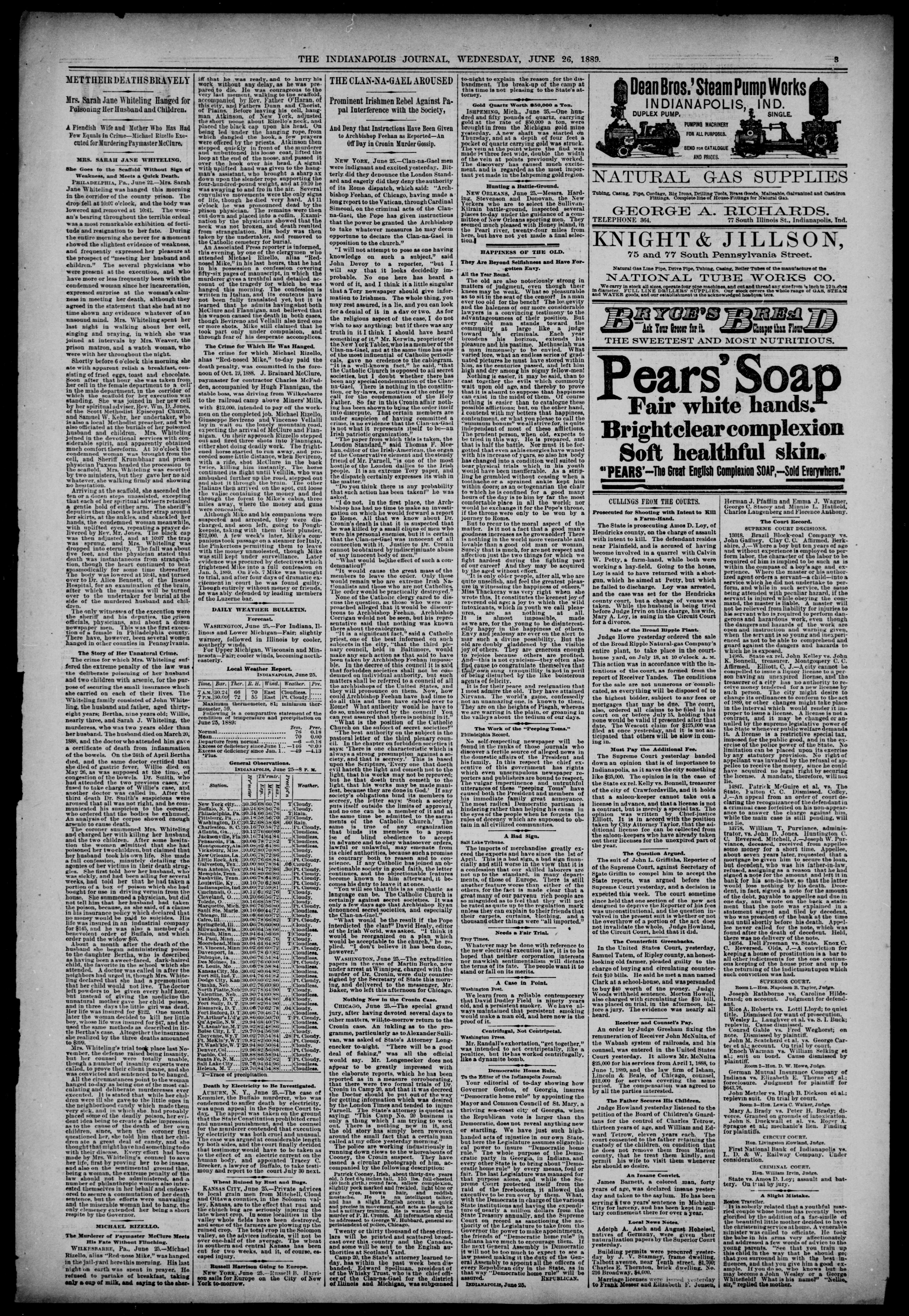
The Indianapolis Journal of June 26, 1889, is in the public domain in its entirety. The image is the Library of Congress scan from Chronicling America, covering columns one and two of page three, so the Whiteling and Rizello reports appear together as readers saw them. The citation and the Library's rights statement are printed under the scan.
The column was copied by hand, word for word, and every line could be read, so nothing is marked illegible. The compositor's slips are left as they fell: "thereform" for therefrom, "ou the lonely mountain road," "A few week's later," a sentence that opens on a lowercase "the," and Rizello's name printed once as "Rizzello." His accomplice appears as both Vellalli and Vellilla, and "Red-nose Mike" becomes "Red-nosed Mike" further down. Wilkesbarre keeps the period spelling.

Transcription
Transcribed word for word from the page scan. Original spelling, punctuation, capitalisation and typographical errors have been kept exactly as printed. Unreadable words are marked [illegible]. Nothing has been modernised or corrected.
MET THEIR DEATHS BRAVELY
Mrs. Sarah Jane Whiteling Hanged for Poisoning Her Husband and Children.
A Fiendish Wife and Mother Who Has Had Few Equals in Crime—Michael Rizello Executed for Murdering Paymaster McClure.
MRS. SARAH JANE WHITELING.
She Goes to the Scaffold Without Sign of Weakness, and Meets a Quick Death.
PHILADELPHIA, Pa., June 22.—Mrs. Sarah Jane Whiteling was hanged this morning in the corridor of the county prison. The drop fell at 10:07 o'clock, and the body was lowered and removed at 10:41. The woman's bearing throughout the terrible ordeal was a most remarkable exhibition of fortitude and resignation to her fate. During the entire morning she never for a moment showed the slightest evidence of weakness, and frequently expressed her pleasure at the prospect of "meeting her husband and children." The several physicians who were present at the execution, and who have more or less frequently been with the condemned woman since her incarceration, expressed surprise at the woman's calmness in meeting her death, although they agreed in the statement that she had at no time shown any evidence whatever of an unsound mind. Mrs. Whiteling spent her last night in walking about her cell, singing and praying, in which she was joined at intervals by Mrs. Weaver, the prison matron, and a watch woman, who were with her throughout the night.
Shortly before 6 o'clock this morning she ate with apparent relish a breakfast, consisting of fried eggs, toast and chocolate. Soon after that hour she was taken from her cell in the female department to a cell in the male department, in the corridor of which the scaffold for her execution was standing. She was joined in her new cell by her spiritual adviser, Rev. Wm. D. Jones, of the Scott Methodist Episcopal Church, and Samuel W. Kehr, her undertaker, who is also a local Methodist preacher, and who also officiated at the burials of her poisoned husband and children. Mrs. Whiteling joined in the devotional services with considerable spirit, and apparently obtained much comfort thereform. At 10 o'clock the condemned woman was brought from the cell, and Sheriff Krumbhaar and prison physician Paxson headed the procession to the scaffold. Mrs. Whiteling was escorted by two ministers, but they gave her no aid whatever, she walking firmly and showing no hesitation.
Arriving at the scaffold, she ascended the ten or a dozen steps unassisted, excepting that each of her spiritual advisers retained a gentle hold of either arm. The sheriff's deputies then placed a leather strap around her skirts, at the ankles, and shackled her hands, the condemned woman meanwhile, with uplifted eyes, repeating a prayer delivered by Rev. Mr. Jones. The black cap was then adjusted, and at 10:07 the trap was sprung, and Mrs. Whiteling was dropped into eternity. The fall was about five feet, and the physician stated that death was instantaneous from strangulation, though the heart continued to beat spasmodically for some time thereafter. The body was lowered at 10:41, and turned over to Dr. Alice Bennett, of the Insane Hospital, for an examination of the brain, after which the remains will be turned over to the undertaker for burial at the side of the murdered husband and children.
The only witnesses of the execution were the sheriff and his deputies, the prison officials, physicians, and about a dozen newspaper men. This was the first execution of a female in Philadelphia county. There have, however, been several women hanged in other counties in Pennsylvania.
The Story of Her Unnatural Crime.
The crime for which Mrs. Whiteling suffered the extreme penalty of the law was the deliberate poisoning of her husband and two children with arsenic, for the purpose of securing the small insurance which she carried on each of their lives. The Whiteling family consisted of John Whiteling, the husband and father, aged thirty-eight years; Bertha, nine years old; Willie, nearly three, and Sarah J. Whiteling, the murderess, who was two years older than her husband. The husband died on March 20, 1888, and the doctor who attended him gave a certificate of death from inflammation of the bowels. On the 24th of April Bertha died, and the same doctor certified that she died of gastric fever. Willie died on May 26, as was supposed at the time, of congestion of the bowels. Dr. Smith, who had attended the two previous cases, refused to take charge of Willie's case, and another doctor was called in. After the third death Dr. Smith's suspicions were aroused that all was not right, and he communicated his suspicion to the coroner, who ordered that the bodies be exhumed. An analysis of the corpse showed enough arsenic to cause death.
The coroner summoned Mrs. Whiteling and charged her with killing her husband and the two children. After some hesitation the woman admitted that she had poisoned her two children, but claimed that her husband took his own life. She made a full confession, minutely detailing the agonies of her victims in their death struggles. She first told how her husband, who was sickly, and had been ailing for several weeks, had told her that he had taken a portion of a box of poison which she had bought for use in driving vermin from the house. She summoned a physician, but did not tell him that her husband had taken the poison, because, as she said, of a clause in his insurance policy which declared that no money would be paid to suicides. His life was insured in an industrial company for $145, and he was also a member of a benevolent order of Buffalo, and which order paid the widow $65.
About a month after the death of the husband she began administering poison to the daughter Bertha, who is described as having been a sweet-faced, dark-haired child, the favorite in the school which she attended. A doctor was called in after the neighbors had urged it, though Mrs. Whiteling declared that she had a premonition that her child would not live. The doctor left powders to be given every half hour, but instead of giving the medicine the unnatural mother gave her child poison, and in three days the little girl was dead. Her life was insured for $122. One month later the woman decided to kill her little boy, whose life was insured for $47, and she used the same methods as described in little Bertha's case. Altogether the insurance she realized by the three deaths amounted to $399.
Mrs. Whiteling's trial took place last November, the defense raised being insanity, but her counsel were totally unable, though a number of insanity experts were called, to prove their client insane, and she was convicted and sentenced to be hanged.
All the circumstances point to the woman hanged to-day as being one of the most calculating and deliberate murderesses ever executed. It is stated that while her children were ill she gave to the little ones in the neighborhood candy which made them very sick, and in which she had probably placed some of the deadly poison, her evident idea being to create a false impression as to the cause of the death of her own children, since, when the coroner first questioned her, she told him that her children ate a great deal of candy, and she thought that might have had something to do with their disease. Every effort had been made by Mrs. Whiteling's counsel to save her life, first by proving her to be insane, and also on the sentimental ground that, being a woman, the extreme penalty of the law should not be administered, and a number of philanthropic women also interested themselves in her behalf and endeavored to secure a commutation of her death sentence, but the efforts were unavailing and the miserable woman had to hang. the only clemency extended her being a short respite by the Governor.
MICHAEL RIZELLO.
The Murderer of Paymaster McClure Meets His Fate Without Flinching.
WILKESBARRE, Pa., June 25.—Michael Rizello, alias "Red-nose Mike," was hanged in the jail-yard here this morning. His last night on earth was spent in prayer. He refused to partake of breakfast, taking only a cup of milk, and saying to the sheriff that he was ready, and to hurry his work without any delay, as he was prepared to die. He was courageous to the very last moment, walking to the scaffold, accompanied by Rev. Father O'Haran, of this city, and Fathers Dunn and Chorist, of Plains. Before leaving his cell, hangman Atkinson, of New York, adjusted the short noose about Rizello's neck, and placed the black cap upon his head. On being led under the hanging rope, from which dangled the hook, a few prayers were offered by the priests. Atkinson then stepped quickly in front of the murderer and unbuttoned his loose coat, lifted the loop at the end of the noose, and passed it over the hook over his head. A signal with uplifted hand was given to the hangman's assistant, who brought a sharp ax down upon the slender rope supporting the four-hundred-pound weight, and at 10:10 he was swaying to and fro in the air. Several convulsive movements were the only signs of life, though he died very hard. At 11 o'clock he was pronounced dead by the prison physician. The remains were then cut down and placed into a coffin. Examination by the physicians showed that the neck was not broken, and death resulted from strangulation. His body was then taken by the undertaker, and removed to the Catholic cemetery for burial.
An Associated Press reporter is informed, this evening, by one of the clergymen who attended Michael Rizello, alias "Red-nosed Mike," in his last hours, that he had in his possession a confession covering fifty-six pages of manuscript, in which the murderer gives a truthful and detailed account of the tragedy for which he was hanged this morning. The confession is written in Italian, and its contents have not been fully translated yet, but it is learned that he admits having shot both McClure and Flannigan. and believed that his weapon caused the death in both cases, though Bevireno and Vellalli also fired one or more shots. Mike still claimed that he took part only under compulsion, and through fear of his desperate accomplices.
The Crime for Which He Was Hanged.
The crime for which Michael Rizello, alias "Red-nosed Mike," to-day paid the death penalty, was committed in the forenoon of Oct. 19, 1888. J. Brainard McClure, paymaster for contractor Charles McFadden, accompanied by Hugh Flannigan, the stable boss, was driving from Wilkesbarre to the railroad camp above Miners' Mills, with $12,000, intended to pay off the workmen on the completed job. Michael Rizello, Giusseppe Bevireno and Vincenso Vellalli lay in wait ou the lonely mountain road, expecting the arrival of McClure and Flannigan. On their approach Rizzello stepped out and fired three shots into Flannigan, either shot doing deadly work. The frightened horse started to run away, and proceeded some little distance, when Bevireno, with a rifle, shot McClure in the back twice, killing him instantly. The horse continued its flight until Vellilla, who was ambushed further up the road, stepped out and shot it through the brain. The other Italians then arrived on the spot, cut loose the valise containing the money and fled through the forest to Mike's cabin, three miles away, where the money and guns were concealed.
Although Mike and his companions were suspected and arrested, they were discharged, and soon left, going to Poughkeepsie, taking with them their plunder, $12,000. A few week's later, Mike's companions took passage on a steamer for Italy, the Pinkertons permitting them to leave with the money unmolested, though Mike was still kept under surveillance. Later evidence was procured by detectives which frightened Mike into a full confession on Jan. 5, 1889. On Feb. 7 Mike was brought to trial, and after four days of dramatic excitement in court he was found guilty. Though entirely without money or friends, he was ably defended by leading members of the Luzerne bar.