MAN WHO KEPT GIRL'S CORPSE IN HIS ROOM 7 YEARS FACES TRIAL: EVENING STAR, OCTOBER 8, 1940
Key West lined up to look. By the time the Associated Press filed this dispatch, more than 2,000 people had filed through an undertaking establishment for a glimpse of the body an old man had kept in his bedroom for seven years. The man was Carl Tanzler, who called himself Count Carl von Cosel, and the Evening Star in Washington printed the story on October 8, 1940. The remains were those of Elena Hoyos, and he said he had wax-molded them into a likeness of the young woman he loved.
He was in jail for want of a $1,000 bond, charged with "maliciously" disturbing the contents of a tomb, and set for a hearing in Justice of the Peace Court. County Solicitor Allen B. Cleare Jr. wanted a sanity hearing whatever came of it, saying no one knew how Tanzler would react if he felt he had lost the body forever. Elena's sister, named here only as Mrs. Mario Medina, wanted her buried again.
Tanzler seemed surprised that anyone would arrest him. "I promised Elena that I would take care of her no matter what happened," he said. "Her father told me I could care for her body. She was so beautiful I wanted to preserve her and try my experiments to see whether life could be restored." He readily told the rest: falling in love while she was treated at the hospital for tuberculosis, paying for a vault after her death, treating the decaying remains with chemicals, and finally taking the body home.
This is a wire report from the first days of the case, and it repeats what Tanzler and the county solicitor said without testing it. It gives him as "Karl Tanzler Van Cosel," aged 70; he was born Georg Karl Tänzler on February 8, 1877, and was 63. It says Elena died at 19; born July 31, 1909, she was 22 when she died on October 25, 1931. It puts the hearing on October 8; the preliminary hearing is otherwise dated October 9. Elena's sisters were Florinda, called Nana, and Celia; the paper gives no first name. Tanzler killed no one. He was held to answer on the grave charge, which was then dropped because the two-year statute of limitations had run.
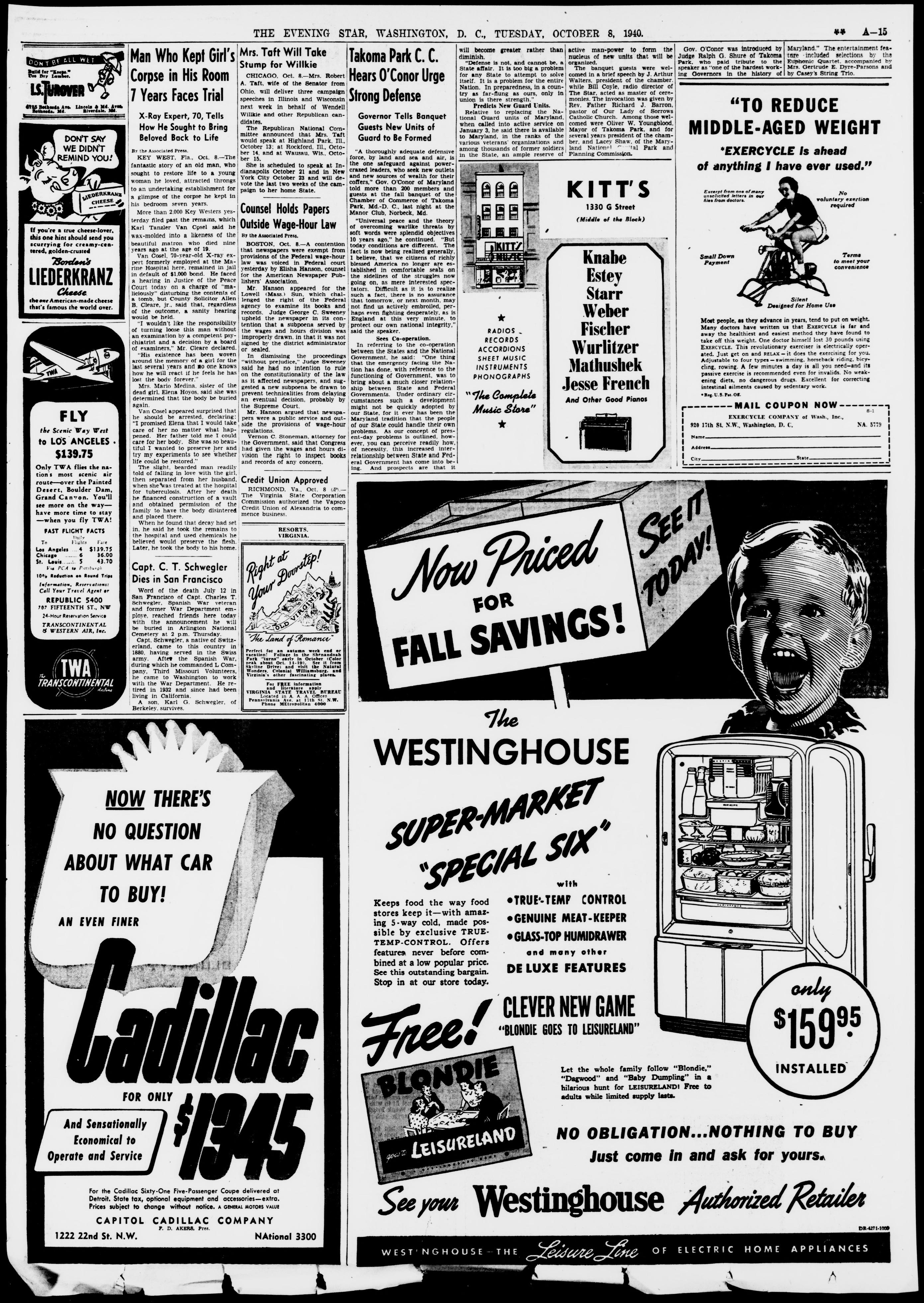
The Evening Star printed this Associated Press story on October 8, 1940, with no copyright notice on the article or on page 15. The scan is the Library of Congress copy in Chronicling America. The Library believes papers of this age are in the public domain but says they may contain some copyrighted third-party material; the only notices in this issue sit on an advertisement and a separately credited feature elsewhere, and neither covers this story. The citation and rights statement appear under the scan.
The scan is clear, so the text below runs word for word with no illegible marks. The wire's spellings are left alone, among them "Karl Tanzler Van Cosel" and "disintered" for disinterred, and "jr." stays lowercase after Mr. Cleare's name. Words broken across lines by the narrow column have been joined. The crop takes in the headline, the deck and the entire story, which ends above a short rule.
Transcription
Transcribed word for word from the page scan. Original spelling, punctuation, capitalisation and typographical errors have been kept exactly as printed. Unreadable words are marked [illegible]. Nothing has been modernised or corrected.
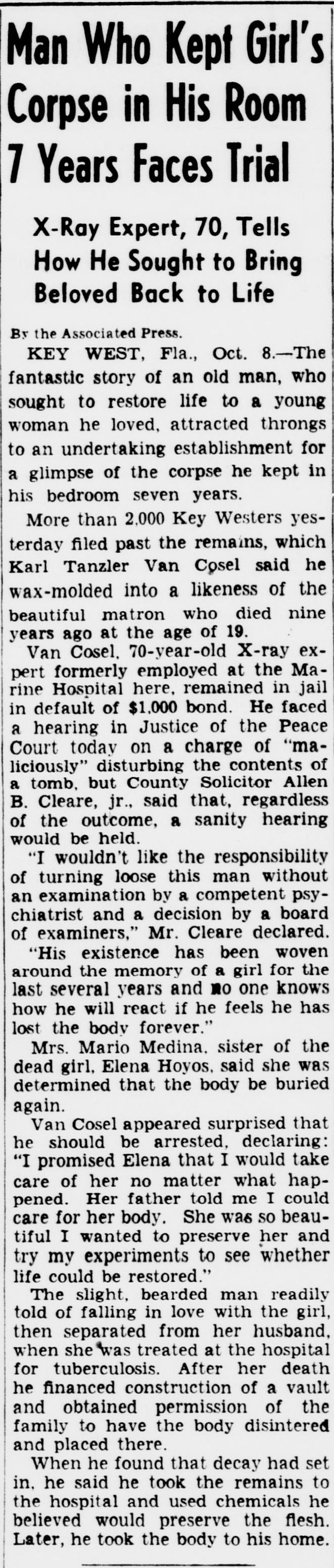
Man Who Kept Girl's Corpse in His Room 7 Years Faces Trial
X-Ray Expert, 70, Tells How He Sought to Bring Beloved Back to Life
By the Associated Press.
KEY WEST, Fla., Oct. 8.—The fantastic story of an old man, who sought to restore life to a young woman he loved, attracted throngs to an undertaking establishment for a glimpse of the corpse he kept in his bedroom seven years.
More than 2,000 Key Westers yesterday filed past the remains, which Karl Tanzler Van Cosel said he wax-molded into a likeness of the beautiful matron who died nine years ago at the age of 19.
Van Cosel, 70-year-old X-ray expert formerly employed at the Marine Hospital here, remained in jail in default of $1,000 bond. He faced a hearing in Justice of the Peace Court today on a charge of "maliciously" disturbing the contents of a tomb, but County Solicitor Allen B. Cleare, jr., said that, regardless of the outcome, a sanity hearing would be held.
"I wouldn't like the responsibility of turning loose this man without an examination by a competent psychiatrist and a decision by a board of examiners," Mr. Cleare declared.
"His existence has been woven around the memory of a girl for the last several years and no one knows how he will react if he feels he has lost the body forever."
Mrs. Mario Medina, sister of the dead girl, Elena Hoyos, said she was determined that the body be buried again.
Van Cosel appeared surprised that he should be arrested, declaring: "I promised Elena that I would take care of her no matter what happened. Her father told me I could care for her body. She was so beautiful I wanted to preserve her and try my experiments to see whether life could be restored."
The slight, bearded man readily told of falling in love with the girl, then separated from her husband, when she was treated at the hospital for tuberculosis. After her death he financed construction of a vault and obtained permission of the family to have the body disintered and placed there.
When he found that decay had set in, he said he took the remains to the hospital and used chemicals he believed would preserve the flesh. Later, he took the body to his home.
Notes: Associated Press dispatch ("By the Associated Press."). The crop takes in the three-line headline, the three-line second deck and the full text, ending above a short rule; the next item in the column ("Capt. C. T. Schwegler Dies in San Francisco") is excluded. Printed forms kept as printed: "Karl Tanzler Van Cosel" (the name is usually given as Carl Tanzler von Cosel), "Elena Hoyos" and "disintered" (for disinterred). Line-end hyphenation from column setting has been joined ("yes-/terday", "ex-/pert", "Ma-/rine", "ma-/liciously", "psy-/chiatrist", "hap-/pened", "beau-/tiful"); "wax-molded" and "X-ray" are hyphenated within the line and are kept. The "n" of "no one" is heavily inked but readable. Readability: very good; no [illegible] marks needed.