MADE BUSINESS OF MURDER: METROPOLIS WEEKLY GAZETTE, OCTOBER 6, 1922
Ninety-three years after William Burke was hanged in Edinburgh, his name was still good for a column of filler in a small Illinois weekly. On October 6, 1922, the Metropolis Weekly Gazette ran an uncredited syndicated piece that told the story of William Burke and William Hare in a single paragraph, and its real interest is in the deck: Burke, the "Infamous Irishman," had added a verb to the language. This is a later feature written nearly a century after the murders, not news from the time, and it tells the story the way popular memory had settled it.
Its outline holds. In 1827 Burke lodged in the cheap house Hare kept in Edinburgh; an old army pensioner died there owing rent, and the two men sold the body to Dr. Robert Knox, an anatomist whose school asked no questions. After that they made the bodies themselves. The poor and the friendless were drawn in, given drink and smothered so that no mark showed, and Knox paid as much as £14 apiece. The dead had names: Abigail Simpson, a salt seller from Gilmerton; Mary Paterson, about eighteen; James Wilson, the lame young man the streets called Daft Jamie; and the last, Margaret Docherty, killed on October 31, 1828.
The ending the Gazette gives is true in its shape. Hare turned king's evidence against his partner, and Burke, convicted of Margaret Docherty's murder, was hanged on January 28, 1829, and publicly dissected. Hare was never tried for anything. He walked out of the Calton Jail on February 5 under the name of Mr. Black, was nearly lynched by a crowd in Dumfries, and was set down on the road toward England, and there he drops out of the record. The verb outlived them both. "To burke," the paper explains, meant to suffocate or to suppress, and it came from the way these men killed.
This is filler printed in 1922, ninety-odd years after the events and without a byline, and several of its claims are legend rather than record. It calls the pair body-snatchers and resurrectionists, but there is no proof they ever robbed a grave, and Burke himself denied it. It counts "At least 15" dead, where Burke's confessions put the total at sixteen. It has the victims smothered "under mattresses"; the usual method was one man lying across the chest while the other closed the nose and mouth. It sends Burke to Scotland "about 1817," a year early, and repeats the tale that Hare died in England under an assumed name, which no document supports. Burke was convicted of one murder, Docherty's; Hare was never tried.
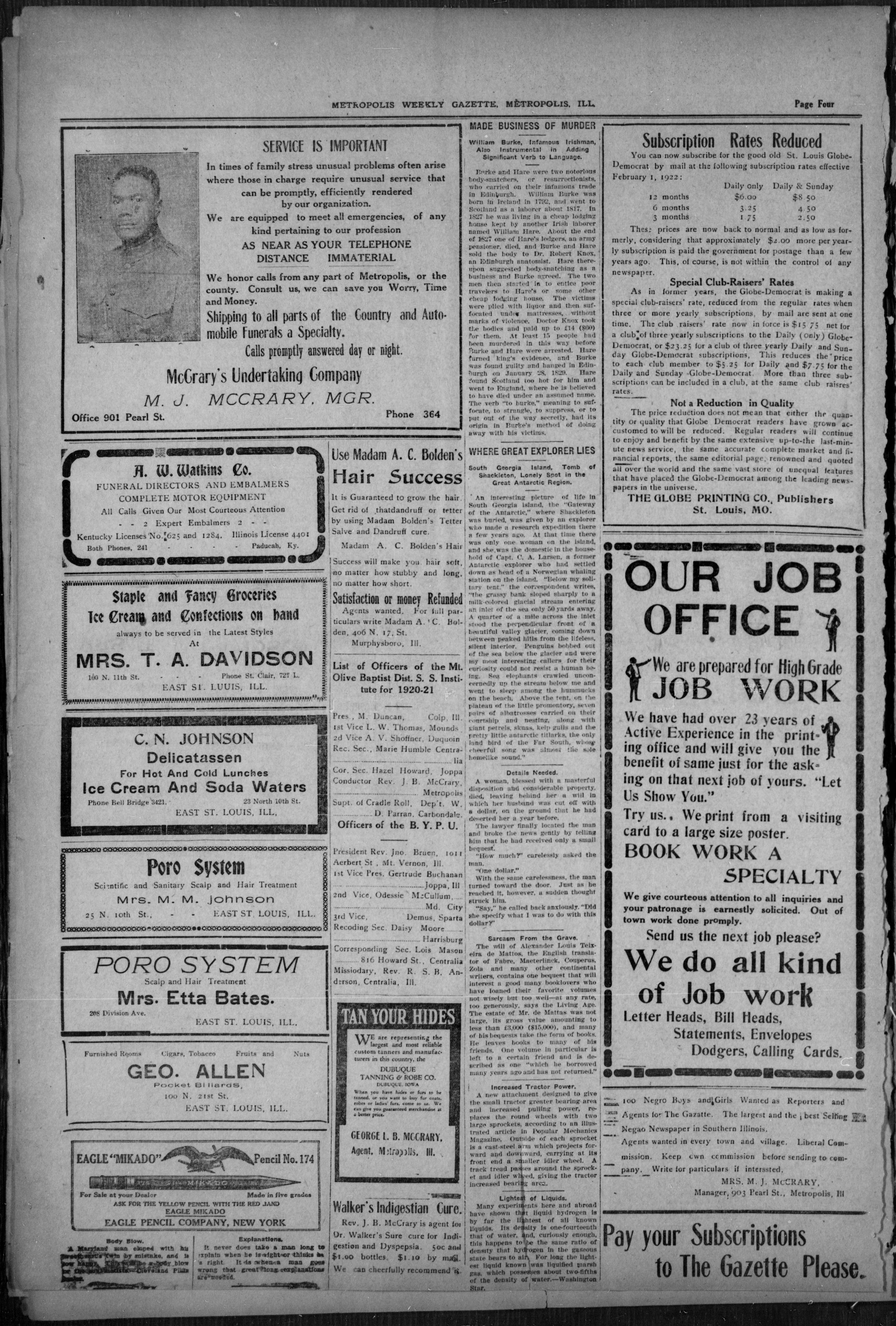
The Metropolis Weekly Gazette of Metropolis, Illinois, printed this on page 4 of its October 6, 1922, issue. A United States newspaper more than ninety-five years old is in the public domain in its entirety, and no copyright notice appears on the article or the page. The scan is the Library of Congress copy in Chronicling America, and the full citation and the Library's rights statement appear beneath it.
The piece is one unbroken paragraph in a single column, transcribed exactly as the Gazette set it, with nothing illegible. Its period touches are left alone: the lower-case "king's evidence," the price given as "£14 ($60)," and the American spellings "laborer" and "travelers" in a story set in Scotland. The deck under the headline is part of the transcription.
Transcription
Transcribed word for word from the page scan. Original spelling, punctuation, capitalisation and typographical errors have been kept exactly as printed. Unreadable words are marked [illegible]. Nothing has been modernised or corrected.
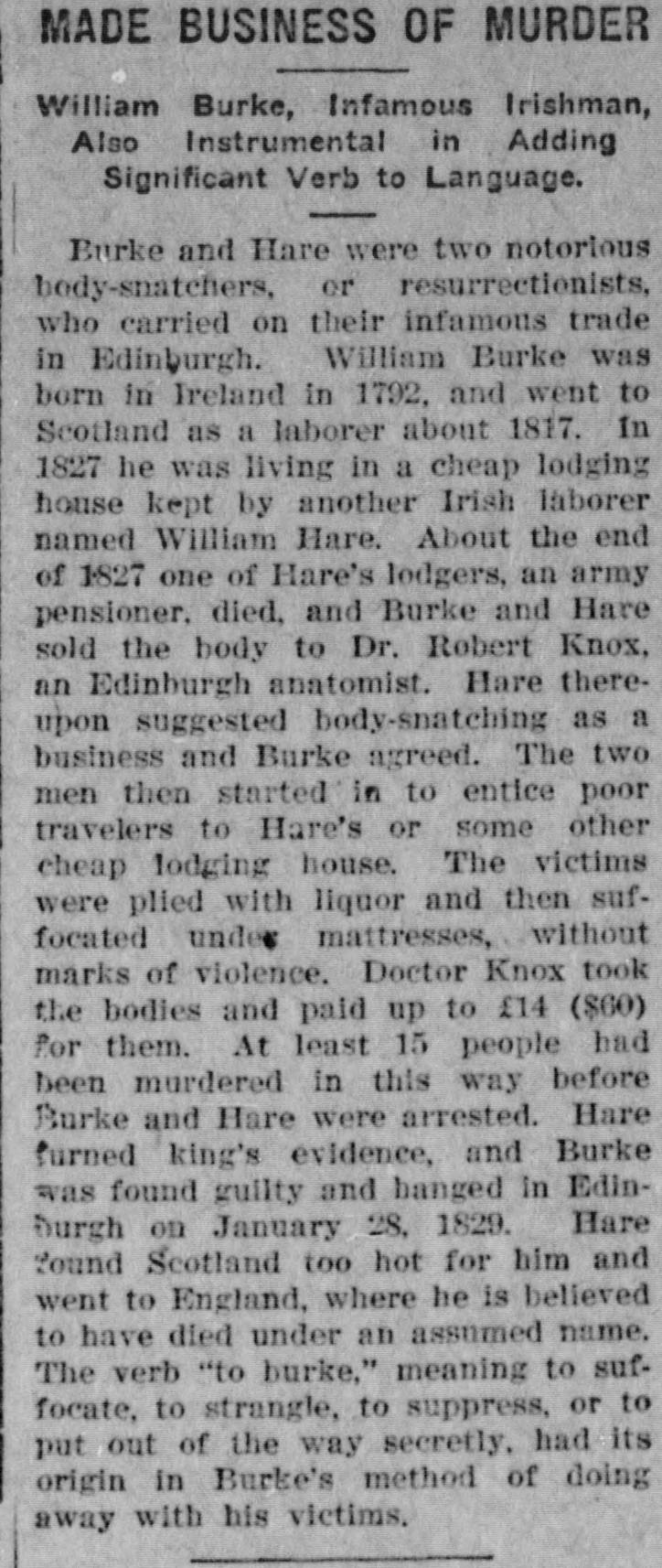
MADE BUSINESS OF MURDER
William Burke, Infamous Irishman, Also Instrumental in Adding Significant Verb to Language.
Burke and Hare were two notorious body-snatchers, or resurrectionists, who carried on their infamous trade in Edinburgh. William Burke was born in Ireland in 1792, and went to Scotland as a laborer about 1817. In 1827 he was living in a cheap lodging house kept by another Irish laborer named William Hare. About the end of 1827 one of Hare's lodgers, an army pensioner, died, and Burke and Hare sold the body to Dr. Robert Knox, an Edinburgh anatomist. Hare thereupon suggested body-snatching as a business and Burke agreed. The two men then started in to entice poor travelers to Hare's or some other cheap lodging house. The victims were plied with liquor and then suffocated under mattresses, without marks of violence. Doctor Knox took the bodies and paid up to £14 ($60) for them. At least 15 people had been murdered in this way before Burke and Hare were arrested. Hare turned king's evidence, and Burke was found guilty and hanged in Edinburgh on January 28, 1829. Hare found Scotland too hot for him and went to England, where he is believed to have died under an assumed name. The verb "to burke," meaning to suffocate, to strangle, to suppress, or to put out of the way secretly, had its origin in Burke's method of doing away with his victims.
Notes: This is an uncredited syndicated feature. It is printed as a single column. Readability is good, and no words were illegible.