LEONSKI DOOMED TO HANG FOR 3 AUSTRALIAN SLAYINGS: THE WASHINGTON DAILY NEWS, JULY 17, 1942
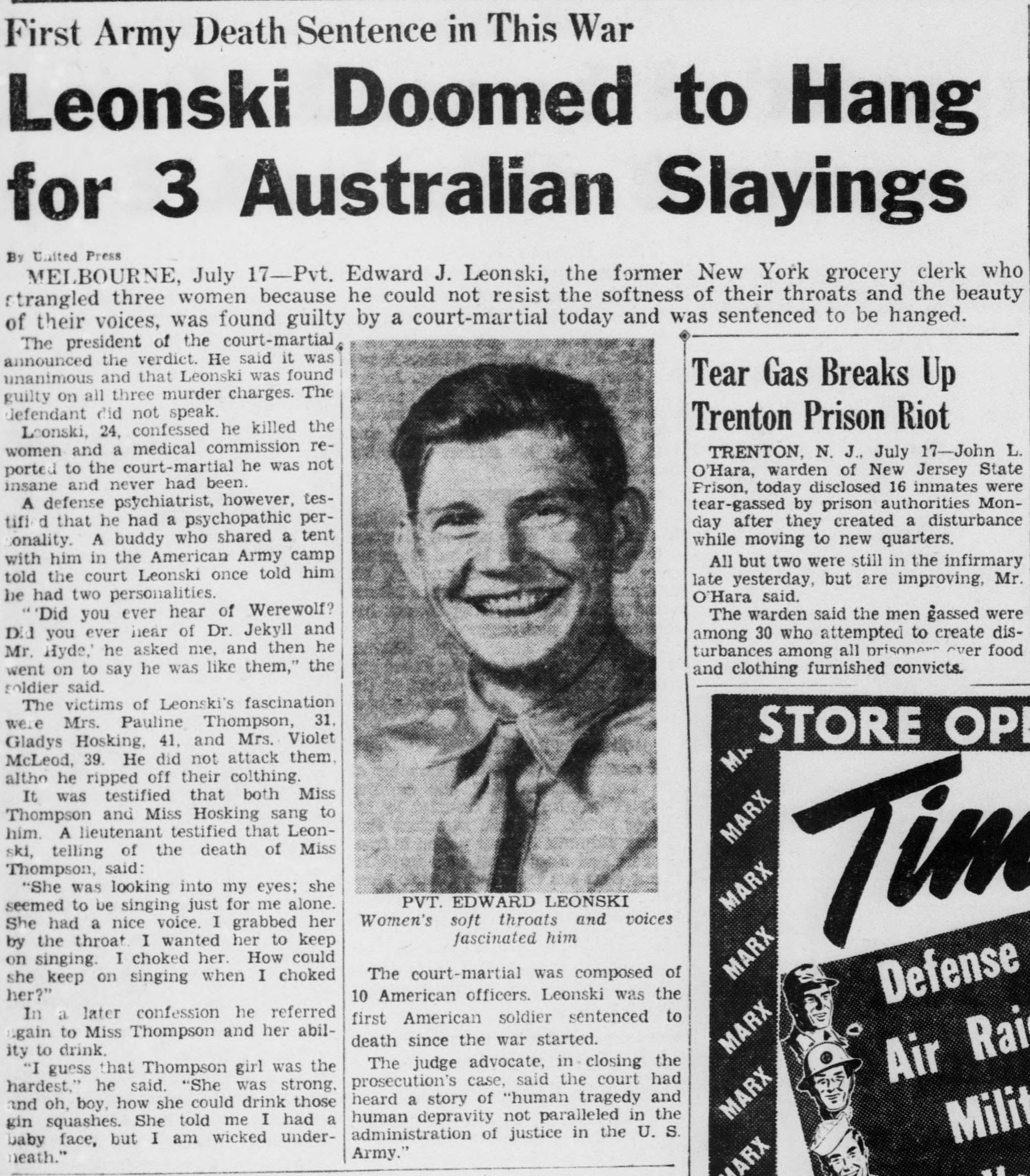
In Melbourne on July 17, 1942, a court-martial of American officers found Private Eddie Leonski guilty of strangling three women in the city's darkened wartime streets that May and sentenced him to hang. The United Press had it in Washington the same day. The Washington Daily News gave the verdict a two-column headline, a large smiling portrait of the defendant, and an opening sentence that put the whole case in one line: he had killed because he could not resist "the softness of their throats and the beauty of their voices." When the verdict was read, the paper noted, Leonski did not speak.
The rest of the report is the trial in miniature. A medical commission had found that he was not insane and never had been; a defense psychiatrist called his personality psychopathic. A soldier who shared his tent told the court that Leonski claimed two personalities and had asked him, "Did you ever hear of Werewolf?" Then came the words that made the story. A lieutenant testified that Leonski, describing Pauline Thompson's death, had said: "She was looking into my eyes; she seemed to be singing just for me alone. She had a nice voice. I grabbed her by the throat. I wanted her to keep on singing."
The three women behind the headline had lives the column barely touches. Pauline Thompson, 31, typed for a living by day and worked a radio station switchboard at night; her husband and their two children were in Bendigo. Gladys Hosking worked in the chemistry department of the University of Melbourne and lived close to the camp where Leonski was quartered. Ivy Violet McLeod, the first to die, was found in a shop doorway in Albert Park on May 3. The sentence passed review, and on November 9, 1942, Leonski was hanged at Pentridge prison, the only man a foreign court has ever hanged on Australian soil.
This is a wire report sent from Melbourne on the day of the verdict, not the court record, and several of its details differ from that record. It gives the court as ten officers; there were eleven. It calls the verdict unanimous, when the finding of guilt was reached by secret written ballot with three-quarters concurring, and only the death sentence required every vote. It prints the ages of Gladys Hosking and Violet McLeod as 41 and 39; both were 40. It also slips from "Mrs." to "Miss Thompson," though she was married. Leonski confessed, and he was convicted of all three murders.
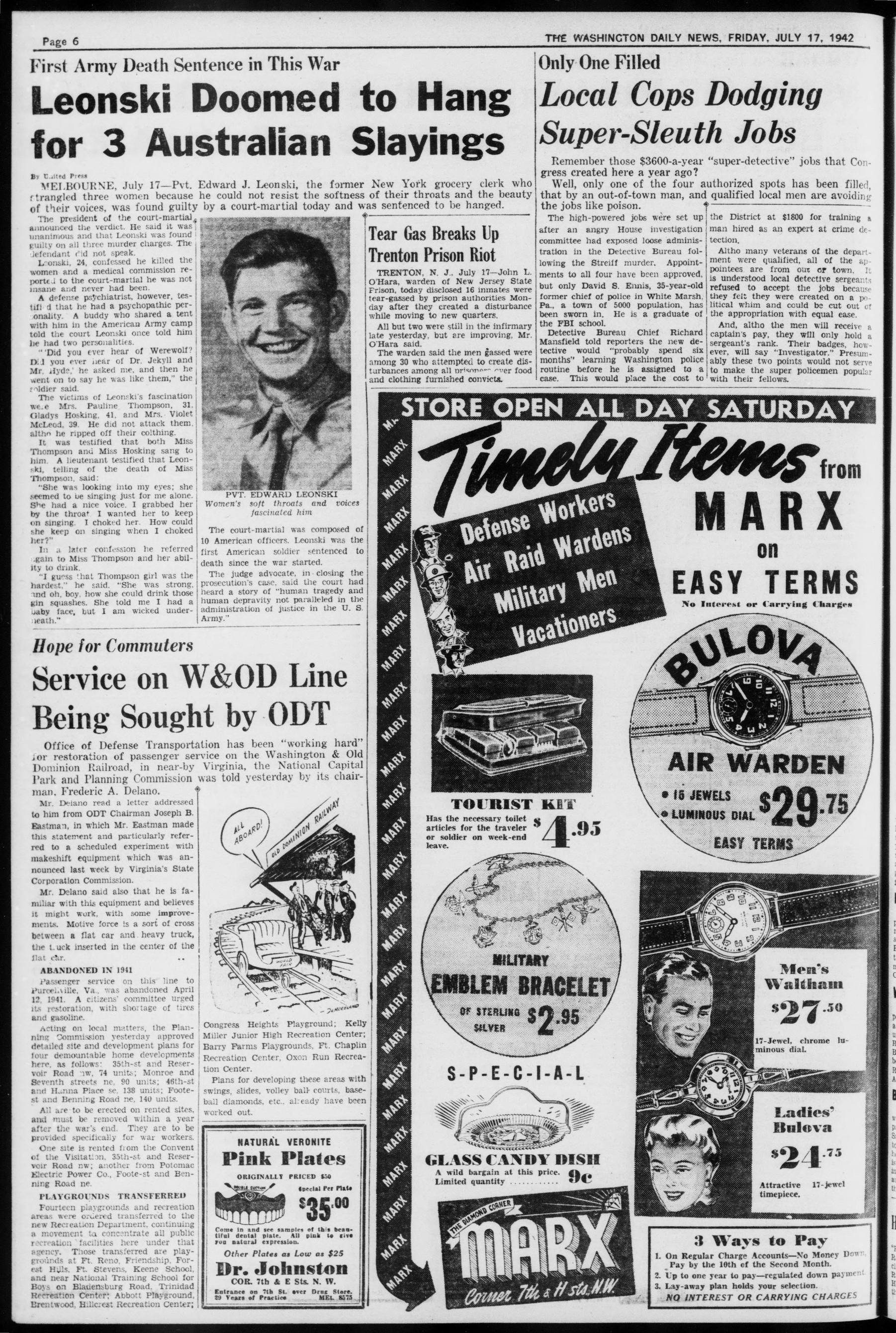
This 1942 issue of The Washington Daily News is less than ninety-five years old, and for issues of that age the Library of Congress says only that it believes they are in the public domain, noting that they may contain some copyrighted third-party material. Nothing in this item, the portrait included, appears to be syndicated or separately copyrighted. The scan is the Library's copy in Chronicling America, and the citation and rights statement sit beneath it.
The type is grey and the left edge of the first column is worn, but every word could be read and nothing is marked illegible. The headline and the opening paragraph run wider than the narrow column crops, so the ends of those lines were read from the full page rather than guessed. The paper's "colthing" and its house spelling "altho" are left as printed. The portrait's place in the second column is marked in the transcription with its two-part caption, and the article ends on this page.
Transcription
Transcribed word for word from the page scan. Original spelling, punctuation, capitalisation and typographical errors have been kept exactly as printed. Unreadable words are marked [illegible]. Nothing has been modernised or corrected.
Leonski Doomed to Hang for 3 Australian Slayings
By United Press
MELBOURNE, July 17—Pvt. Edward J. Leonski, the former New York grocery clerk who strangled three women because he could not resist the softness of their throats and the beauty of their voices, was found guilty by a court-martial today and was sentenced to be hanged.
The president of the court-martial announced the verdict. He said it was unanimous and that Leonski was found guilty on all three murder charges. The defendant did not speak.
Leonski, 24, confessed he killed the women and a medical commission reported to the court-martial he was not insane and never had been.
A defense psychiatrist, however, testified that he had a psychopathic personality. A buddy who shared a tent with him in the American Army camp told the court Leonski once told him he had two personalities.
"'Did you ever hear of Werewolf? Did you ever hear of Dr. Jekyll and Mr. Hyde,' he asked me, and then he went on to say he was like them," the soldier said.
The victims of Leonski's fascination were Mrs. Pauline Thompson, 31, Gladys Hosking, 41, and Mrs. Violet McLeod, 39. He did not attack them, altho he ripped off their colthing.
It was testified that both Miss Thompson and Miss Hosking sang to him. A lieutenant testified that Leonski, telling of the death of Miss Thompson, said:
"She was looking into my eyes; she seemed to be singing just for me alone. She had a nice voice. I grabbed her by the throat. I wanted her to keep on singing. I choked her. How could she keep on singing when I choked her?"
In a later confession he referred again to Miss Thompson and her ability to drink.
"I guess that Thompson girl was the hardest," he said. "She was strong, and oh, boy, how she could drink those gin squashes. She told me I had a baby face, but I am wicked underneath."
[photograph, captioned: PVT. EDWARD LEONSKI / Women's soft throats and voices fascinated him]
The court-martial was composed of 10 American officers. Leonski was the first American soldier sentenced to death since the war started.
The judge advocate, in closing the prosecution's case, said the court had heard a story of "human tragedy and human depravity not paralleled in the administration of justice in the U. S. Army."
Transcriber's notes
- Readability: Good. The type is a little grey and the left-hand letters of many lines in column 1 are worn, but every word is legible. No [illegible] markers were needed.
- Printers' errors kept as printed: "altho he ripped off their colthing" — "colthing" for "clothing", and "altho" is the paper's house spelling of "although".
- The paper first names the victims as "Mrs. Pauline Thompson, 31, Gladys Hosking, 41, and Mrs. Violet McLeod, 39" and thereafter calls two of them "Miss Thompson" and "Miss Hosking"; the inconsistency is as printed.
- The accepted record gives Gladys Hosking's age as 40 and Ivy Violet McLeod's as 40; the paper prints 41 and 39. Transcription left as printed.
- Split headline: the headline is set across the full width of the article and is cut in two by the column crops — column 1 gives "Leonski D…" / "for 3 Aus…" and column 2 "…Doomed t…" / "…stralian S…". The halves are joined above as "Leonski Doomed to Hang / for 3 Australian Slayings". The headline and the three-line opening paragraph both run past the right-hand edge of the supplied crop, so the ends of those lines are not present in any of the six tiles; they were read from the full-page scan held alongside the tiles in the same folder (leonski.fullpage.jpg) rather than guessed.
- A halftone portrait of Leonski occupies the top of column 2, below the opening paragraph and above the text that resumes with "The court-martial was composed of 10 American officers."; it is marked in place above. Its caption is set in two parts, a line of capitals and two italic lines.
- Column 2 is a continuation of column 1 and the article ends with "…in the U. S. Army." above a closing rule; it does not jump to another page.
- At the right-hand edge of the headline crop a separate italic-headed column ("Loc… / Sup…", beginning "Remember… gress crea… Well, on… that by an… the jobs li… The high-…") is partly visible; it is a different, unrelated item and is not transcribed.