KINGSBURY RUN DEATH CLUE LEADS TOWARD SOLUTION: IMPERIAL VALLEY PRESS, JULY 7, 1939
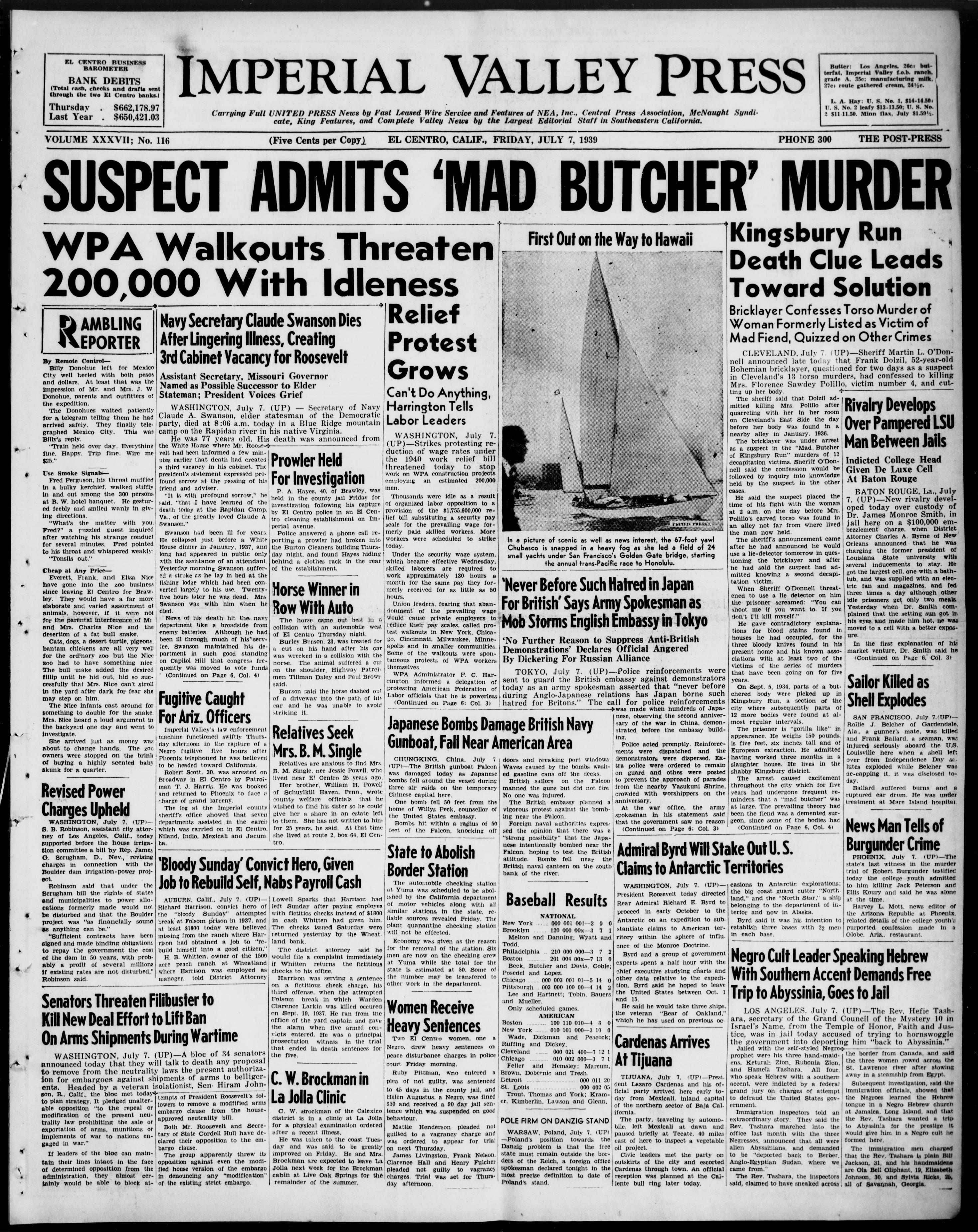
For five years Cleveland had been finding pieces of people, and on July 7, 1939, a sheriff said at last that he had a confession. The United Press dispatch went onto the front page of the Imperial Valley Press in El Centro, California, that same day. Sheriff Martin L. O'Donnell announced that Frank Dolezal (the paper spells it Dolzil), a fifty-two-year-old Bohemian bricklayer held for two days as a suspect in the work of the Cleveland Torso Murderer, had admitted killing Mrs. Florence Sawdey Polillo and cutting up her body. The paper counted thirteen dead and listed her as "victim number 4."
By O'Donnell's account, Dolezal said he had quarreled with Polillo at 2 a.m. in her room on the East Side, the day before her carved torso turned up in an alley near where he lived, in January 1936. The rest of the dispatch shows what the case against him rested on. He had given contradictory explanations for blood stains in houses he had lived in, for three bloody knives found in his present home, and for knowing at least two of the victims. He had worked three months in a slaughterhouse. And when the sheriff threatened him with a lie detector, he screamed: "You can shoot me if you want to. If you don't I'll kill myself."
Then the story turns to the man himself, "gorilla like" in appearance, five feet six and 150 pounds, from the shabby Kingsbury district, and to a city's relief after five years of reminders that a "mad butcher" was at large. The front-page text breaks off in the middle of a sentence about the theory that the killer was a demented surgeon. Dolezal never came to trial. Six weeks after this report he died in the sheriff's jail, and the murders were never solved.
This is a wire dispatch reporting a sheriff's announcement, filed the day the news broke; it is not the confession and not a court record. The paper counts thirteen victims and dates the first discovery to September 5, 1934, in Kingsbury Run. The remains found that day, the Lady of the Lake, came from the Lake Erie shore near Bratenahl, and the official series of twelve leaves them out. It spells the suspect Dolzil and the victim Florence Sawdey Polillo; she is also recorded as Florence Genevieve Polillo. A date of August 24, 1939, sometimes given for Dolezal's arrest cannot be squared with this July 7 report. The Cleveland Torso Murderer was never identified, and no one was ever convicted.
Published on July 7, 1939, this issue is less than 95 years old. The Library of Congress believes newspapers of that age in Chronicling America are in the public domain, but it cautions that they may contain some copyrighted third-party material. This story carries a United Press credit, so it is agency copy rather than the paper's own reporting, though no separate copyright notice appears on or beside it. The scan is the Library's Chronicling America copy, with the citation and rights statement beneath it.
The transcription is word for word from the front page, and nothing on it was too worn to read. The paper's inconsistencies are kept, "lie-detector" in one sentence and "lie detector" in the next, and "gorilla like" without a hyphen. The final printed line is the jump, "(Continued on Page 6, Col. 4)," and page six was not captured, so the story stops at "since some of the bodies had" and the rest of it is missing here.
Transcription
Transcribed word for word from the page scan. Original spelling, punctuation, capitalisation and typographical errors have been kept exactly as printed. Unreadable words are marked [illegible]. Nothing has been modernised or corrected.
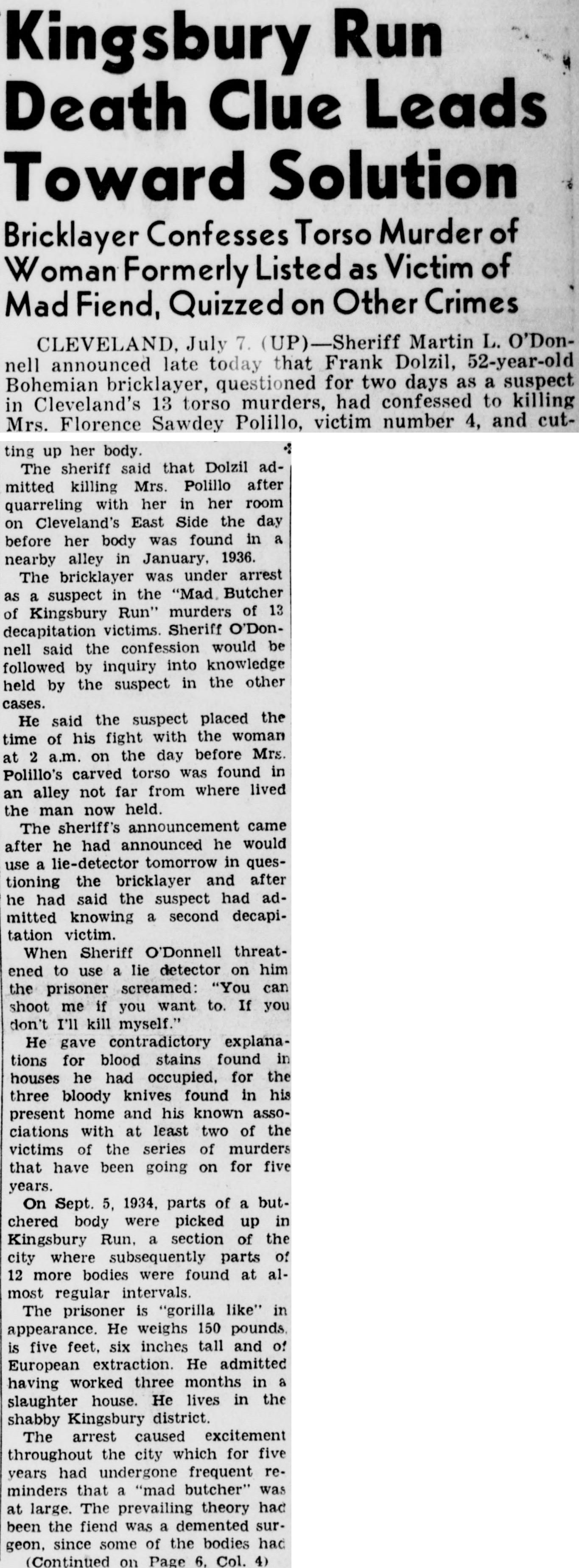
Kingsbury Run Death Clue Leads Toward Solution
Bricklayer Confesses Torso Murder of Woman Formerly Listed as Victim of Mad Fiend, Quizzed on Other Crimes
CLEVELAND, July 7. (UP)—Sheriff Martin L. O'Donnell announced late today that Frank Dolzil, 52-year-old Bohemian bricklayer, questioned for two days as a suspect in Cleveland's 13 torso murders, had confessed to killing Mrs. Florence Sawdey Polillo, victim number 4, and cutting up her body.
The sheriff said that Dolzil admitted killing Mrs. Polillo after quarreling with her in her room on Cleveland's East Side the day before her body was found in a nearby alley in January, 1936.
The bricklayer was under arrest as a suspect in the "Mad Butcher of Kingsbury Run" murders of 13 decapitation victims. Sheriff O'Donnell said the confession would be followed by inquiry into knowledge held by the suspect in the other cases.
He said the suspect placed the time of his fight with the woman at 2 a.m. on the day before Mrs. Polillo's carved torso was found in an alley not far from where lived the man now held.
The sheriff's announcement came after he had announced he would use a lie-detector tomorrow in questioning the bricklayer and after he had said the suspect had admitted knowing a second decapitation victim.
When Sheriff O'Donnell threatened to use a lie detector on him the prisoner screamed: "You can shoot me if you want to. If you don't I'll kill myself."
He gave contradictory explanations for blood stains found in houses he had occupied, for the three bloody knives found in his present home and his known associations with at least two of the victims of the series of murders that have been going on for five years.
On Sept. 5, 1934, parts of a butchered body were picked up in Kingsbury Run, a section of the city where subsequently parts of 12 more bodies were found at almost regular intervals.
The prisoner is "gorilla like" in appearance. He weighs 150 pounds, is five feet, six inches tall and of European extraction. He admitted having worked three months in a slaughter house. He lives in the shabby Kingsbury district.
The arrest caused excitement throughout the city which for five years had undergone frequent reminders that a "mad butcher" was at large. The prevailing theory had been the fiend was a demented surgeon, since some of the bodies had
(Continued on Page 6, Col. 4)