JURY TELLS GUILTY VERDICT IN SURGEON FAMILY CASE: THE SALT LAKE TRIBUNE, NOVEMBER 30, 1971
Firemen looking for water to fight a blaze at a hilltop house near Santa Cruz went to the swimming pool, and in the pool they found five bodies. Each had been blindfolded, the wrists bound with silk scarves. Dr. Victor Ohta, forty-five, a wealthy eye surgeon, had been shot three times. With him were his wife, Virginia, forty-three, their sons, Derrick, twelve, and Taggart, eleven, and his secretary, Dorothy Cadwallader, thirty-eight. Thirteen months later, on Monday, November 29, 1971, a Superior Court jury in Redwood City convicted John Linley Frazier, a twenty-five-year-old former automobile mechanic, of five counts of murder. The Salt Lake Tribune ran the Associated Press story the next day.
Under the windshield of Ohta's Rolls-Royce lay a note typed on the doctor's own typewriter. "Today, World War 3 will begin as brought to you by the people of the Free Universe," it announced, and it promised death to anyone "who misuses the natural environment or destroys same." It was signed with four Tarot cards, the Knights of Wands, Cups, Pentacles and Swords. The prosecutor, Peter Chang, told the jury what Frazier meant by rednecks: materialists, capitalists, people who built big houses and damaged the natural order of things. Joseph Cole, one of three young men who went to the authorities after the murders, testified that Frazier talked of "ripping off rednecks" and once said he would shoot his mother if necessary to promote the revolution.
The rest of the case was objects. A neighbor, Donald Muni, testified that .38 and .22-caliber guns had been stolen from his house around October 5, 1970, along with a red telephone, a wastebasket and a radio. Police found the telephone, the wastebasket and the radio in a shed near the shack where Frazier lived, half a mile from the Ohta house, and with them a pair of binoculars and a .45 semiautomatic that witnesses said had been Ohta's. The murder weapons were never found. The defense attorney, James Jackson, pressed the point: "There were no fingerprints, no eyewitnesses, no confession, nothing to place the defendant at the scene." The same jury still had to decide whether Frazier was sane.
Filed on verdict day, this is a wire summary of the prosecution's case, and the defense gets a single sentence. Some details differ from the record. The paper dates the fire and the discovery to October 19, 1970; the record gives Monday, October 20. It has Ohta shot with a .38 and the other four with a .22, where the record has all five shot with a .38 revolver. Other versions of the note read "Halloween" and "World War III." The sanity question went against him: the jury found Frazier legally sane, and he was sentenced to death at the end of 1971, a sentence that became life when California's death penalty was struck down in 1972. The five murders were a single night's attack.
The Salt Lake Tribune of November 30, 1971, printed the story on page 2 as unsigned Associated Press copy. In that whole issue, copyright notices appear only on a handful of syndicated stories and columns on other pages; the article and the masthead carry none, and in 1971 an American publication needed one to keep its copyright. Utah Digital Newspapers at the University of Utah's J. Willard Marriott Library holds the scan and rates the issue "No Copyright - United States," a rating printed with the full citation beneath the scan.
Transcribed word for word, with no illegible words. Because the first column runs further down the page than the second, the scan is in two crops, the second beginning at "The note, typed on Ohta's typewriter." The paper's mistakes are left alone: "Santa Crus" for Santa Cruz, "Hallowe'n" in the note, Frazier spelled "Frazer" once, and a crosshead, "Reported Bullet Thefts," over a paragraph about stolen guns. One "Frazier" broken in the soft scan is set as the word plainly intended.
Transcription
Transcribed word for word from the page scan. Original spelling, punctuation, capitalisation and typographical errors have been kept exactly as printed. Unreadable words are marked [illegible]. Nothing has been modernised or corrected.
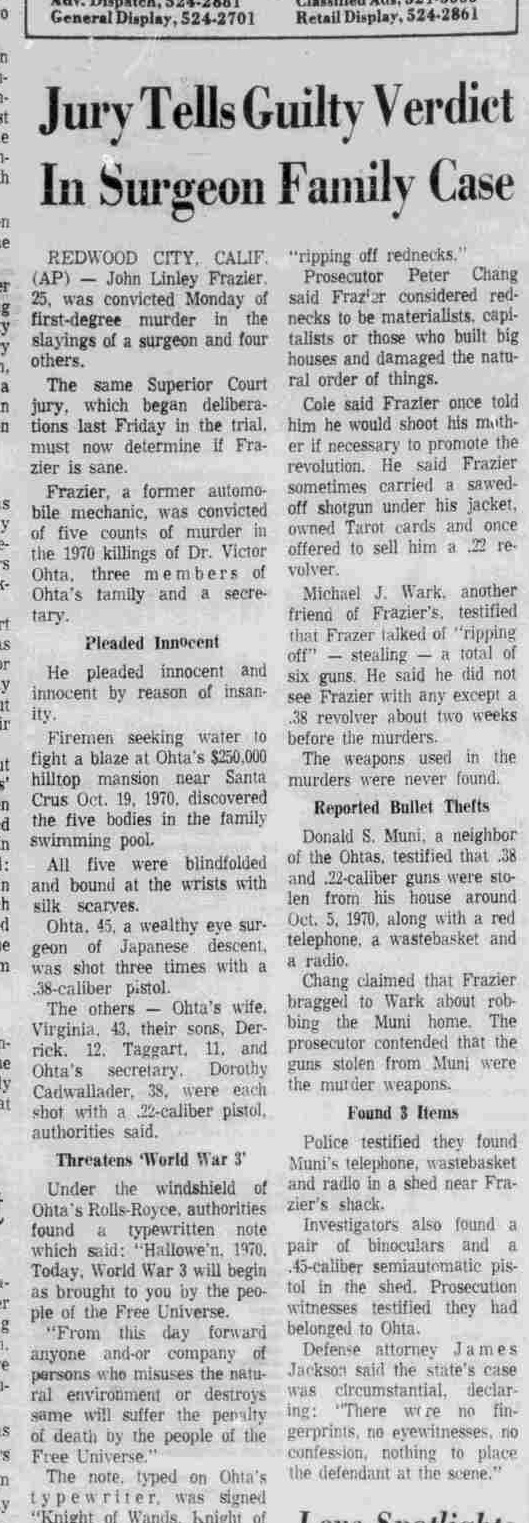
Jury Tells Guilty Verdict In Surgeon Family Case
REDWOOD CITY, CALIF. (AP) — John Linley Frazier, 25, was convicted Monday of first-degree murder in the slayings of a surgeon and four others.
The same Superior Court jury, which began deliberations last Friday in the trial, must now determine if Frazier is sane.
Frazier, a former automobile mechanic, was convicted of five counts of murder in the 1970 killings of Dr. Victor Ohta, three members of Ohta's family and a secretary.
Pleaded Innocent
He pleaded innocent and innocent by reason of insanity.
Firemen seeking water to fight a blaze at Ohta's $250,000 hilltop mansion near Santa Crus Oct. 19, 1970, discovered the five bodies in the family swimming pool.
All five were blindfolded and bound at the wrists with silk scarves.
Ohta, 45, a wealthy eye surgeon of Japanese descent, was shot three times with a .38-caliber pistol.
The others — Ohta's wife, Virginia, 43, their sons, Derrick, 12, Taggart, 11, and Ohta's secretary, Dorothy Cadwallader, 38, were each shot with a .22-caliber pistol, authorities said.
Threatens 'World War 3'
Under the windshield of Ohta's Rolls-Royce, authorities found a typewritten note which said: "Hallowe'n, 1970. Today, World War 3 will begin as brought to you by the people of the Free Universe.
"From this day forward anyone and-or company of persons who misuses the natural environment or destroys same will suffer the penalty of death by the people of the Free Universe."
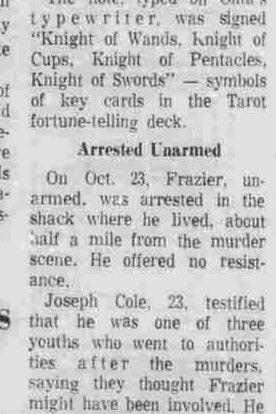
The note, typed on Ohta's typewriter, was signed "Knight of Wands, Knight of Cups, Knight of Pentacles, Knight of Swords" — symbols of key cards in the Tarot fortune-telling deck.
Arrested Unarmed
On Oct. 23, Frazier, unarmed, was arrested in the shack where he lived, about half a mile from the murder scene. He offered no resistance.
Joseph Cole, 23, testified that he was one of three youths who went to authorities after the murders, saying they thought Frazier might have been involved. He said Frazier had talked of "ripping off rednecks."
Prosecutor Peter Chang said Frazier considered rednecks to be materialists, capitalists or those who built big houses and damaged the natural order of things.
Cole said Frazier once told him he would shoot his mother if necessary to promote the revolution. He said Frazier sometimes carried a sawed-off shotgun under his jacket, owned Tarot cards and once offered to sell him a .22 revolver.
Michael J. Wark, another friend of Frazier's, testified that Frazer talked of "ripping off" — stealing — a total of six guns. He said he did not see Frazier with any except a .38 revolver about two weeks before the murders.
The weapons used in the murders were never found.
Reported Bullet Thefts
Donald S. Muni, a neighbor of the Ohtas, testified that .38 and .22-caliber guns were stolen from his house around Oct. 5, 1970, along with a red telephone, a wastebasket and a radio.
Chang claimed that Frazier bragged to Wark about robbing the Muni home. The prosecutor contended that the guns stolen from Muni were the murder weapons.
Found 3 Items
Police testified they found Muni's telephone, wastebasket and radio in a shed near Frazier's shack.
Investigators also found a pair of binoculars and a .45-caliber semiautomatic pistol in the shed. Prosecution witnesses testified they had belonged to Ohta.
Defense attorney James Jackson said the state's case was circumstantial, declaring: "There were no fingerprints, no eyewitnesses, no confession, nothing to place the defendant at the scene."
Notes: Kept as printed: "Santa Crus" for Santa Cruz; "Hallowe'n"; "Frazer" once for Frazier; the crosshead "Reported Bullet Thefts" (the paragraph is about stolen guns); the note's opening quotation is not closed before the second paragraph, which is normal. The OCR-era scan is soft, and "Frazier" in "said Frazier considered" is broken; it is set as the intended word. Column 1 runs further down the page than column 2, so the article is supplied as ARTICLE-CROP.jpg (headline and both columns) and ARTICLE-CROP-PART-2.jpg (the foot of column 1, from "The note, typed on Ohta's typewriter"). No words were illegible.