JOHN WESLEY HARDIN'S LIFE: THE AUSTIN WEEKLY STATESMAN, AUGUST 22, 1895
They buried John Wesley Hardin in El Paso the day after he was shot, and the dispatch sent out that day began with a eulogy of a kind: he was "the most noted desperado in the State, and whose light was put out last night by Constable John Sellman, an old policeman of this place." The Austin Weekly Statesman printed it on August 22, 1895, under a deck that announced "A SCORE OF PEOPLE SUCCUMBED HIS DEADLY AIM." What follows is less an obituary than a ledger of the man as Texas remembered him, set down within a day of his death.
The first half is the legend, and it moves at a gallop. Hardin leads the Taylor faction in the Taylor-Sutton feud, with "16 deaths being laid at Hardin's door"; he guns down Deputy Sheriff Webb of Brown County in a Comanche saloon; he kills Captain Jack Helm, the writer says, while Helm is stabbing a 14-year-old boy. He flees to Jacksonville, Florida, as a butcher named Swayne, is captured, tried for Webb's killing and sentenced to 25 years. In prison he studies law, and on his release he is admitted to the bar at Pecos. Each step is told as settled fact, and much of it is not.
The second half is El Paso, and here the writer is on home ground. Hardin takes a half interest in the Wigwam saloon by asking for it, makes a dealer at the Gem hand back his losses, drinks hard, writes his life story and threatens the police. On the night of August 19 he quarrels with Sellman over his son, and when the constable comes into the Acme saloon the two men watch each other in the mirror over the bar. Hardin reached for his gun, Sellman says, and the first shot "crashed through Hardin's brain." The next day, the dispatch says, 340 pages of manuscript turned up in his trunk, "a history of his life."
This is a local dispatch written the day after the shooting, and its account of Hardin's earlier life rests on reputation. Much of it is wrong. He was born in 1853 at Bonham in Fannin County, not Comanche County in 1851, and his father was a Methodist preacher, not a Baptist one. Webb died on May 26, 1874, not in February. Hardin was captured at Pensacola in 1877, after living as J. H. Swain, and served about fifteen and a half years before his 1894 discharge and pardon. The paper's "McRose" was Martin Mroz, its "Sellman" John Selman. Two inquest witnesses said Hardin never reached for a weapon. His only convictions were for Webb's second-degree murder and the 1873 manslaughter of J. B. Morgan; Helm's killing and the rest were never tried.
The Austin Weekly Statesman ran this as a special dispatch from El Paso, with no byline or wire credit, in its issue of August 22, 1895. That issue is in the public domain in the United States. The Library of Congress holds the scan in Chronicling America, and its citation and rights statement are printed below the page.
The dispatch fills column 1 and spills over to the head of column 2, and the transcription covers both crops, from the headline decks down to "a prominent horseman of Austin." Broken letters at the left margin and an over-inked "Paso" in the dateline were all readable, so no [illegible] marks were needed. The paper's misspellings and slips stay put: "Sellman," "Dona Ina county," "Juaraz," "beligerents," "Victor Queen" beside "McQueen's," "Ontlow" beside "Outlow," the doubled full stop in "a year ago.." and "whole-liquor house," which looks like a slip for wholesale.

Transcription
Transcribed word for word from the page scan. Original spelling, punctuation, capitalisation and typographical errors have been kept exactly as printed. Unreadable words are marked [illegible]. Nothing has been modernised or corrected.
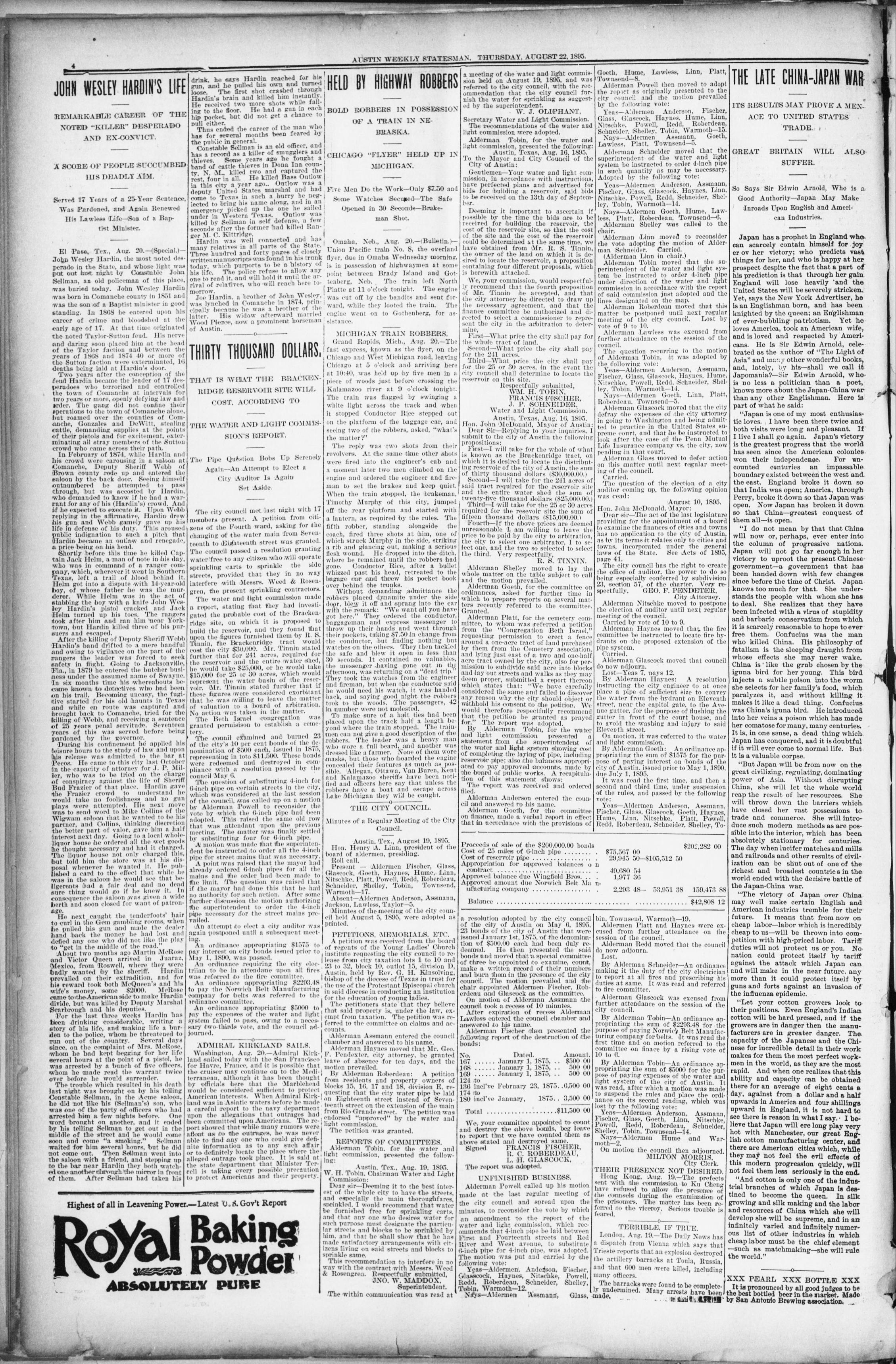
JOHN WESLEY HARDIN'S LIFE
REMARKABLE CAREER OF THE NOTED "KILLER" DESPERADO AND EX-CONVICT.
A SCORE OF PEOPLE SUCCUMBED HIS DEADLY AIM.
Served 17 Years of a 25-Year Sentence, Was Pardoned, and Again Renewed His Lawless Life—Son of a Baptist Minister.
El Paso, Tex., Aug. 20.—(Special.)—John Wesley Hardin, the most noted desperado in the State, and whose light was put out last night by Constable John Sellman, an old policeman of this place, was buried today. John Wesley Hardin was born in Comanche county in 1851 and was the son of a Baptist minister in good standing. In 1868 he entered upon his career of crime and bloodshed at the early age of 17. At that time originated the noted Taylor-Sutton feud. His nerve and daring soon placed him at the head of the Taylor faction and between the years of 1868 and 1874 40 or more of the Sutton faction were exterminated, 16 deaths being laid at Hardin's door.
Two years after the conception of the feud Hardin became the leader of 17 desperadoes who terrorized and controlled the town of Comanche at intervals for two years or more, openly defying law and order. The gang did not confine their operations to the town of Comanche alone, but roamed over the counties of Comanche, Gonzales and DeWitt, stealing cattle, demanding supplies at the points of their pistols and for excitement, exterminating all stray members of the Sutton crowd who came across their path.
In February of 1874, while Hardin and his crowd were carousing in a saloon at Comanche, Deputy Sheriff Webb of Brown county rode up and entered the saloon by the back door. Seeing himself outnumbered he attempted to pass through, but was accosted by Hardin, who demanded to know if he had a warrant for any of his (Hardin's) crowd. And if he expected to execute it. Upon Webb replying in the affirmative, Hardin drew his gun and Webb gamely gave up his life in defense of his duty. This aroused public indignation to such a pitch that Hardin became an outlaw and renegade, a price being on his head.
Shortly before this time he killed Captain Jack Helm, a man of note in his day, who was in command of a ranger company, which, wherever it went in Southern Texas, left a trail of blood behind it. Helm got into a dispute with 14-year-old boy, of whose father he was the murderer. While Helm was in the act of stabbing the boy with a knife John Wesley Hardin's pistol cracked and Jack Helm turned up his toes. The rangers took after him and ran him near Yorktown, but Hardin killed three of his pursuers and escaped.
After the killing of Deputy Sheriff Webb Hardin's band drifted to a mere handful and owing to vigilance on the part of the rangers the leader was forced to seek safety in flight. Going to Jacksonville, Fla., in 1879 he entered the butcher business under the assumed name of Swayne. In six months time his whereabouts became known to detectives who had been on his trail. Becoming uneasy, the fugitive started for his old haunts in Texas and while en route was captured and brought back to Comanche, tried for the killing of Webb, and receiving a sentence of 25 years penal servitude. Seventeen years of this was served before being pardoned by the governor.
During his confinement he applied his leisure hours to the study of law and upon his release was admitted to the bar at Pecos. He came to this city last October in the capacity of attorney for J. P. Miller, who was to be tried on the charge of conspiracy against the life of Sheriff Bud Frazier of that place. Hardin gave the Frazier crowd to understand he would take no foolishness and no gun plays were attempted. His next move was to send word to Mike Collins of the Wigwam saloon that he wanted to be his partner, and Collins, thinking discretion the better part of valor, gave him a half interest next day. Going to a local whole-liquor house he ordered all the wet goods he thought necessary and had it charged. The liquor house not only charged this, but told him the store was at his disposal whenever he wanted it. He published a card to the effect that while he was in the saloon he would see that beligerents had a fair deal and no dead sure thing would go if he knew it. In consequence the saloon was given a wide berth and soon closed for want of patronage.
He next caught the tenderfoots' hair to curl in the Gem gambling rooms, when he pulled his gun and made the dealer hand back the money he had lost and defied any one who did not like the play to "get in the middle of the road."
About two months ago Martin McRose and Victor Queen arrived in Juaraz, Mexico, from Roswell, where they were badly wanted by the sheriff. Hardin prevailed on their extradition, and for his reward took both McQueen's and his wife's money, some $2000. McRose came to the American side to make Hardin divide, but was killed by Deputy Marshal Scarbrough and his deputies.
For the last three weeks Hardin has been drinking considerable, writing a story of his life, and making life a burden to the police, whom he threatened to run out of the country. Several days since, on the complaint of Mrs. McRose, whom he had kept begging for her life several hours at the point of a pistol, he was arrested by a bunch of five officers, whom he made read the warrant twice over before he would surrender.
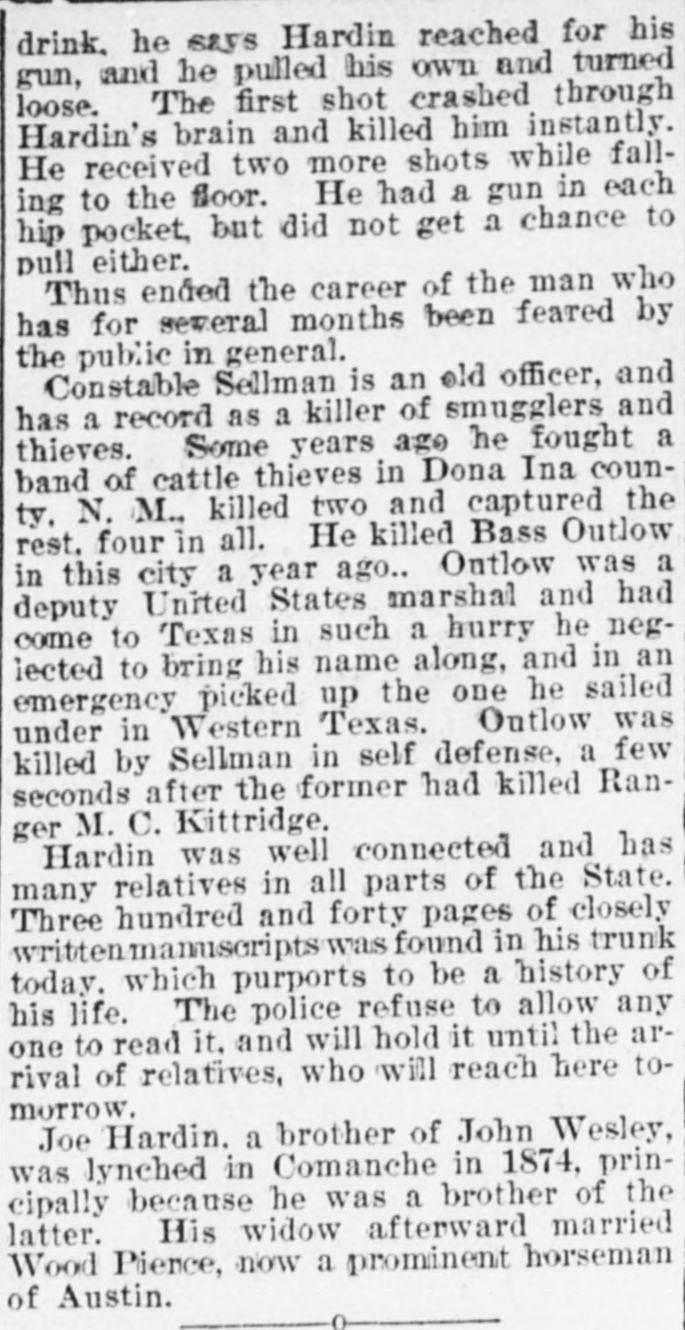
The trouble which resulted in his death last night was brought on by his telling Constable Sellman, in the Acme saloon, he did not like his (Sellman's) son, who was one of the party of officers who had arrested him a few nights before. One word brought on another, and it ended by his telling Sellman to get out in the middle of the street and he would come soon and come "a smoking." Sellman waited for him several hours, but he did not come out. Then Sellman went into the saloon with a friend, and stepping up to the bar near Hardin they both watched one another through the mirror in front of them. After Sellman had taken his drink, he says Hardin reached for his gun, and he pulled his own and turned loose. The first shot crashed through Hardin's brain and killed him instantly. He received two more shots while falling to the floor. He had a gun in each hip pocket, but did not get a chance to pull either.
Thus ended the career of the man who has for several months been feared by the public in general.
Constable Sellman is an old officer, and has a record as a killer of smugglers and thieves. Some years ago he fought a band of cattle thieves in Dona Ina county, N. M., killed two and captured the rest, four in all. He killed Bass Outlow in this city a year ago.. Ontlow was a deputy United States marshal and had come to Texas in such a hurry he neglected to bring his name along, and in an emergency picked up the one he sailed under in Western Texas. Outlow was killed by Sellman in self defense, a few seconds after the former had killed Ranger M. C. Kittridge.
Hardin was well connected and has many relatives in all parts of the State. Three hundred and forty pages of closely written manuscripts was found in his trunk today, which purports to be a history of his life. The police refuse to allow any one to read it, and will hold it until the arrival of relatives, who will reach here tomorrow.
Joe Hardin, a brother of John Wesley, was lynched in Comanche in 1874, principally because he was a brother of the latter. His widow afterward married Wood Pierce, now a prominent horseman of Austin.
Notes: The article runs the full length of column 1 and continues at the top of column 2 ("drink, he says Hardin reached for his gun…"), ending above a small rule before the city council report. Because a single rectangle would take in most of the unrelated city council story in column 2, it is supplied as ARTICLE-CROP.jpg (column 1, with all headline decks) plus ARTICLE-CROP-PART-2.jpg (top of column 2). Printed errors and inconsistencies kept as printed: "Sellman" (for Selman), "Dona Ina county" (for Doña Ana), "Juaraz", "Victor Queen" beside "McQueen's", "Ontlow" beside "Outlow", the double full stop in "a year ago..", "beligerents", "drinking considerable", "with 14-year-old boy", "manuscripts was found", "receiving a sentence" and the deck "SUCCUMBED HIS DEADLY AIM". "whole-liquor house" falls across a line end ("whole-" / "liquor"); it appears to be a compositor's slip for "wholesale liquor", so the hyphen has been kept rather than joined. In the dateline the final letter of "Paso" is over-inked and looks like "Pase"; it has been read as "Paso". Line-end hyphenations from column setting have been joined (e.g. "des-/perado", "watch-/ed", "Ran-/ger", "to-/morrow"). Several letters at the left margin of column 1 are broken or faint, but every word could be read. Because the page is slightly skewed, the lower right edge of ARTICLE-CROP.jpg shows the column rule and a few specks of the neighbouring column; no readable text from it is included. Readability: good throughout; no [illegible] marks needed.