NARROWLY ESCAPES LYNCHING: EVENING STAR, MAY 9, 1908
By the cable's account, the crowd outside the house was shouting "Let us get at the ogress," and the police had to fight their way to the jail with their prisoner. The woman was Jeanne Weber, and the Washington Evening Star had the story on its front page on May 9, 1908, in a special cablegram datelined Nancy. A seven-year-old boy had been strangled, it said, and once people learned who the stranger in town really was, they tried to lynch her.
The boy was Marcel Poirot, and he died on the evening of May 8 at Commercy, in the Meuse, in the small cafe-hotel his father kept. The woman lodging there had asked whether the child could sleep in her bed, and Poirot, who knew her only as Jeanne Moulinet, had agreed. The cable says she was found asleep beside the body, that the child was covered with blood and that his tongue had been cut out. The police commissioner arrested her that night, and by the next day her real name was everywhere.
The name mattered because of what had come before. In 1906 a Paris jury had acquitted her of killing children in her family, after the most eminent forensic physicians in the city testified that the deaths were natural. In January 1908 a court at Bourges had dismissed a second case, the death of a farmer's nine-year-old son in the Indre. The cable sums all of it up in a sentence and says she was let go because no proof could be found. This time the autopsy was unequivocal. She was found insane, never tried, and died in the asylum at Fains on July 5, 1918.
A cable sent within hours of the arrest, and its details are those of the first rumors. It places the killing at Nancy, where the dispatch was filed; the boy died at Commercy. It has her lodging "in the home of a workingman," though the Poirots kept a small hotel, and later accounts give Marcel's age as six or seven. The bleeding, the cut tongue and the mob all come from this cable alone. Its "over a score of children" is a newspaper figure; most accounts lay about ten deaths at her door. Whatever the headline says, no court ever convicted her: the 1906 acquittal and the 1908 dismissal stand, and the Commercy case ended in a finding of insanity.
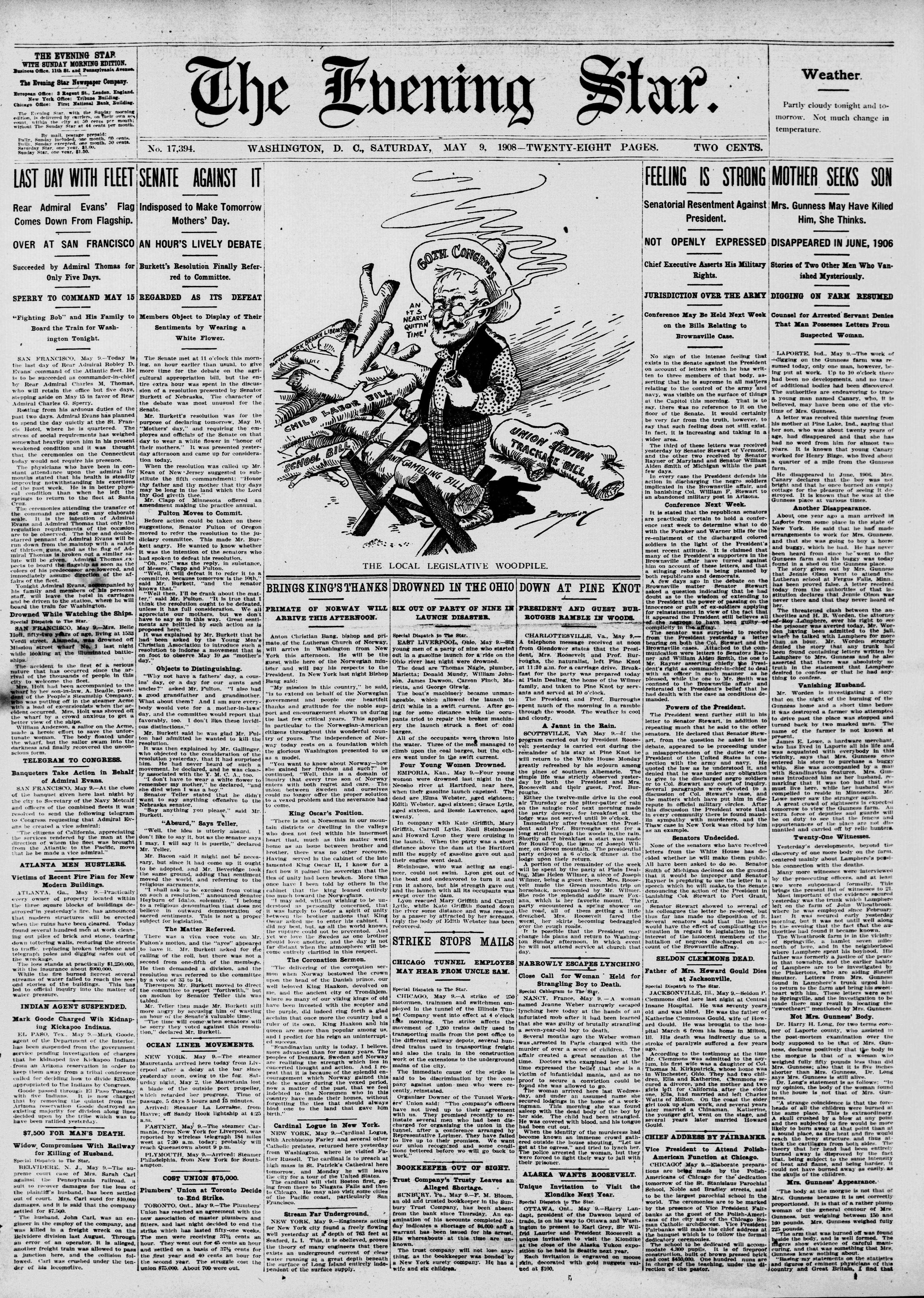
The Evening Star printed this on May 9, 1908, and the issue is in the public domain. The scan is the Library of Congress copy in Chronicling America; its citation and rights statement are given under the scan.
Heavy, clean front-page type left nothing in doubt, so no word is marked illegible. The transcription keeps the paper's phrasing as set, including "infanticidal mania," "workingman" as one word, "the Weber woman" and the quotation marks around the crowd's cry. The item sits between column rules; the story below it, headed "ALASKA WANTS ROOSEVELT.," is unrelated and not transcribed.
Transcription
Transcribed word for word from the page scan. Original spelling, punctuation, capitalisation and typographical errors have been kept exactly as printed. Unreadable words are marked [illegible]. Nothing has been modernised or corrected.
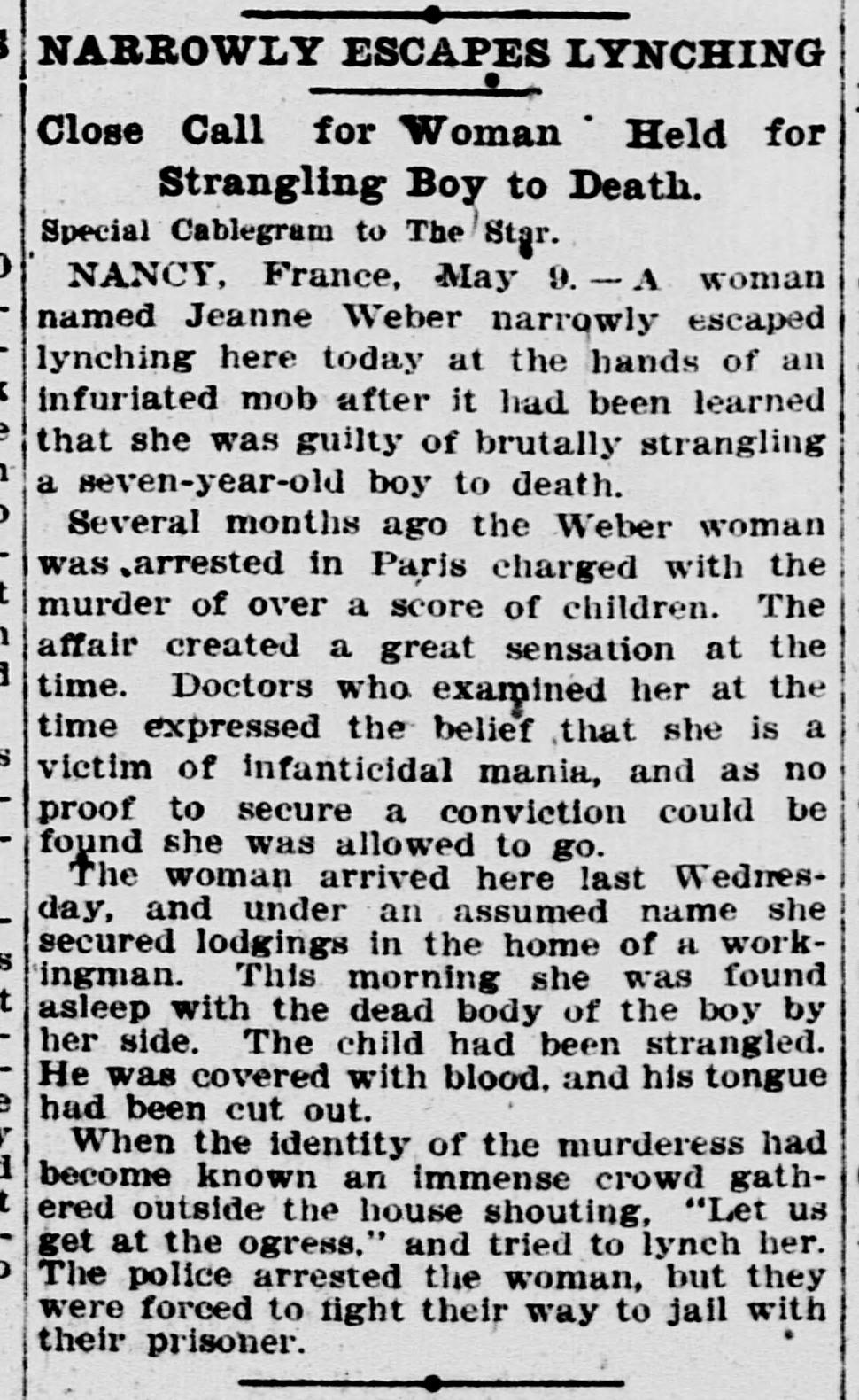
NARROWLY ESCAPES LYNCHING
Close Call for Woman Held for Strangling Boy to Death.
Special Cablegram to The Star.
NANCY, France, May 9. — A woman named Jeanne Weber narrowly escaped lynching here today at the hands of an infuriated mob after it had been learned that she was guilty of brutally strangling a seven-year-old boy to death.
Several months ago the Weber woman was arrested in Paris charged with the murder of over a score of children. The affair created a great sensation at the time. Doctors who examined her at the time expressed the belief that she is a victim of infanticidal mania, and as no proof to secure a conviction could be found she was allowed to go.
The woman arrived here last Wednesday, and under an assumed name she secured lodgings in the home of a workingman. This morning she was found asleep with the dead body of the boy by her side. The child had been strangled. He was covered with blood, and his tongue had been cut out.
When the identity of the murderess had become known an immense crowd gathered outside the house shouting, "Let us get at the ogress," and tried to lynch her. The police arrested the woman, but they were forced to fight their way to jail with their prisoner.
Transcriber's notes
- Readability: very good. Clean, heavy type on a front page; the column rules show through at the edges of the crop. No [illegible] markers were needed.
- Kept as printed: "infanticidal mania", "workingman" as one word, "the Weber woman", and the paper's own quotation marks around "Let us get at the ogress".
- The boy was Marcel Poirot, killed at Commercy near Nancy on 8 May 1908. The paper's account of the earlier Paris proceedings — examined, no proof found, allowed to go — is accurate: Weber had been cleared twice before this killing, which is the point of the story.
- The item is self-contained between rules; the article printed below it, headed "ALASKA WANTS ROOSEVELT.", is unrelated.