JANE TOPPAN MAKES A CONFESSION: BISMARCK DAILY TRIBUNE, JUNE 25, 1902
Two days after a jury at Barnstable found her not guilty by reason of insanity, Jane Toppan was on the front page of a daily in Bismarck, North Dakota, with a number no one had heard in the courtroom. The Bismarck Daily Tribune ran the Boston wire report on June 25, 1902. Suspected in eleven deaths and indicted for three, the nurse had told her own senior counsel, Judge Fred M. Bixby, that she had killed "no less than thirty-one human beings" in her years at the bedside.
What she told Bixby was not a plea for pity. She admitted setting fires and "other serious acts," said she could not help herself, and then turned on the verdict that had just saved her. "She said she knew she was doing wrong when she administered poison to her victims and she asked Judge Bixby how, under such circumstances, she could be of unsound mind." She had made the same argument out loud at her trial, shouting that the alienist who called her incurably insane was lying. Her drug, the paper said, was morphine, and her victims were close friends and the patients of doctors who hired her for her skill.
Only three of the dead have names in the story, the three she was indicted for: Mrs. Gibbs, Mrs. Harry Gordon of Chicago and Alden P. Davis, all of whom died at Cataumet the summer before. They were a father and two of his daughters, Mary Gibbs, forty, and Genevieve Gordon, and the mother of the family, Mattie Davis, had died the same summer under the same nurse's care. The story ends with Toppan on her way to the Taunton insane hospital that day. She lived there for thirty-six years and died there on August 17, 1938.
What survives here is a lawyer's account of a private conversation, passed along by wire, and not anything Toppan wrote or swore to; no court ever tested the figure of thirty-one. The paper's "Mrs. Harry Gordon" was Genevieve Gordon, Alden Davis's daughter. Its closing phrase about a "life sentence" is loose: a jury found her not guilty by reason of insanity, so there was no sentence, only commitment for life. The headline calls her a murderess, but she was never convicted of any killing, and the only one a jury ever heard was Mary Gibbs's.
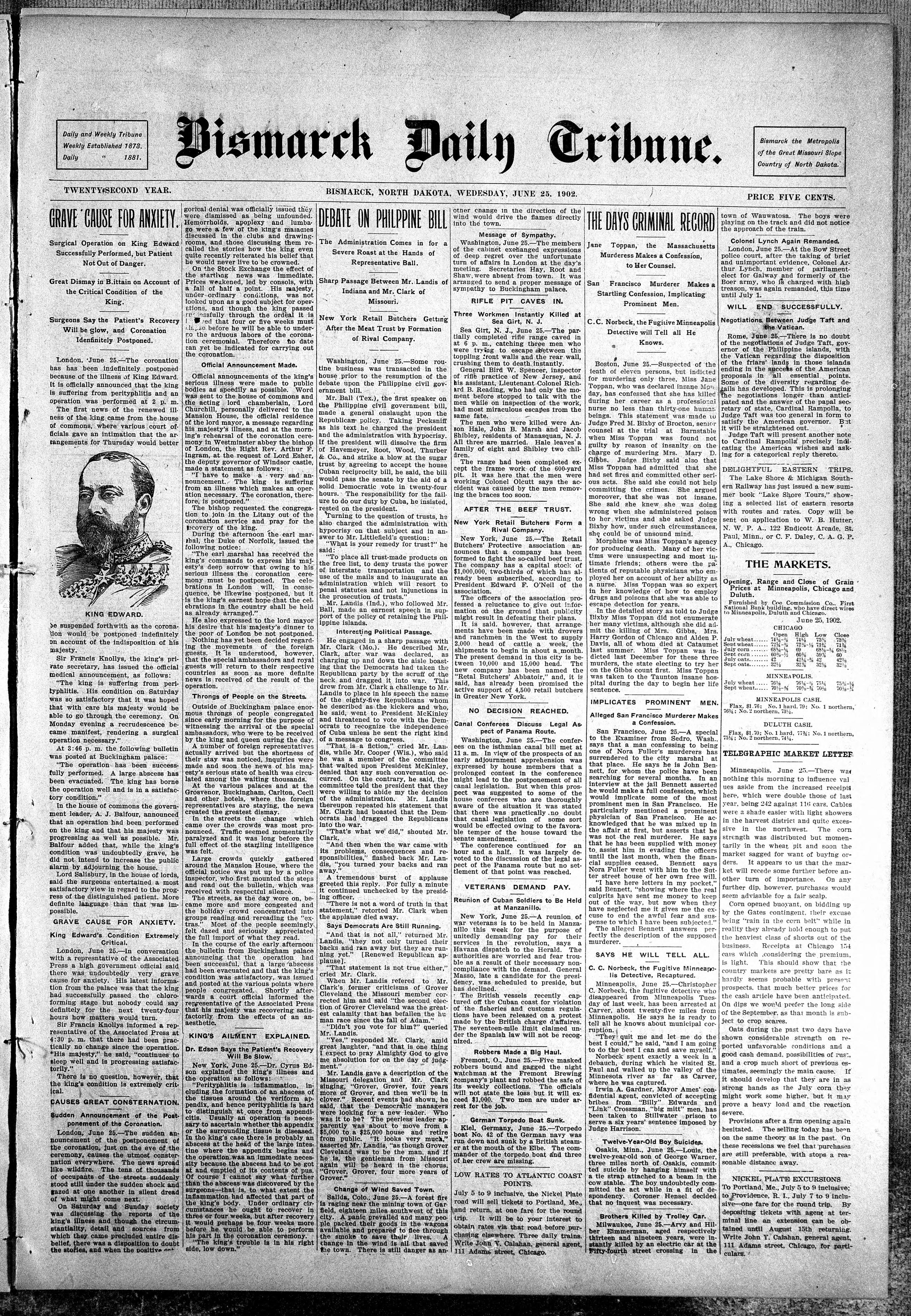
This issue of the Bismarck Daily Tribune is from 1902, and it is in the public domain. The scan is the Library of Congress copy in Chronicling America, and the citation and the Library's rights statement appear beneath it.
The page is lightly foxed, but every word could be read and none is marked illegible. The paper's spelling "Brocton" for Brockton stands, as do the stray comma in "She argued moreover, that she was not insane" and the headline's odd punctuation, "Confession, to Her Counsel." Two other headings stacked above the column belong to unrelated stories; they are visible in the crop and are not transcribed.
Transcription
Transcribed word for word from the page scan. Original spelling, punctuation, capitalisation and typographical errors have been kept exactly as printed. Unreadable words are marked [illegible]. Nothing has been modernised or corrected.
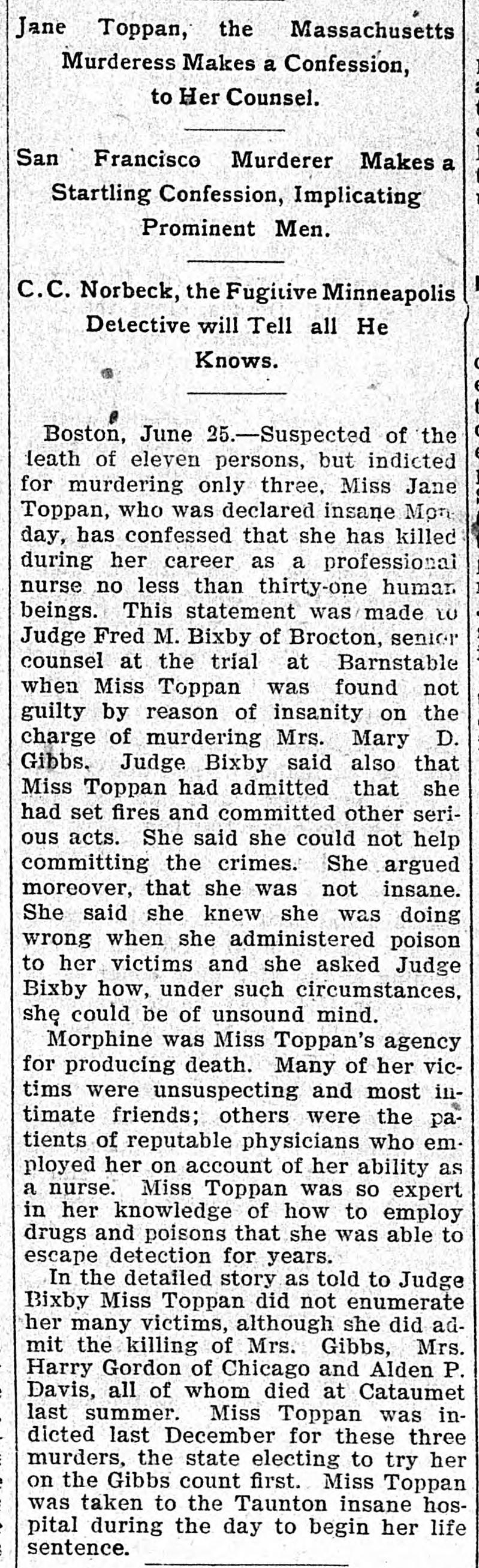
Jane Toppan, the Massachusetts Murderess Makes a Confession, to Her Counsel.
Boston, June 25.—Suspected of the death of eleven persons, but indicted for murdering only three, Miss Jane Toppan, who was declared insane Monday, has confessed that she has killed during her career as a professional nurse no less than thirty-one human beings. This statement was made to Judge Fred M. Bixby of Brocton, senior counsel at the trial at Barnstable when Miss Toppan was found not guilty by reason of insanity on the charge of murdering Mrs. Mary D. Gibbs. Judge Bixby said also that Miss Toppan had admitted that she had set fires and committed other serious acts. She said she could not help committing the crimes. She argued moreover, that she was not insane. She said she knew she was doing wrong when she administered poison to her victims and she asked Judge Bixby how, under such circumstances, she could be of unsound mind.
Morphine was Miss Toppan's agency for producing death. Many of her victims were unsuspecting and most intimate friends; others were the patients of reputable physicians who employed her on account of her ability as a nurse. Miss Toppan was so expert in her knowledge of how to employ drugs and poisons that she was able to escape detection for years.
In the detailed story as told to Judge Bixby Miss Toppan did not enumerate her many victims, although she did admit the killing of Mrs. Gibbs, Mrs. Harry Gordon of Chicago and Alden P. Davis, all of whom died at Cataumet last summer. Miss Toppan was indicted last December for these three murders, the state electing to try her on the Gibbs count first. Miss Toppan was taken to the Taunton insane hospital during the day to begin her life sentence.
Transcriber's notes
- Readability: very good. The paper is lightly foxed but the type is clean and every word was legible. No [illegible] markers were needed.
- Kept as printed: "Brocton" for Brockton, "Cataumet" (the paper's spelling of Cataumet, Mass.), the comma in "She argued moreover, that she was not insane", and the headline's punctuation "Confession, to Her Counsel."
- The headline is the first of three stacked single-line headings at the top of this column, each belonging to a different story in the column below. Only the Toppan heading and the Toppan story are transcribed here; the other two headings ("San Francisco Murderer Makes a Startling Confession, Implicating Prominent Men." and "C. C. Norbeck, the Fugitive Minneapolis Detective will Tell all He Knows.") belong to separate items and are visible in the crop above the article.
- The figure of thirty-one is the one Toppan gave her counsel; the paper notes she was indicted for three murders and suspected of eleven.