INSANITY IS PLEA IN 'RIPPER' TRIAL: ATLANTA GEORGIAN, OCTOBER 18, 1912
In October 1912 a defense lawyer stood up in Atlanta's superior court and told a jury that his client's confessions were worth nothing. Lawton Brown was on trial before Judge Roan for the murder of Eva Barnes, also known as Eva Green, who had been found with her throat cut in the Pittsburg section several months before, and the detectives who held him said he had admitted far more than that: a hand in several of the unsolved throat-cuttings the city had laid at the door of the Atlanta Ripper. The Atlanta Georgian covered the opening on October 18, 1912, in four short paragraphs.
The defense did not claim that Brown had kept silent. It claimed he talked too much. His lawyer, Judge Willingham, promised to prove that Brown was "insane on the subject of notoriety," a man who "becomes hysterical when he gets excited, assumes an air of braggadocio and confesses to things he never did." Brown, Willingham told the jury, had confessed to crimes he had never heard of until he was sweated at police headquarters, and the admissions the detectives prized were "hallucinations obtained under the pressing of the police 'third degree.'"
Against him stood the men who had taken the statements. Chief of Detectives Lanford and Officers Coker and McGill asserted that Brown had confessed to killing Eva Barnes and had admitted a part in other Ripper crimes. Then a cousin of the prisoner said Brown had been chained to a chair at headquarters when the confession was forced out of him. The Georgian gave the cousin a sneer (he "would have had the court believe" it) and the detectives none. Yet his account goes to the doubt that hangs over the whole Ripper investigation, in which police moved from one suspect to the next and never convicted anyone of the series.
What the Georgian printed is local courtroom reporting from the first day of a trial, and it ends before any verdict; it does not say how Brown's case came out. Nor does it name the other killings he was said to have admitted. The Atlanta Ripper was never identified. Six suspects were arrested at different times and every one was released, and no one was ever convicted of the series. Nothing in this column proves that Lawton Brown, or any single man, committed those murders, and the confessions themselves were contested in open court. The racial labels in the headline and text are the paper's own.
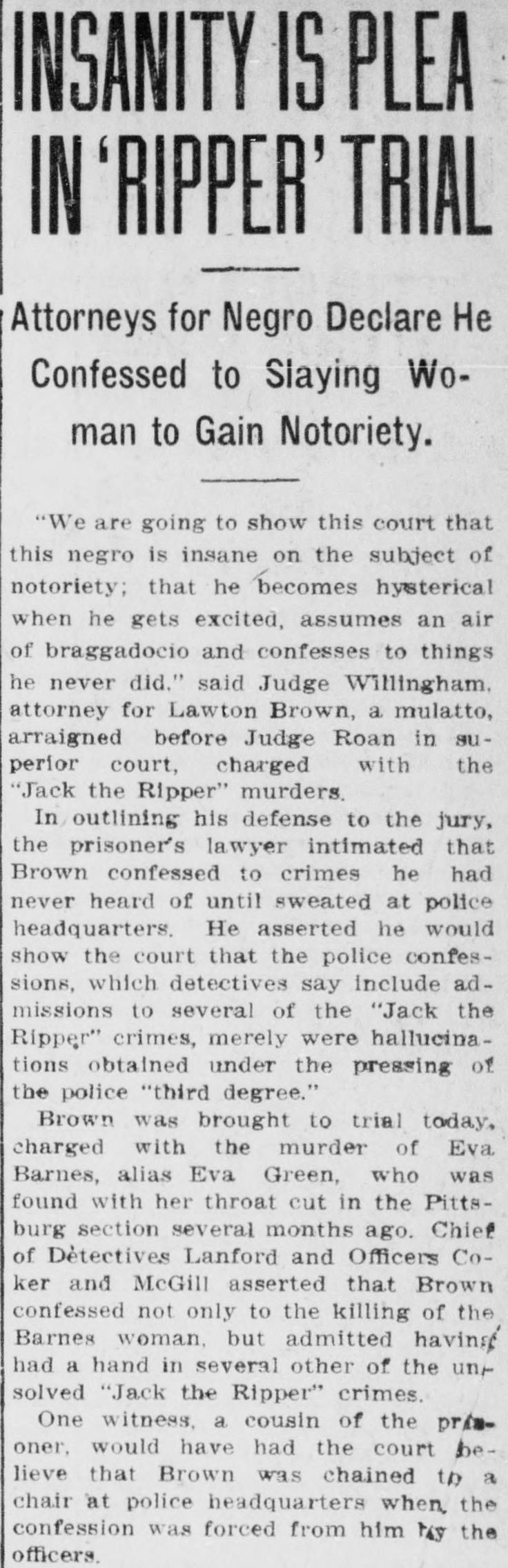
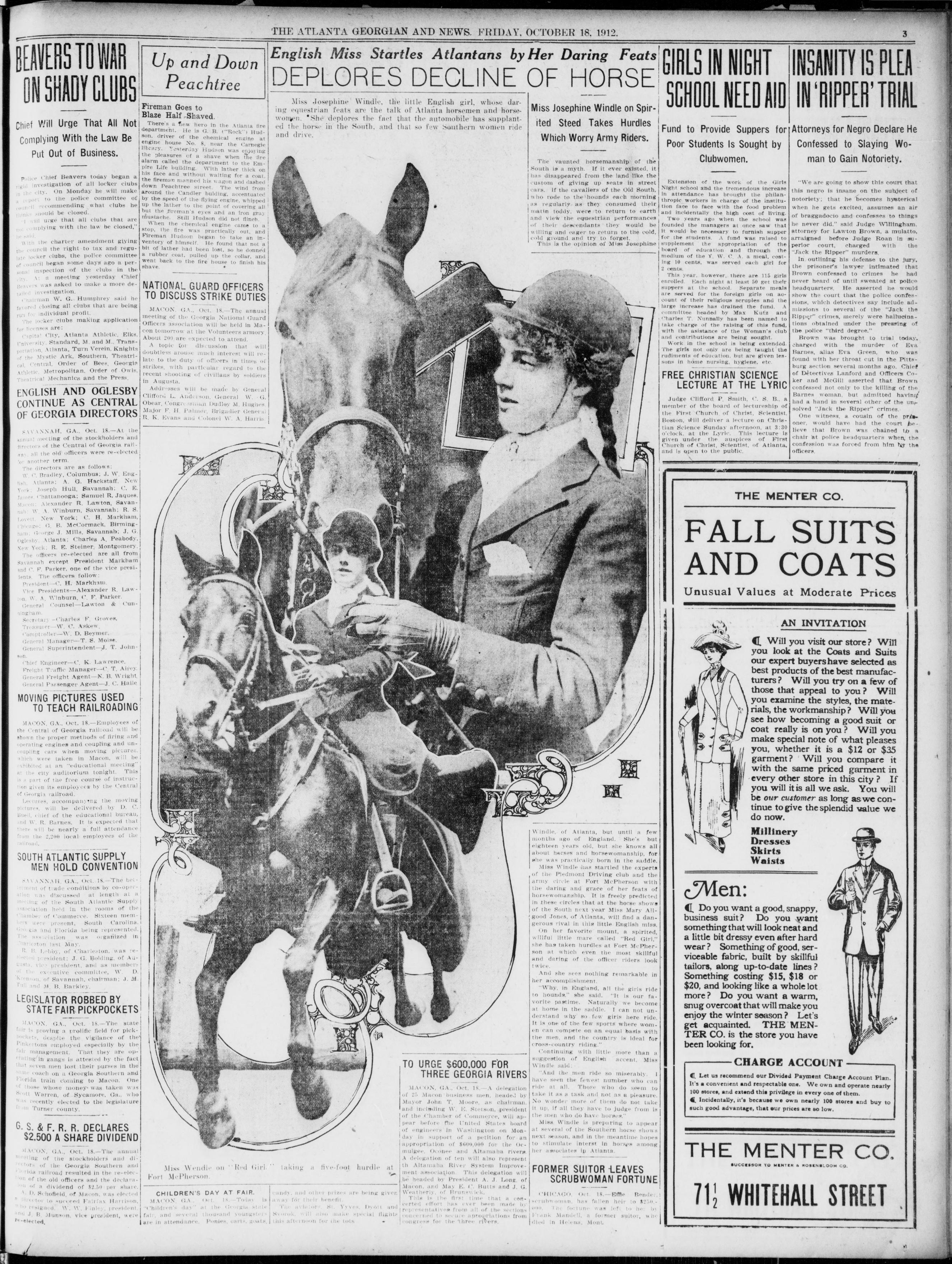
This issue of the Atlanta Georgian, dated October 18, 1912, is more than 95 years old and in the public domain. The scan is the Library of Congress copy in Chronicling America, page three, column seven. The crop holds that one column only, headline to last line, and the Library's citation and rights statement are set out beneath it.
Nothing in the column was too faint to read, and the transcription below follows the scan exactly. One printer's slip is kept: Willingham's long quotation closes with a period before "said Judge Willingham," where a comma belongs. "Pittsburg" stands without an h, as printed, and so do the paper's words for Brown ("negro," "a mulatto"), which are reproduced rather than softened.
Transcription
Transcribed word for word from the page scan. Original spelling, punctuation, capitalisation and typographical errors have been kept exactly as printed. Unreadable words are marked [illegible]. Nothing has been modernised or corrected.
INSANITY IS PLEA IN 'RIPPER' TRIAL
Attorneys for Negro Declare He Confessed to Slaying Woman to Gain Notoriety.
"We are going to show this court that this negro is insane on the subject of notoriety; that he becomes hysterical when he gets excited, assumes an air of braggadocio and confesses to things he never did." said Judge Willingham, attorney for Lawton Brown, a mulatto, arraigned before Judge Roan in superior court, charged with the "Jack the Ripper" murders.
In outlining his defense to the jury, the prisoner's lawyer intimated that Brown confessed to crimes he had never heard of until sweated at police headquarters. He asserted he would show the court that the police confessions, which detectives say include admissions to several of the "Jack the Ripper" crimes, merely were hallucinations obtained under the pressing of the police "third degree."
Brown was brought to trial today, charged with the murder of Eva Barnes, alias Eva Green, who was found with her throat cut in the Pittsburg section several months ago. Chief of Detectives Lanford and Officers Coker and McGill asserted that Brown confessed not only to the killing of the Barnes woman, but admitted having had a hand in several other of the unsolved "Jack the Ripper" crimes.
One witness, a cousin of the prisoner, would have had the court believe that Brown was chained to a chair at police headquarters when the confession was forced from him by the officers.