HUNGARIAN BLUEBEARD DECOYED VICTIMS THROUGH MARRIAGE PROMISES: HOPKINSVILLE KENTUCKIAN, MAY 16, 1916
The house stood in Cinkota, a village outside Budapest, and the man who had lived in it was away at the war. In the spring of 1916 sealed metal cases were found inside, and by the middle of May the story of what they held had crossed the Atlantic. The Hopkinsville Kentuckian printed it on May 16 under a Budapest dateline from the day before, calling the tenant a modern Bluebeard and giving the name that the investigation had only just pinned to him: Béla Kiss.
The police, the dispatch says, believed they understood his method. For years he had placed marriage advertisements, drawn women in with the promise of a wedding, taken their money and killed them. They had a record of eighteen women he had been involved with; eight had long been reported missing, and the other ten had not been found. Packages of love letters lay in the house, sent from all over the world, the United States among them.
Four of the seven cases had been opened. Three held the bodies of strangled women. The fourth held seven women's house dresses, and one of them had been recognized as belonging to a young woman missing for ten years. Then the dispatch closes the case on a confident note: there seemed to be no doubt that Kiss had died at Valjevo, in Serbia. He had rarely worked, it adds, but he spent so freely that people called him "The American Uncle."
This is a short foreign dispatch, filed while the investigation was still under way, and it reports what the Budapest police believed in mid-May 1916; it is not a record of anything proved, because nothing ever was. The confident sentence about his death was wrong. In October 1916 Kiss was traced to a hospital in Serbia and slipped away before the police arrived, and every later sighting, the last in New York in 1932, came to nothing. He was never caught or tried. The paper's figures also differ from the fuller count: all seven cases are elsewhere said to have held a woman's body, and the search of the property eventually found twenty-four bodies, twenty-three of them women.
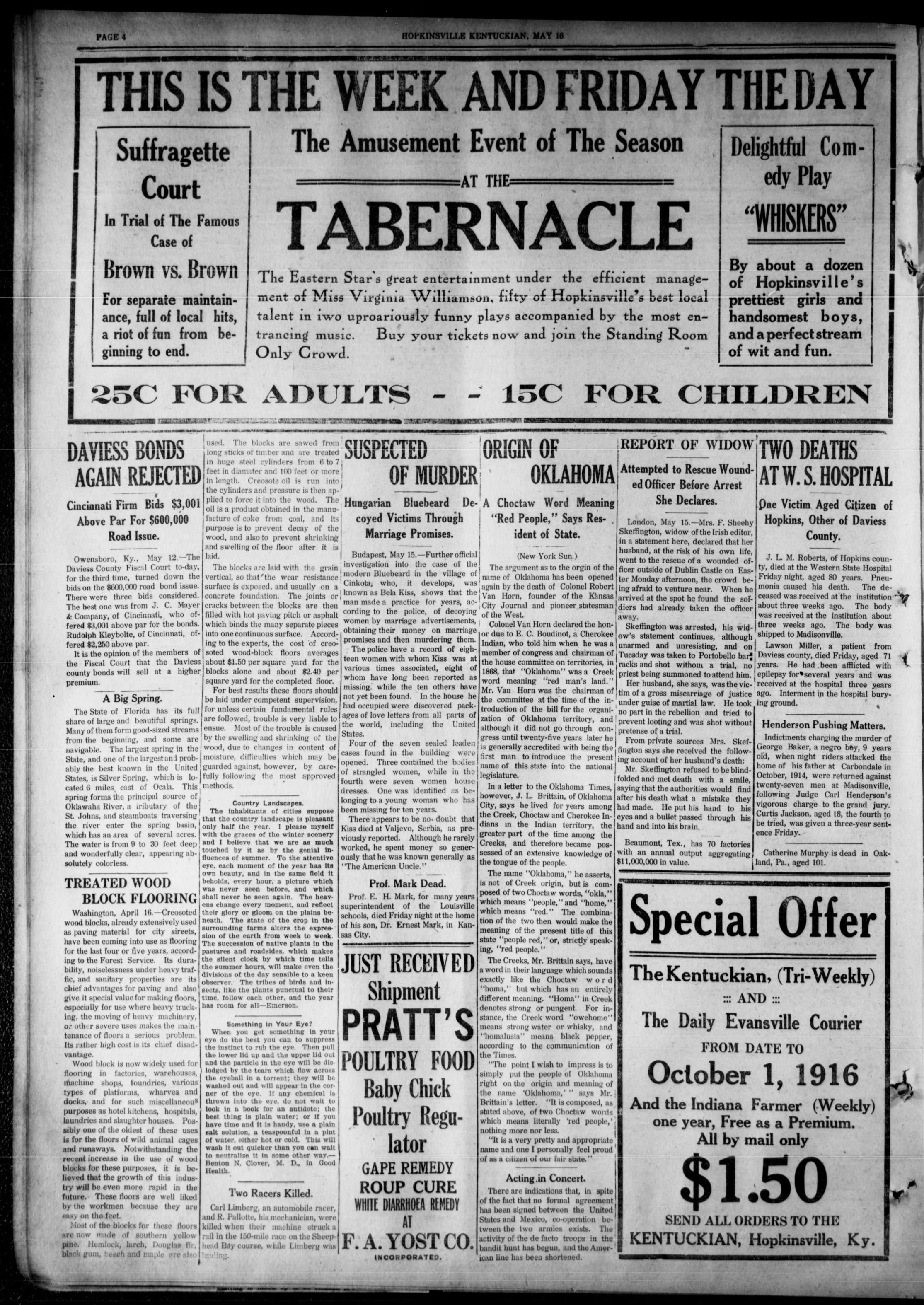
Printed in 1916, this page of the Hopkinsville Kentuckian is wholly in the public domain, and nothing on it, the Budapest dispatch included, carries any restriction. The scan below is the Library of Congress copy held in Chronicling America, and the citation and the Library's rights statement accompany it.
Every word was legible, so the transcription is complete and carries no illegible marks. One slip of the compositor survives exactly as set, a full point in the middle of a sentence before "while the ten others," along with the paper's "leaden cases," "women house dresses" and its spelling of Valjevo. The village is printed as Cinkota throughout.
Transcription
Transcribed word for word from the page scan. Original spelling, punctuation, capitalisation and typographical errors have been kept exactly as printed. Unreadable words are marked [illegible]. Nothing has been modernised or corrected.
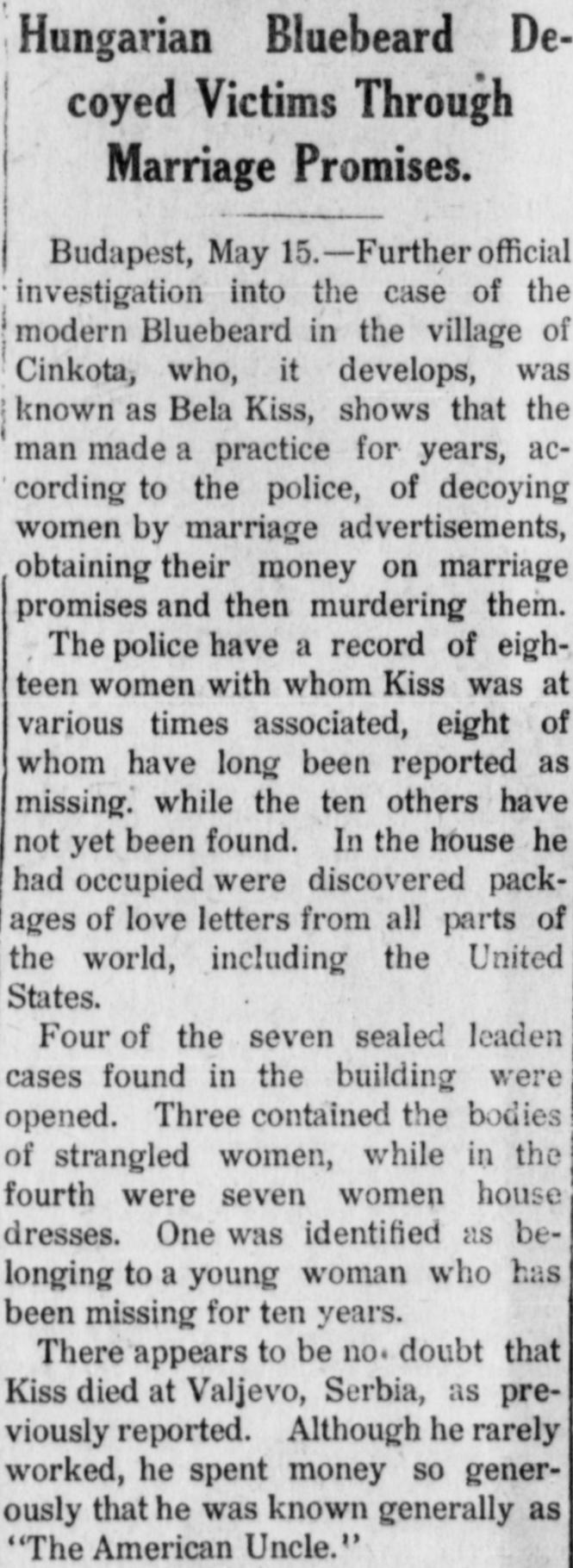
Hungarian Bluebeard Decoyed Victims Through Marriage Promises.
Budapest, May 15.—Further official investigation into the case of the modern Bluebeard in the village of Cinkota, who, it develops, was known as Bela Kiss, shows that the man made a practice for years, according to the police, of decoying women by marriage advertisements, obtaining their money on marriage promises and then murdering them.
The police have a record of eighteen women with whom Kiss was at various times associated, eight of whom have long been reported as missing. while the ten others have not yet been found. In the house he had occupied were discovered packages of love letters from all parts of the world, including the United States.
Four of the seven sealed leaden cases found in the building were opened. Three contained the bodies of strangled women, while in the fourth were seven women house dresses. One was identified as belonging to a young woman who has been missing for ten years.
There appears to be no doubt that Kiss died at Valjevo, Serbia, as previously reported. Although he rarely worked, he spent money so generously that he was known generally as "The American Uncle."
Transcriber's notes
- Readability: excellent. Clean, well-inked type throughout. No [illegible] markers were needed.
- Kept as printed: the full point in "reported as missing. while the ten others" (the compositor set a point where a comma belongs), "leaden cases", "women house dresses", and the spelling "Valjevo".
- The report of Kiss's death at Valjevo was wrong; he was not in fact confirmed dead and was hunted for years afterwards. The paragraph is transcribed as printed and is a useful record of what the authorities believed in May 1916.