HUMAN MONSTERS: GLOUCESTER COUNTY DEMOCRAT, MAY 1, 1884
In the spring of 1884 a weekly paper in Woodbury, New Jersey, told its readers about a murder business in Vienna that ran on the marriage columns. Hugo Schenk, a judge's son, answered the advertisements of servant women who had saved some money, presenting himself as an engineer on a good salary or as a rich aristocrat who looked down on class prejudice. He courted each one for days or weeks, persuaded her to draw her savings out of the bank, and took her away on what the paper calls a "journey to get married." At some quiet spot along the way, his accomplices were waiting.
The Gloucester County Democrat printed the story on May 1 under the headline "Human Monsters," and it credits the gang with twenty murdered servant girls. It tells of passengers on a train near Lundenburg who saw a man struggling with a woman, and of police who reached the place and found nothing. It says Hugo was writing love letters to fifty more women at the time of the arrests. The end, by this account, came through greed: one of the gang took a dead woman's bank book to the post office to draw out her deposit, the clerks were suspicious because she had been missed, and the three men were arrested.
Nearly half the column belongs to the gallows. The paper sets out, step by step, how Austria hanged its murderers: sixty witnesses in a small prison courtyard, a post about eight feet high with a hook at the top and a pulley at the bottom, the condemned man standing against it unblindfolded at seven in the morning. The executioner put a rope around his neck and lifted him onto the hook while an assistant hauled on a second rope tied to his feet. "Schenk and Schlossarek met their doom in this manner," the last line reads. The women whose savings paid for the gang's comfortable life go unnamed from beginning to end.
This is a secondhand account printed in New Jersey after the hanging, not a court record, and its numbers are the talk of the day. Hugo Schenk and Karl Schlossarek were sentenced to death for four murders, all committed in 1883; the victims included Josefine Timal, her aunt Katharina, Theresia Ketterl and Rosa Ferenczy. The twenty of the headline were never proved, and suspicion at the time put the total at six or more. The paper says the trial opened "on the 12th of last month"; the trial was held in March 1884, and the hanging took place on April 22. It calls the brothers Silesians, though Hugo was born in Moravia.
The Gloucester County Democrat for May 1, 1884, appeared well over ninety-five years ago, and the issue is in the public domain in its entirety. The story runs in the first column of page 4. The image shown is the Library of Congress scan from Chronicling America, and the citation and the Library's rights statement are printed beneath it.
The column was transcribed word for word from the scan. The small type is worn in places but every word could be read, so nothing is marked illegible. The paper's own forms stand as printed: "Carl" for Karl Schenk, the British spelling "pretence," "postoffice" run together as one word, "lovelike," and "beside" where a modern writer would put "besides." The dash after Hugo Schenk's name in the second paragraph is the compositor's and stays in the text.

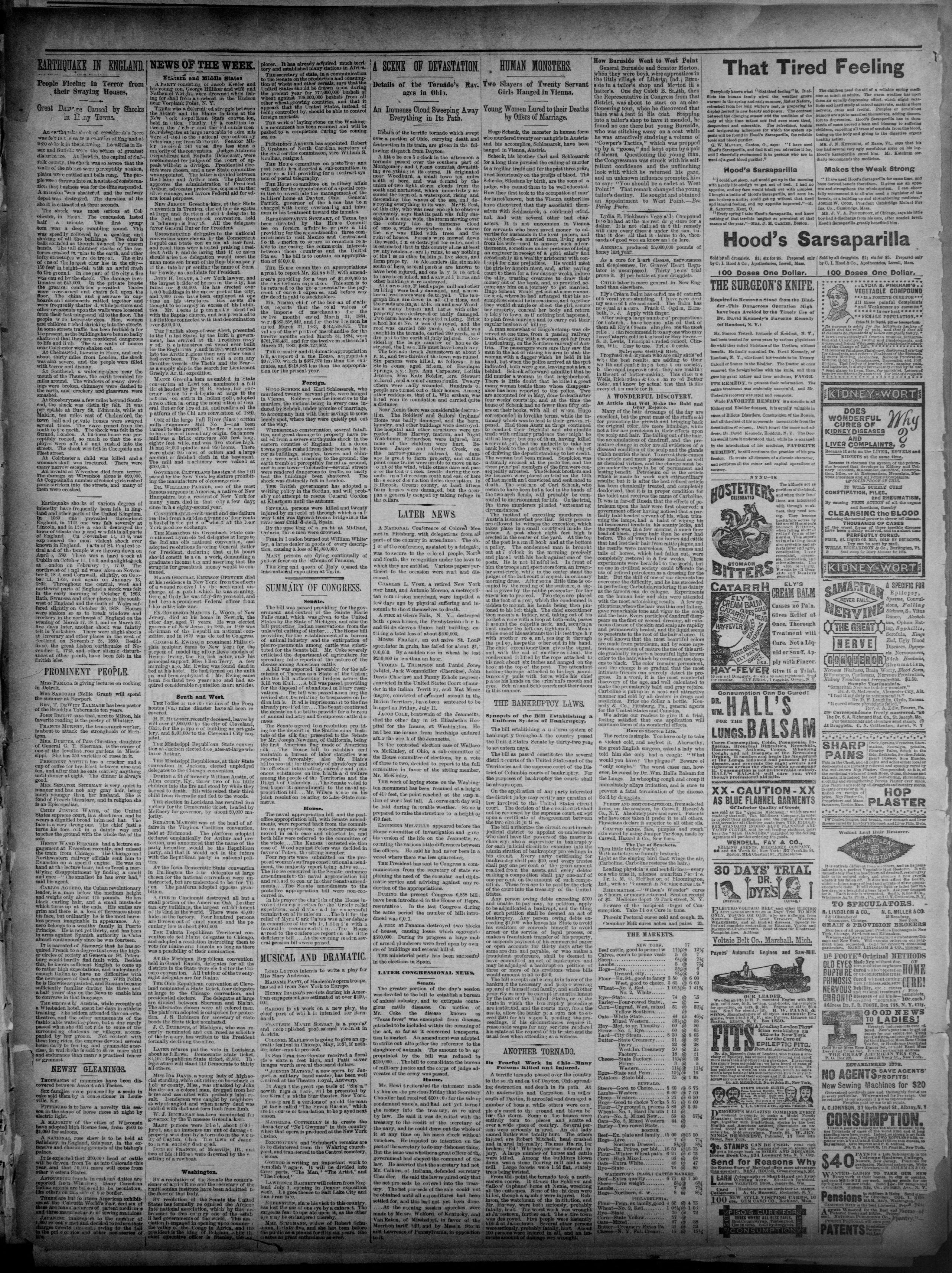
Transcription
Transcribed word for word from the page scan. Original spelling, punctuation, capitalisation and typographical errors have been kept exactly as printed. Unreadable words are marked [illegible]. Nothing has been modernised or corrected.
HUMAN MONSTERS.
Two Slayers of Twenty Servant Girls Hanged in Vienna.
Young Women Lured to their Deaths by Offers of Marriage.
Hugo Schenk, the monster in human form who murdered twenty servant girls in Austria, and his accomplice, Schlossarek, have been hanged in Vienna, Austria.
Schenk, his brother Carl and Schlossarek for a long time pursued the calling of murder as a regular trade and for the past three years lived luxuriously on the profits of blood. The Schenks, Silesians by birth, are the sons of a judge, who caused them to be well educated. How they first took to the occupation of murder is not known, but the Vienna authorities have discovered that they associated themselves with Schlossarek, a confirmed criminal, and with several other bad characters. It is not uncommon in Vienna for servants who have saved money to advertise for husbands in the local papers, and Hugo Schenk—a married man, living apart from his wife—used to answer such advertisements, sometimes under pretence of being an engineer in receipt of a good salary and occasionally as a wealthy aristocrat with contempt for class prejudices. He would meet the girls by appointment, and, after paying court to them for a few days or weeks, induce the silly, trusting creatures to draw their money out of the bank, and, so provided, accompany him on a journey to get married. Hugo Schenk would get out at some romantic spot, where he had arranged that his accomplices should be in readiness, and together they would strangle or shoot the girl, secure her property, conceal her body and return quickly to town, as if nothing had happened, to plan fresh murders and to carry out their regular business of killing.
A man somewhat of Hugo's stamp was observed at one time, from a passing railway train, struggling with a woman, not far from Lundenburg, on the Northern railway of Austria. The passengers were sure they saw the man in the act of raising his arm to stab the woman with a dagger which he held in his hand, but when the police arrived at the spot indicated, both were gone, leaving not a trace behind. Schenk afterward admitted that he did murder a woman in that neighborhood. There is little doubt that he killed a great many women beside those whose disappearance has been reported to the police. Two are accounted for in May, done to death after four weeks' courtship; and at the time the house of Schenk had no fewer than fifty others on their books, with all of whom Hugo corresponded in lovelike terms, while the intimacy which was to lead to their graves, ripened. Had these Austrian thugs continued to conduct their frightful and abominable trade with ordinary prudence they might be still at large; but one of them, having killed a servant girl, had the audacity to take her bank book to the postoffice, with the object of drawing the deposit standing to her credit. The woman had been missed. Suspicion was naturally aroused at the postoffice, and the three principal members of the firm were consequently arrested. The Schenk brothers and Schlossarek were placed on trial on the 12th of last month and convicted and sentenced to death. The sentence of Carl Schenk, who seems to have been but a tool in the hands of the two arch fiends, will probably be commuted to imprisonment for life. On the trial, the three murderers pleaded "extenuating circumstances."
The method of executing murderers in Austria is somewhat peculiar. Sixty persons are allowed to witness the execution, which takes place in a small courtyard inside the prison. A post about eight feet high is erected in the center of the yard. At the top of the post is a small hook and at the bottom a pulley. The condemned man is brought out at 7 o'clock in the morning precisely and placed with his back against one of the posts. He is not blindfolded. In front of him the troops and spectators form an irregular semi-circle, while in the center stand the judges of the last court of appeal, in ordinary morning dress. After some little time is occupied by the reading of the sentence, a signal is given by the public prosecutor for the execution to proceed. Two steps are placed at the foot of a post, which the condemned is bidden to mount, his hands being then pinioned to his left thigh. The chief executioner then mounts a ladder, and, taking out of his pocket a rope with a loop at both ends, passes it around the culprit's neck, and, securing a knot under the left ear, tightens it. Meanwhile one of his assistants ties his feet together with another rope, and, passing it through the pulley, keeps the other end in his hand. The chief executioner then gives the signal, and, with the aid of another assistant, the condemned is lifted by the rope attached to his neck about six inches and hanged on the hook at the top of the post. The attendant holding the rope attached to his legs simultaneously pulls with force, while his chief places his hands on the criminal's mouth and eyes. Schenk and Schlossarek met their doom in this manner.