HEIRENS PLEADS GUILTY TO DEGNAN SLAYING, TWO OTHER KILLINGS: EVENING STAR, SEPTEMBER 4, 1946
James Degnan tucked his six-year-old daughter into bed about midnight on January 6, 1946, and in the morning her bedroom window was open, Suzanne was gone, and a note demanded $20,000. Eight months later he told that story to a judge in Chicago, and when he stepped down he stopped at the prosecution table a few feet from the seventeen-year-old who had just pleaded guilty to her murder. William George Heirens, a sophomore at the University of Chicago, stared at him blankly. The Associated Press account ran in Washington's Evening Star that same day, September 4.
Heirens had rattled off "guilty" to a long list of lesser crimes. When the clerk read the indictment for Suzanne Degnan's murder, he wrung his hands, his lips quivered, and he answered haltingly. Chief Justice Harold G. Ward stopped the proceeding to warn him that he was giving up a jury and that the court could now sentence him to death. "Having been informed of this do you still persist in pleading guilty?" the judge asked. "Yes," Heirens replied. The same procedure followed for the murders of Josephine Ross, a forty-three-year-old widow killed in her apartment in June 1945, and Frances Brown.
The State called only two witnesses on the Degnan murder, and the defense cross-examined neither. Capt. John L. Sullivan described the search that found parts of Suzanne's body in the sewers near her home. Then a maid, Martha Engle, told of finding Frances Brown's door ajar at the Pine Crest Hotel on the morning of December 10, 1945, the radio blaring, and a message written in lipstick on the wall: "For heavens sake catch me before I kill more. I can't control myself." The next day Heirens was sentenced to three consecutive life terms. Almost at once he said the confession was false.
This is wire reporting of one day in court, and it takes the confession at face value; the case has never been that simple. Heirens pleaded on the urging of his own lawyers after days of near-continuous questioning in which he was injected with sodium pentothal without his consent. No witness saw any of the crimes, and the police changed their account of a print found at the Brown apartment. The paper's parenthesis on what his signed confession said is the confession's version, not established fact. He recanted, maintained his innocence until he died in prison on March 5, 2012, and no court ever set the plea aside. The paper dates the Ross killing June 5; other accounts say June 3.
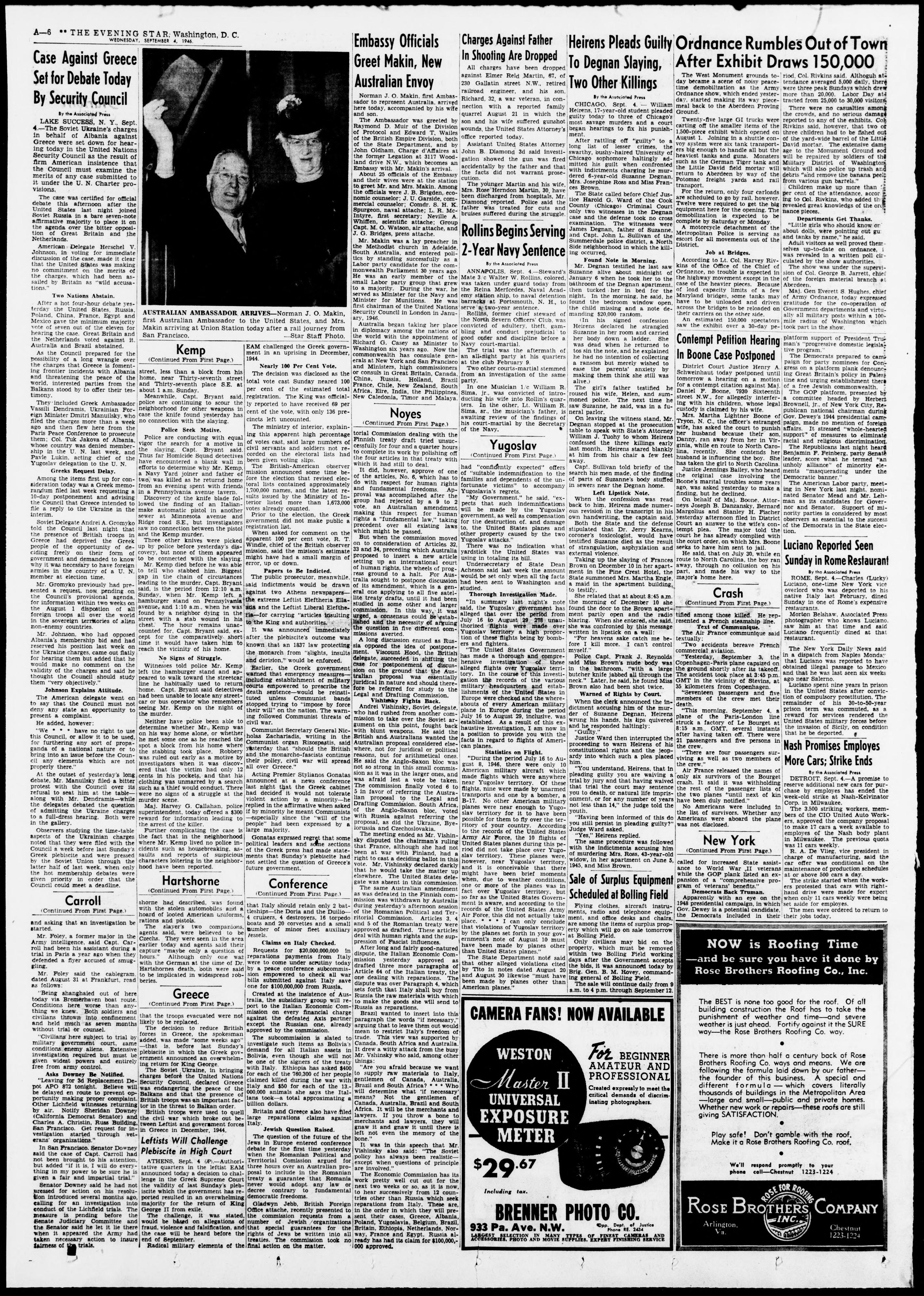
This Evening Star is dated September 4, 1946, inside the last ninety-five years. The Library of Congress believes such issues in Chronicling America are in the public domain but notes that they may contain some copyrighted third-party material; nothing in this item appears to be separately copyrighted. The scan is the Library's own copy, with the citation and rights statement printed below it.
The type is heavy and fills in toward the lower part of the column, where several words had to be made out letter by letter, but none had to be marked [illegible]. The compositor's errors are all still there: "rantom" for ransom, "tos sin" for toss in, "numerous revision" and "cn" for on in the last line. The lipstick message keeps its missing apostrophe in "heavens," a wording other accounts give differently, and the judge is "Chief Justice" in one paragraph and "Judge Ward" in another, as printed. The story ends with the Ross and Brown pleas and does not continue on another page.

Transcription
Transcribed word for word from the page scan. Original spelling, punctuation, capitalisation and typographical errors have been kept exactly as printed. Unreadable words are marked [illegible]. Nothing has been modernised or corrected.
Heirens Pleads Guilty To Degnan Slaying, Two Other Killings
By the Associated Press
CHICAGO, Sept. 4. — William Heirens, 17-year-old student pleaded guilty today to three of Chicago's most savage murders and a court began hearings to fix his punishment.
After rattling off "guilty" to a long list of lesser crimes, the swarthy, bushy-haired University of Chicago sophomore haltingly admitted his guilt when confronted with indictments charging he murdered 6-year-old Suzanne Degnan, Mrs. Josephine Ross and Miss Frances Brown.
The State called before Chief Justice Harold G. Ward of the Cook County (Chicago) Criminal Court only two witnesses in the Degnan case and the defense took no cross examination. The witnesses were James Degnan, father of Suzanne, and Capt. John L. Sullivan of the Summerdale police district, a North Side neighborhood in which the killing occurred.
Found Note in Morning.
Mr. Degnan testified he last saw Suzanne alive about midnight of January 6 when he took her to the bathroom of the Degnan apartment, then tucked her in bed for the night. In the morning, he said, he found the bedroom window open, the child missing and a note demanding $20,000 rantom.
(In his signed confession Heirens declared he strangled Suzanne in her room and carried her body down a ladder. She was dead when he returned to tos sin the note, and he explained he had no intention of collecting a ransom but merely wished to ease the parents' anxiety by making them think she still was alive.)
The girl's father testified he roused his wife, Helen, and summoned police. The next time he saw Suzanne, he said, was in a funeral parlor.
On leaving the witness stand, Mr. Degnan stopped at the prosecution table to speak with State's Attorney William J. Tuohy to whom Heirens confessed the three killings early last month. Heirens stared blankly at him from his chair a few feet away.
Capt. Sullivan told briefly of the search his men made, of the finding of parts of Suzanne's body stuffed in sewers near the Degnan home.
Left Lipstick Note.
When the confession was read back to him, Heirens made numerous revision in the transcript in his own handwriting, the captain said.
Both the State and the defense stipulated that Dr. Jerry Kearns, coroner's toxicologist, would have testified Suzanne died as the result of strangulation, asphyxiation and external violence.
Taking up the slaying of Frances Brown on December 10 in her apartment in the Pine Crest Hotel, the State summoned Mrs. Martha Engle, a maid in the apartment building, to testify.
She related that at about 8:45 a.m. the morning of December 10 she found the door to the Brown apartment partly open and the radio blaring. When she entered, she said, she was confronted by this message written in lipstick on a wall:
"For heavens sake catch me before I kill more. I can't control myself."
Police Capt. Frank J. Reynolds said Miss Brown's nude body was in the bathroom, "with a large butcher knife jabbed all through the neck." Later, he said, he found Miss Brown also had been shot twice.
Warned of Rights by Court.
When the clerk announced the indictment accusing him of the murder of Suzanne Degnan, Heirens wrung his hands, his lips quivered and he responded haltingly:
"Guilty."
Justice Ward then interrupted the proceeding to warn Heirens of his constitutional rights and the jeopardy into which such a plea placed him.
"You understand, Heirens, that in pleading guilty you are waiving a trial by jury and that having waived that trial the court may sentence you to death, or natural life imprisonment, or for any number of years not less than 14," the judge told the youth.
"Having been informed of this do you still persist in pleading guilty?" Judge Ward asked.
"Yes," Heirens replied.
The same procedure was followed with the indictments accusing him of murdering Mrs. Ross, 43-year-old widow, in her apartment cn June 5, 1945, and Miss Brown.
Transcriber's notes
- Readability: Good overall, and no [illegible] markers were needed. The type is a touch heavier and more ink-filled than the other items transcribed in this batch, and the worst stretch is the lower half of the sixth tile (c1_003700.png) and the junction into the seventh, where the impression is dark and several words are nearly closed up; those words were still resolvable by letterform. Two one-word readings there and in the eighth tile needed close inspection and are flagged below rather than silently smoothed.
- Printers' errors kept as printed: "a note demanding $20,000 **rantom**" (for "ransom" — note that the same paragraph spells "ransom" correctly two sentences later); "She was dead when he returned to **tos sin** the note" — the compositor has split the words wrongly, setting "tos sin" for "toss in"; "Heirens made numerous **revision** in the transcript" (singular, for "revisions"); and "in her apartment **cn** June 5, 1945" — a wrong or turned sort gives "cn" for "on".
- Punctuation and spelling kept as printed: "William Heirens, 17-year-old student pleaded guilty" has no comma closing the appositive after "student"; the lipstick message is set as "For heavens sake" with no apostrophe in "heavens"; the three sub-headlines each carry a full point as printed ("Found Note in Morning.", "Left Lipstick Note.", "Warned of Rights by Court.").
- The court's presiding officer is styled two different ways in the same story, both kept: "Chief Justice Harold G. Ward" and "Justice Ward" earlier, then "the judge" and "Judge Ward" in the closing passage.
- Extent of the article: the piece ends at "…1945, and Miss Brown." part-way down the eighth tile (c1_005180.png), closed off by a column rule. The matter below it, which fills the rest of that tile and the whole of the short final tile (c1_005920.png), is an unrelated local item headlined "Sale of Surplus Equipment Scheduled at Bolling Field"; it has not been transcribed. The Heirens story carries no jump line and does not continue on another page — it simply ends with the arraignment on the Ross and Brown indictments.
- Factual note, offered neutrally and with no change made to the transcription: the paper's particulars agree with the accepted record — Josephine Ross, a widow of 43, was killed on 5 June 1945, Frances Brown on 10 December 1945 at the Pine Crest Hotel, and Suzanne Degnan, aged 6, was taken from the Degnan apartment overnight on 6–7 January 1946, which is consistent with her father's "about midnight of January 6". Heirens, then 17, was reported as a University of Chicago student. Readers of the archive may wish to know that Heirens spent the rest of his life in prison and for decades after this hearing retracted the confession described here; the paper of 4 September 1946 of course reports only the guilty pleas as entered that day.