HE MURDERED 33; SAYS IT IS "AN AWFULLY EASY JOB": NEW BRITAIN HERALD, JUNE 6, 1923
He was fifty-two, he told the correspondent who came to his cell, he had had a good time, and he did not want to live any longer. Vasili Komaroff, the Moscow horse dealer in whose storeroom police had found a man's body still warm in the hay, wanted the court to be quick about it and shoot him. The Associated Press sent his words from Moscow as his trial for the murder of thirty-three people began, and on June 6, 1923, the New Britain Herald in Connecticut set them at the head of the first column of its front page, under a headline built from his own phrase.
He called murder "an awfully easy job," and he explained it in a breath: "I just knocked them on their heads with a hammer or strangled them." The men he meant were mostly countrymen who had come into Moscow in the hungry years after the civil war to buy a horse cheap. He advertised animals below the market price, brought the buyers to his stable, poured vodka while they talked price, and killed them there. The bodies were tied, put in sacks and left in vacant lots, in the Moskva River or under his own hay. Only one ever fought back, he said: a man who tried to beat him in a horse trade.
The dispatch is a few lines long and leaves nearly everything out. It does not mention his wife, Sofia, who helped dispose of the bodies and was tried beside him, or the night of May 18, 1923, when police came looking for an illegal still, moved toward his storeroom and watched him jump from a window and run. It notes only that the prisoner had three times tried to kill himself. The court moved fast, as he had asked. He and Sofia were sentenced to be shot, and on June 18, 1923, they were.
This is a brief wire dispatch, not a court record, written at the opening of the trial and before any verdict. Its dateline has the trial opening on June 6, while the trial is recorded as beginning on June 7, 1923, at the Polytechnic Museum, where it was moved to hold the crowds. The paper calls him a peasant; he drove a cab and dealt in horses, and he had been born Vasili Terentyevich Petrov. Here the headline's number is also the verdict: he confessed to thirty-three killings and was convicted of thirty-three, though only twenty-seven bodies were found.
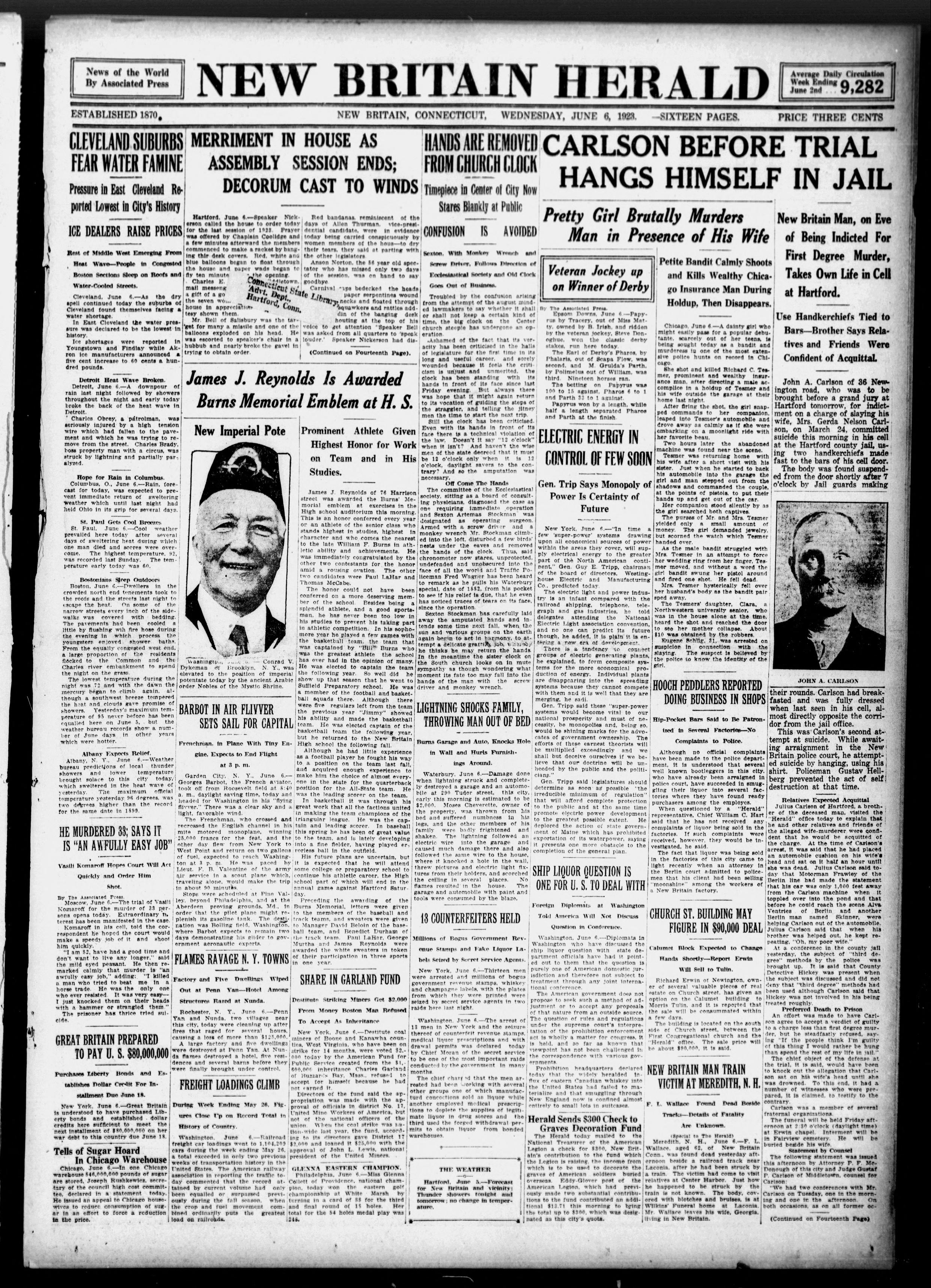
The New Britain Herald of June 6, 1923, was printed more than ninety-five years ago, so the front page, this Moscow dispatch with it, is entirely in the public domain. Under the scan, which is the Library of Congress copy from Chronicling America, are the full citation and the Library's rights statement.
The type is clean on lightly grayed paper, and the transcription needed no [illegible] marks. Three small things are kept just as the paper set them: the spelling "Komaroff," the unhyphenated "mild eyed" and the stray comma after "in his cell." The dispatch is complete between its two rules at the head of the column, and what follows on the page is a separate story.
Transcription
Transcribed word for word from the page scan. Original spelling, punctuation, capitalisation and typographical errors have been kept exactly as printed. Unreadable words are marked [illegible]. Nothing has been modernised or corrected.
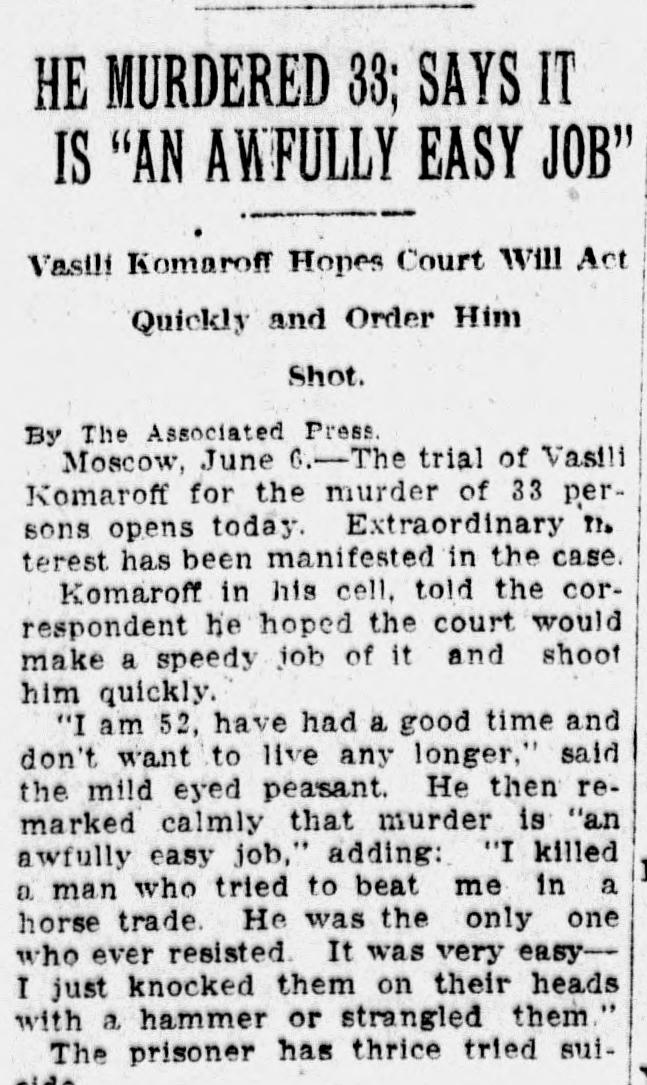
HE MURDERED 33; SAYS IT IS "AN AWFULLY EASY JOB"
Vasili Komaroff Hopes Court Will Act Quickly and Order Him Shot.
By The Associated Press.
Moscow, June 6.—The trial of Vasili Komaroff for the murder of 33 persons opens today. Extraordinary interest has been manifested in the case.
Komaroff in his cell, told the correspondent he hoped the court would make a speedy job of it and shoot him quickly.
"I am 52, have had a good time and don't want to live any longer," said the mild eyed peasant. He then remarked calmly that murder is "an awfully easy job," adding: "I killed a man who tried to beat me in a horse trade. He was the only one who ever resisted. It was very easy—I just knocked them on their heads with a hammer or strangled them."
The prisoner has thrice tried suicide.
Transcriber's notes
- Readability: very good. The type is clean, the paper lightly greyed. No [illegible] markers were needed.
- Kept as printed: "Komaroff" (the Russian is Komarov, and SKC files him as Vasili Komaroff), "mild eyed" unhyphenated, and the comma after "in his cell".
- The quoted words are the reason to keep this item: the method stated in his own words — a hammer to the head or strangling — and his statement that only one victim resisted. He was tried in Moscow in June 1923 with his wife and shot the same month.
- The item is self-contained between rules at the head of column one. What follows below it on the page is unrelated.