BRITON PLEADS INSANITY DEFENSE IN ADMITTING SLAYING OF NINE: EVENING STAR, JULY 18, 1949
On the first morning of his trial at Lewes, John George Haigh heard his own words read to the court by the man defending him. The Associated Press story that ran in Washington's Evening Star that day, July 18, 1949, calls him handsome and debonair, a thirty-nine-year-old businessman who walked jauntily to the bench and answered "not guilty" in a clear, firm voice. The charge was the murder of Olive Durand-Deacon, a sixty-nine-year-old widow, the previous February 18. The plea was insanity, and the statement Haigh had given the police was the center of it.
Sir David Maxwell-Fyfe, a prosecutor at the Nuremberg trial, read it aloud. In it Haigh told of luring Mrs. Durand-Deacon to a warehouse in Crawley, shooting her in the back of the head and fetching a drinking glass. He "made an incision, I think with a penknife, in the side of her neck, and collected a glass of blood, which I drank." He said he had done the same to William Donald McSwan in 1944 before putting him "in a 40-gallon tank," and that he had killed McSwan's parents, Donald and Amy, and Dr. Archibald Henderson and his wife. "In each of the last four cases, I had my glass of blood as before," the statement went on.
A second statement went further. It gave no names, but it described three more killings done the same way: a woman of about thirty-five he met in a London suburb and struck with a cosh, "a youngish man about the autumn of the same year," and "a girl who later told me her name was Mary." The statement gave no year for any of them. It closed on a denial: "I have had nothing to do with the disappearance of any persons other than those I have already mentioned." The next afternoon the jury needed seventeen minutes to find him guilty.
This is an Associated Press report of the trial's first day, filed from Lewes and printed in Washington the same day, not a transcript of the proceedings. The "nine" of its headline is Haigh's own count. He was tried and convicted only for the murder of Olive Durand-Deacon, and hanged at Wandsworth on August 10, 1949; the five other deaths he admitted were never tried, and the police found no trace of the three unnamed victims, whom other accounts of his statement describe as a young man called Max, a girl from Eastbourne and a woman from Hammersmith. The paper spells the family's name McSwann, calls William, who was thirty-three, a "London youth," and dates his parents' deaths to 1946; they were killed on July 2, 1945.
The Evening Star for July 18, 1949, was published less than ninety-five years ago. The Library of Congress believes issues of that age are also in the public domain, but warns that they may contain some copyrighted third-party material. This article is Associated Press wire copy rather than the paper's own reporting, and no copyright notice appears on or beside it. The scan is the Library's copy in Chronicling America, with the citation and rights statement beneath it.
The text was transcribed word for word from the scan, across both of the article's columns, and nothing in it needed an illegible mark. Its forms are kept as printed: "McSwann" throughout, "McSwann's parent" where the sense calls for parents, "Nuernberg" for Nuremberg, and the gloss "cosh (short club)," which the paper placed inside the quotation marks of Haigh's statement.
Transcription
Transcribed word for word from the page scan. Original spelling, punctuation, capitalisation and typographical errors have been kept exactly as printed. Unreadable words are marked [illegible]. Nothing has been modernised or corrected.
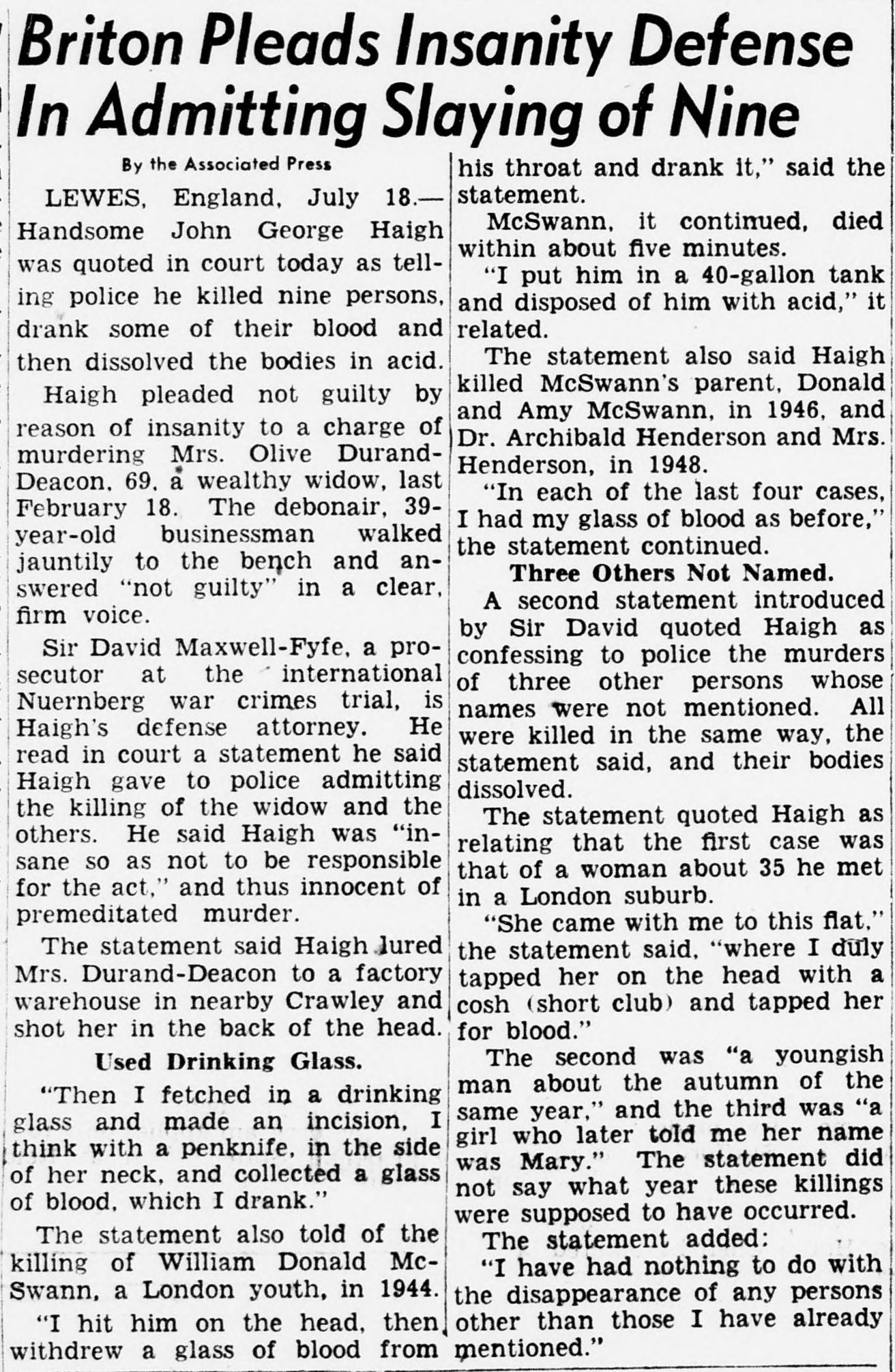
Briton Pleads Insanity Defense In Admitting Slaying of Nine
By the Associated Press
LEWES, England, July 18.—Handsome John George Haigh was quoted in court today as telling police he killed nine persons, drank some of their blood and then dissolved the bodies in acid.
Haigh pleaded not guilty by reason of insanity to a charge of murdering Mrs. Olive Durand-Deacon, 69, a wealthy widow, last February 18. The debonair, 39-year-old businessman walked jauntily to the bench and answered "not guilty" in a clear, firm voice.
Sir David Maxwell-Fyfe, a prosecutor at the international Nuernberg war crimes trial, is Haigh's defense attorney. He read in court a statement he said Haigh gave to police admitting the killing of the widow and the others. He said Haigh was "insane so as not to be responsible for the act," and thus innocent of premeditated murder.
The statement said Haigh lured Mrs. Durand-Deacon to a factory warehouse in nearby Crawley and shot her in the back of the head.
Used Drinking Glass.
"Then I fetched in a drinking glass and made an incision, I think with a penknife, in the side of her neck, and collected a glass of blood, which I drank."
The statement also told of the killing of William Donald McSwann, a London youth, in 1944.
"I hit him on the head, then withdrew a glass of blood from his throat and drank it," said the statement.
McSwann, it continued, died within about five minutes.
"I put him in a 40-gallon tank and disposed of him with acid," it related.
The statement also said Haigh killed McSwann's parent, Donald and Amy McSwann, in 1946, and Dr. Archibald Henderson and Mrs. Henderson, in 1948.
"In each of the last four cases, I had my glass of blood as before," the statement continued.
Three Others Not Named.
A second statement introduced by Sir David quoted Haigh as confessing to police the murders of three other persons whose names were not mentioned. All were killed in the same way, the statement said, and their bodies dissolved.
The statement quoted Haigh as relating that the first case was that of a woman about 35 he met in a London suburb.
"She came with me to this flat," the statement said, "where I duly tapped her on the head with a cosh (short club) and tapped her for blood."
The second was "a youngish man about the autumn of the same year," and the third was "a girl who later told me her name was Mary." The statement did not say what year these killings were supposed to have occurred.
The statement added:
"I have had nothing to do with the disappearance of any persons other than those I have already mentioned."