GUILTY VERDICT RETURNED IN 1 OF 27 TEXAS KILLINGS: THE HERALD, MARCH 5, 1975
It took a Houston jury ninety minutes to decide that David Owen Brooks had helped kill Billy Ray Lawrence, a fifteen-year-old boy who died in the summer of 1973. The verdict came on Tuesday, March 4, 1975. Brooks, twenty, showed no emotion when it was read. His wife, Bridget, sitting ten feet away, cried. By the next day the same jury was deciding what he should pay for it, and The Herald in Provo, Utah, ran the United Press International story on page 22 while they were still out.
The fight over the sentence was a fight over what Brooks had actually done. The law gave the jury a range from five years to life. "The facts of the circumstances cry out for the maximum," the prosecutor, Tommy Dunn, told them. Jim Skelton, for the defense, asked for fairness and insisted the state had never proved its case: "The only case the state could prove was accessory to murder." He was not quibbling. The prosecution had not claimed that Brooks strangled anyone. It had tried him as a principal, a man who was present, knew what was meant to happen, and stood ready to help.
Dunn's answer, in his summation the day before, was blunt. Brooks, he said, had been in on the killing "from the very beginning," and had all but admitted it: "He tells you he was a cheerleader if nothing else." Behind that one count stood the whole series the prosecutor kept invoking, in which Dean Corll, Elmer Wayne Henley and Brooks lured boys to Corll's home, abused and killed them, and buried them in three places in Southeast Texas. The jury gave Dunn the maximum he asked for, life, and Brooks spent the rest of his days insisting he had watched and dug but never killed.
This is a short UPI wire report filed during the punishment phase. Its headline announces the verdict, but the news in its first line is the start of the sentencing deliberations. The lede says Brooks was "convicted of strangling" the boy; the state never claimed he strangled anyone, and the conviction rested on the Texas law of principals. The paper calls the victim both "Billy Lawrence" and "Billy Ray Lawrence"; the court record gives his name as William Ray Lawrence. The 27 in the headline was the count in 1975, and at least 28 deaths are now attributed to the Corll series. Brooks was convicted of this one murder, sentenced to life, lost his appeal in 1979 and died in custody in 2020.
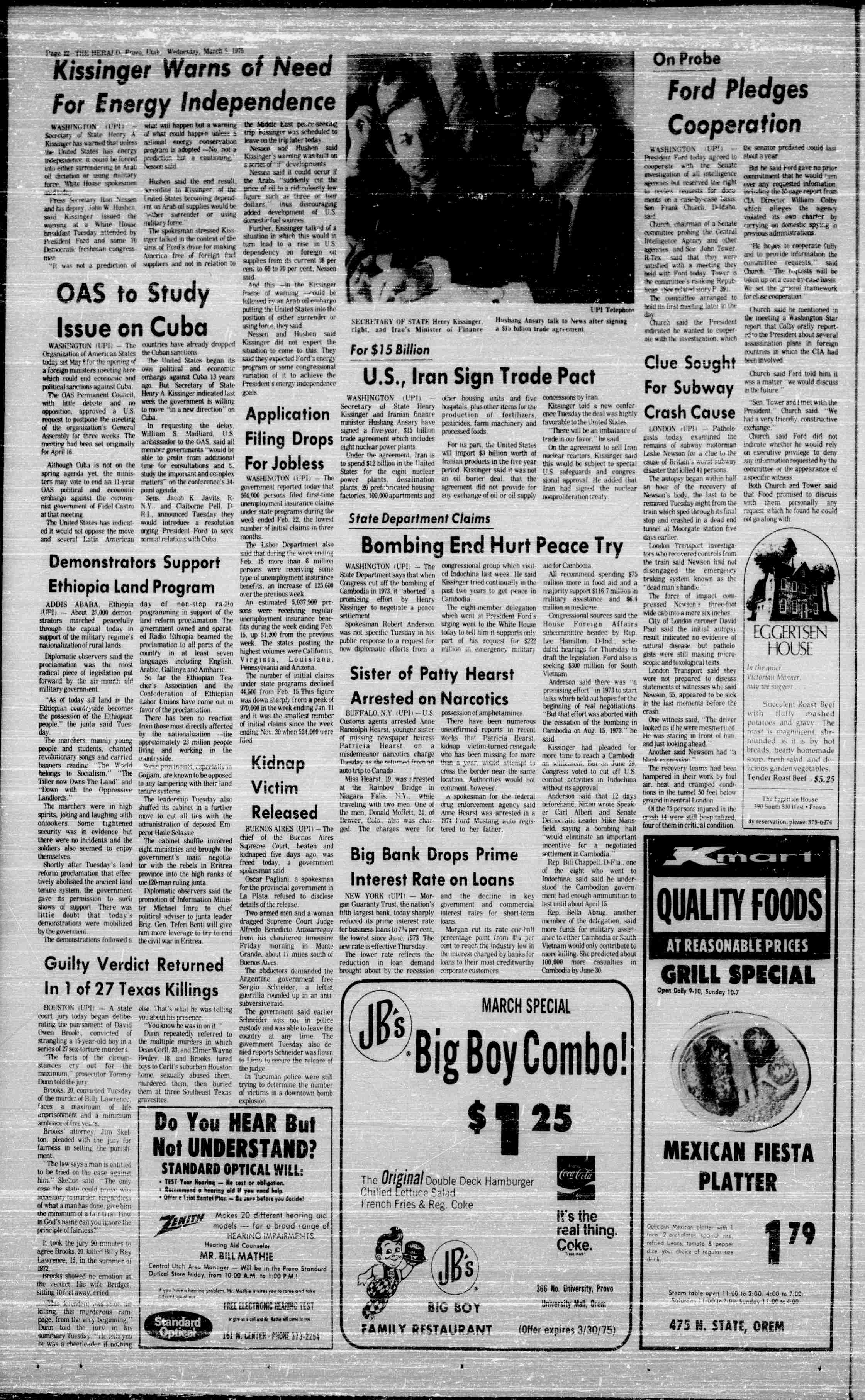
The Herald printed this story on March 5, 1975, as United Press International wire copy, with no staff byline. The scan is from Utah Digital Newspapers at the J. Willard Marriott Library, University of Utah, and the library's item-level rights field rates this issue "In Copyright," meaning it treats the issue as still protected. No copyright notice turned up on the masthead or on this story; the only one found in the issue sits on a supermarket advertisement on page 12. The library's rating is the one recorded with the citation under the scan.
The scan is faint and broken across most of the first column, and the transcription follows it word for word. One word in Dunn's line "This [illegible] was in on the killing" cannot be read; it was probably "defendant," and "in on the" in the same line is a best reading of damaged type. Words such as "imprisonment," "Skelton" and "Regardless" came clear under magnification. The paper's own repetitions stand as printed, including Brooks's age, given as 20 twice in a few paragraphs, and the boy's name in two forms.
Transcription
Transcribed word for word from the page scan. Original spelling, punctuation, capitalisation and typographical errors have been kept exactly as printed. Unreadable words are marked [illegible]. Nothing has been modernised or corrected.
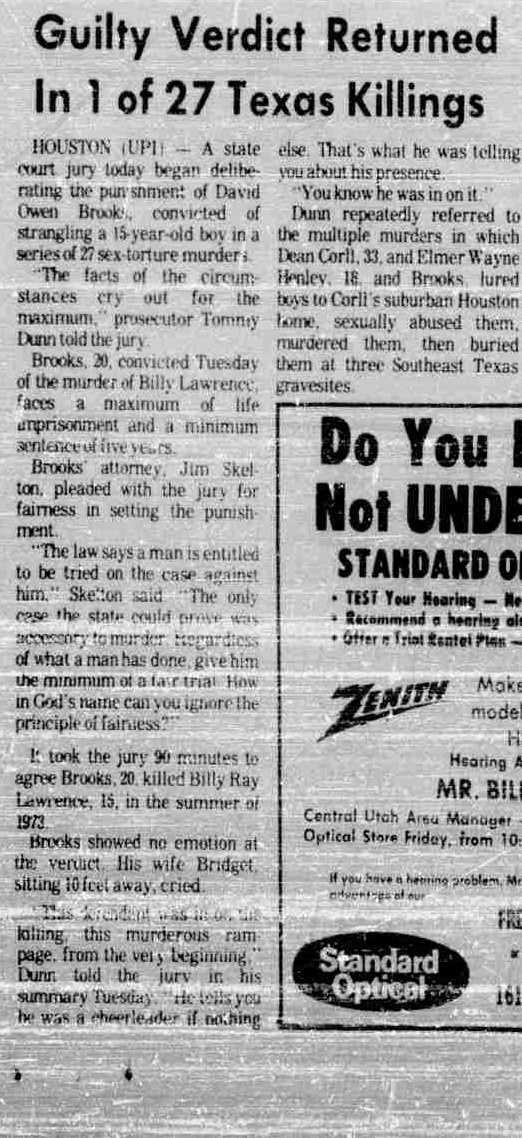
Guilty Verdict Returned In 1 of 27 Texas Killings
HOUSTON (UPI) — A state court jury today began deliberating the punishment of David Owen Brooks, convicted of strangling a 15-year-old boy in a series of 27 sex-torture murders.
"The facts of the circumstances cry out for the maximum," prosecutor Tommy Dunn told the jury.
Brooks, 20, convicted Tuesday of the murder of Billy Lawrence, faces a maximum of life imprisonment and a minimum sentence of five years.
Brooks' attorney, Jim Skelton, pleaded with the jury for fairness in setting the punishment.
"The law says a man is entitled to be tried on the case against him," Skelton said. "The only case the state could prove was accessory to murder. Regardless of what a man has done, give him the minimum of a fair trial. How in God's name can you ignore the principle of fairness?"
It took the jury 90 minutes to agree Brooks, 20, killed Billy Ray Lawrence, 15, in the summer of 1973.
Brooks showed no emotion at the verdict. His wife Bridget, sitting 10 feet away, cried.
"This [illegible] was in on the killing, this murderous rampage, from the very beginning," Dunn told the jury in his summary Tuesday. "He tells you he was a cheerleader if nothing else. That's what he was telling you about his presence.
"You know he was in on it."
Dunn repeatedly referred to the multiple murders in which Dean Corll, 33, and Elmer Wayne Henley, 18, and Brooks lured boys to Corll's suburban Houston home, sexually abused them, murdered them, then buried them at three Southeast Texas gravesites.
Notes: The scan is very faint and broken across most of column 1. One word (probably "defendant") in the line "This ... was in on the killing" cannot be read and is marked [illegible]; "in on the" in the same line is a best reading of damaged type. Other damaged words ("punishment", "imprisonment", "years", "Skelton", "Regardless", "fair trial", "nothing") were legible at magnification. Readability: poor to fair. The headline says the verdict was "Returned"; the lede reports that the jury had begun deliberating punishment the day after the verdict. No other words were illegible.