GUILLOTINE CLAIMS FRITZ HAARMANN FOR 26 MURDERS: SOUTH BEND NEWS-TIMES, APRIL 16, 1925
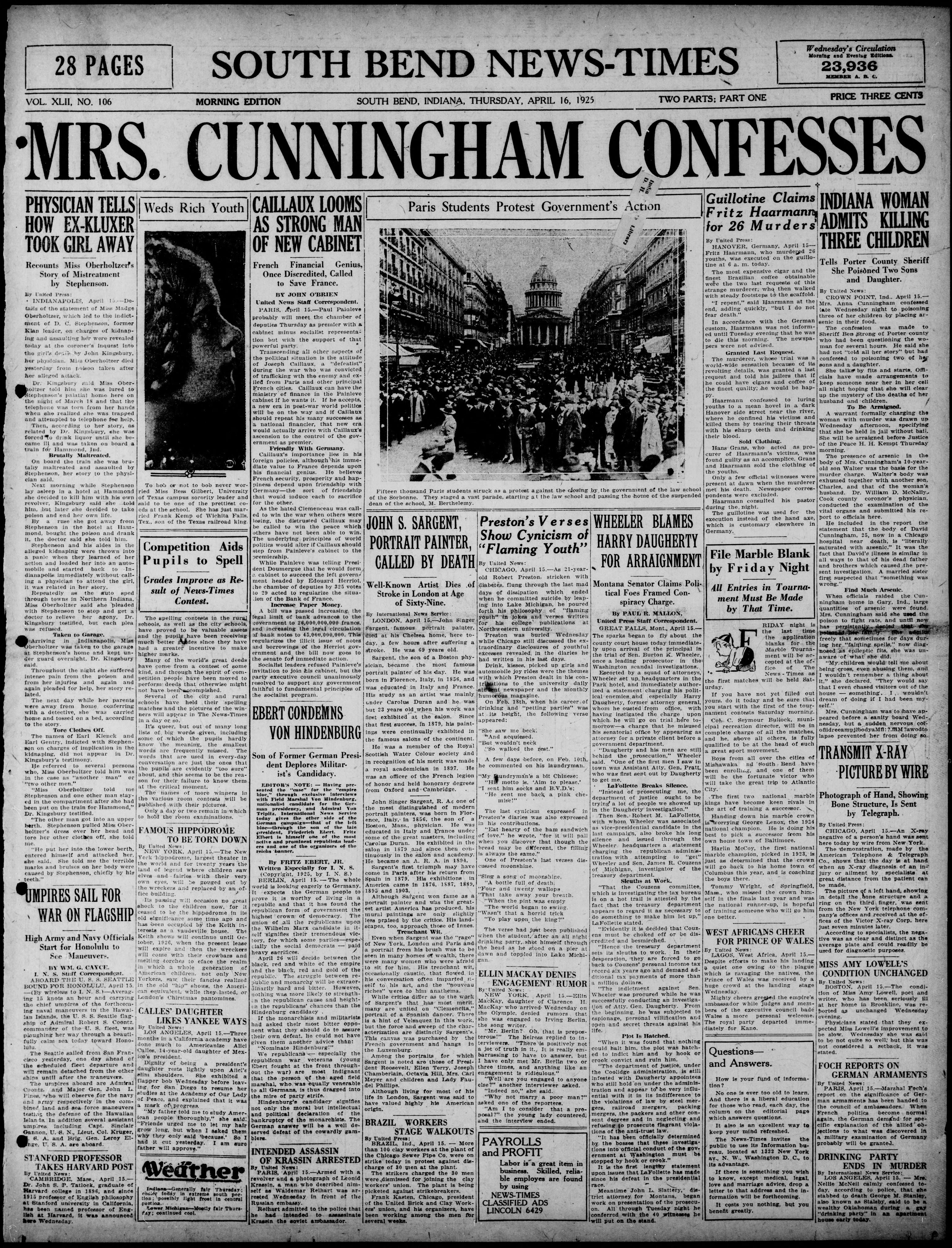
Nobody told him until the evening before. Under German custom, the United Press explained, the condemned man learned only on Tuesday that he would die on Wednesday morning, and the newspapers were not told at all. At six o'clock on April 15, 1925, in Hanover, Friedrich Haarmann, the Fritz of the headline, walked to the guillotine, by the wire writer's account, with steady footsteps. The South Bend News-Times had it on its front page the next morning, under a headline that took both his guilt and the paper's count of his victims for granted.
He went out asking for luxuries. His last requests, the paper reports, were the most expensive cigar and the finest Brazilian coffee that could be found, and he told his jailers that with those he would be happy. He saw his pastor during the night. At the end he said, "I repent," and then, quickly, "but I do not fear death." Only a few official witnesses were there at dawn, and the correspondents were shut out. The guillotine was used, the paper adds, instead of the hand axe customary elsewhere in Germany.
The middle of the report is the case as the world had heard it. Haarmann, it says, confessed to luring youths to a hovel in a dark side street near the river, where he held them and killed them. Hans Grans, his companion, is described as the procurer of the victims and as convicted as an accomplice, and the two had sold the dead youths' clothing. Behind that summary were real families: boys and young men, most of them teenagers, many of them runaways or travelers passing through Hanover's main station, who disappeared after meeting him between 1918 and 1924. The youngest, Friedrich Abeling, was ten.
This is a wire report filed on the day of the execution, and its numbers and its horrors are the press version. The court in Hanover convicted Haarmann of 24 murders, not 26, and acquitted him of three more that had been charged. The paper's method, tearing throats with his teeth and drinking blood, goes beyond the record: he said he had strangled his victims and bitten their throats, and that rests on his word alone. Another account gives his last words as "Auf Wiedersehen." Grans's conviction rested largely on Haarmann's accusations, which Haarmann withdrew in a letter before his death; at a retrial in 1926 the death sentence fell away and Grans received twelve years.
Published in 1925, this issue of the South Bend News-Times is more than ninety-five years old and in the public domain, with no restriction on the United Press report it carries. The Library of Congress holds the issue in Chronicling America, and the scan, its citation and the Library's rights statement are presented together below.
Large type on a well-kept page made this an easy column to read, and the transcription is complete, with no illegible marks. It keeps "HANOVER" in the paper's English form, the colon after "By United Press," the two subheads "Granted Last Request." and "Sold Clothing." with their periods, and the headline's capitals. The report ends at a rule; the notice beneath it is a separate item and is not transcribed.
Transcription
Transcribed word for word from the page scan. Original spelling, punctuation, capitalisation and typographical errors have been kept exactly as printed. Unreadable words are marked [illegible]. Nothing has been modernised or corrected.
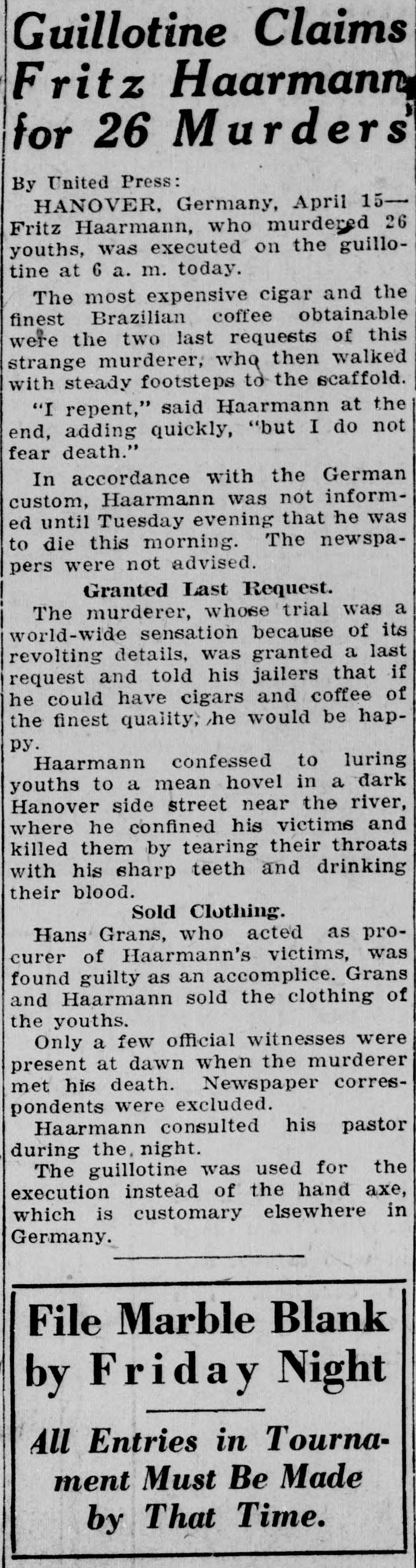
Guillotine Claims Fritz Haarmann for 26 Murders
By United Press:
HANOVER, Germany, April 15—Fritz Haarmann, who murdered 26 youths, was executed on the guillotine at 6 a. m. today.
The most expensive cigar and the finest Brazilian coffee obtainable were the two last requests of this strange murderer, who then walked with steady footsteps to the scaffold.
"I repent," said Haarmann at the end, adding quickly, "but I do not fear death."
In accordance with the German custom, Haarmann was not informed until Tuesday evening that he was to die this morning. The newspapers were not advised.
Granted Last Request.
The murderer, whose trial was a world-wide sensation because of its revolting details, was granted a last request and told his jailers that if he could have cigars and coffee of the finest quality, he would be happy.
Haarmann confessed to luring youths to a mean hovel in a dark Hanover side street near the river, where he confined his victims and killed them by tearing their throats with his sharp teeth and drinking their blood.
Sold Clothing.
Hans Grans, who acted as procurer of Haarmann's victims, was found guilty as an accomplice. Grans and Haarmann sold the clothing of the youths.
Only a few official witnesses were present at dawn when the murderer met his death. Newspaper correspondents were excluded.
Haarmann consulted his pastor during the night.
The guillotine was used for the execution instead of the hand axe, which is customary elsewhere in Germany.
Transcriber's notes
- Readability: excellent. Large, clean type on a well-preserved page. No [illegible] markers were needed.
- Kept as printed: "HANOVER" for Hannover, "Fritz Haarmann" (SKC files him under Friedrich Haarmann), the United Press credit with its colon, and the headline's capitalisation.
- The paper gives the victim count as 26. The Hanover court convicted Haarmann of 24 murders; the figure printed here is the one the wire service carried on the day and has been left as printed.
- The article ends at a rule across the column; what follows beneath it is a separate item.